Atlantic Southwest Europe (292–303 CE): Provincial Reorganization,…
292 CE to 303 CE
Atlantic Southwest Europe (292–303 CE): Provincial Reorganization, Administrative Consolidation, and Cultural Adaptation under the Tetrarchy
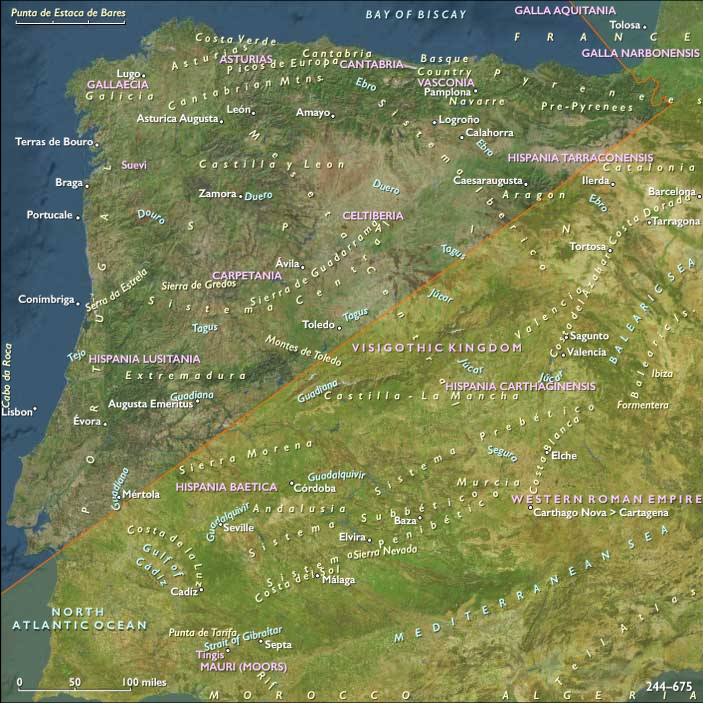
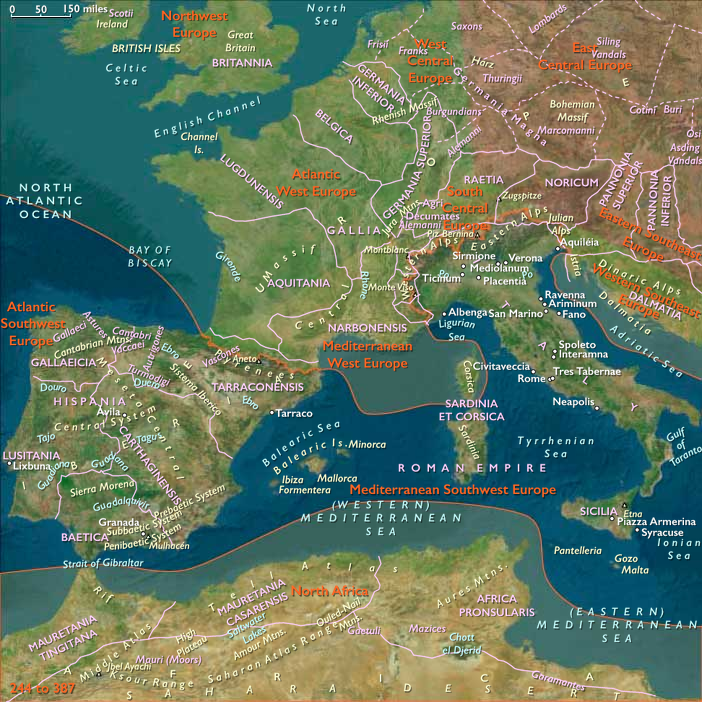
Between 292 and 303 CE, Atlantic Southwest Europe—covering northern and central Portugal, Galicia, Asturias, Cantabria, and northern Spain south of the Franco-Spanish border (43.05548° N, 1.22924° W)—experienced significant administrative and political shifts under Emperor Diocletian’s sweeping reforms known as the Tetrarchy (established 293 CE). These reforms reorganized imperial governance to stabilize Rome following decades of instability, altering provincial administration and strengthening central oversight. Despite these substantial administrative changes, the region maintained considerable internal stability, economic resilience, and vibrant cultural continuity, adapting effectively to evolving political structures.
Political and Military Developments
Imperial Reorganization under Diocletian’s Tetrarchy
-
Diocletian’s establishment of the Tetrarchy in 293 CE significantly reshaped provincial administration. Atlantic Southwest Europe was incorporated into a more centralized imperial framework, becoming part of reorganized administrative divisions aimed at improving governance, tax collection, military oversight, and bureaucratic efficiency.
-
Local civic elites adapted to increased centralization, continuing their essential role in regional governance. Despite enhanced central oversight, the region maintained substantial local autonomy due to the effectiveness of pre-existing municipal institutions and local leadership.
Stability and Continued Integration of Northern Tribes
-
Northern tribal groups—especially the Gallaeci, Astures, and Cantabri—remained stable and integrated, continuing active participation in restructured provincial administration. Cooperation between local elites and imperial authorities ensured peaceful regional governance and internal cohesion.
-
The Vascones preserved territorial autonomy, cultural distinctiveness, and diplomatic neutrality, effectively adapting to evolving imperial frameworks.
Economic and Technological Developments
Economic Stability and Regional Consolidation
-
Despite administrative reorganization, Atlantic Southwest Europe maintained economic stability through adaptive regional strategies and internal self-sufficiency. Local agriculture, livestock production, mining (silver, copper, tin), textiles, pottery, and timber industries remained resilient, reinforcing provincial economic independence from reduced external trade.
-
Provincial elites skillfully managed new imperial taxation and economic directives, preserving regional prosperity through strengthened local economic networks.
Continued Transition from Slavery to Local Labor Systems
-
The shift away from traditional reliance on slavery further accelerated, driven by economic necessity and reduced external slave trade. Local economies increasingly relied on free tenant farmers, semi-free laborers (coloni), and community-based labor arrangements.
Infrastructure Consolidation and Technological Adaptations
-
Imperial reorganization prompted focused maintenance and selective enhancement of provincial infrastructure—roads, fortifications, urban walls, aqueducts, and public amenities—to ensure economic efficiency, administrative effectiveness, and urban resilience.
-
Technological advancements continued locally, particularly in agriculture, metallurgy, and construction, enhancing productivity and provincial economic self-sufficiency.
Cultural and Religious Developments
Cultural Continuity and Adaptive Integration
-
Indigenous cultural traditions persisted actively, reflecting vibrant integration of Iberian, Celtic, and Roman influences. Material culture—including elaborate metalwork, jewelry, ceramics, and ceremonial artifacts—remained strong markers of local identities and cultural vitality.
-
Indigenous communities—particularly Lusitanians, Gallaeci, Astures, Cantabri, and Vascones—maintained resilient cultural expressions, creatively adapting traditions within evolving Roman administrative and cultural frameworks.
Religious and Ritual Resilience
-
Ritual traditions continued vigorously, integrating indigenous Iberian, Celtic, and Roman religious practices. Sacred landscapes, temples, communal ceremonies, and local rites persisted, reinforcing social cohesion, regional identity, and cultural continuity.
-
Traditional ancestral rites, warrior rituals, and local festivals endured strongly, maintaining social solidarity and cultural resilience amid changing imperial structures.
Civic Identity and Imperial Integration
-
Civic identity increasingly reflected a dual orientation, combining strong local and regional identities with enhanced imperial administrative integration under Diocletian’s tetrarchic reforms. Universal Roman citizenship remained foundational, yet regional and local affiliations intensified amid reorganized imperial governance.
Notable Tribal Groups and Settlements
-
Lusitanians: Continued economic stability and cultural vibrancy, effectively adapting to strengthened imperial oversight while maintaining robust regional autonomy.
-
Vettones and Vaccaei: Preserved prosperity, autonomy, and stability, navigating new administrative structures through effective civic participation and local governance.
-
Gallaeci, Astures, Cantabri: Remained prosperous, stable, and culturally resilient, actively integrating within provincial administration and preserving local traditions.
-
Vascones: Successfully maintained diplomatic neutrality, territorial autonomy, and cultural distinctiveness, contributing significantly to regional stability and cohesion.
Long-Term Significance and Legacy
Between 292 and 303 CE, Atlantic Southwest Europe:
-
Successfully adapted to Diocletian’s sweeping tetrarchic reforms, reinforcing provincial stability and effective regional governance within a reorganized imperial structure.
-
Further consolidated economic self-sufficiency and stability, accelerating shifts from traditional slavery toward sustainable local labor systems.
-
Demonstrated continued cultural resilience and robust regional identities, dynamically integrating indigenous traditions with evolving Roman administrative and cultural frameworks.
This era significantly reinforced Atlantic Southwest Europe's historical trajectory, establishing a durable balance between strengthened imperial oversight and vibrant local autonomy, economic adaptability, and cultural continuity, crucial for navigating subsequent imperial and regional developments.
People
Groups
Commodities
Subjects
Regions
Southwest Europe
View →Subregions