Atlantic Southwest Europe (340–351 CE): Provincial Stability…
340 CE to 351 CE
Atlantic Southwest Europe (340–351 CE): Provincial Stability amid Imperial Rivalries and Consolidation of Christian Influence
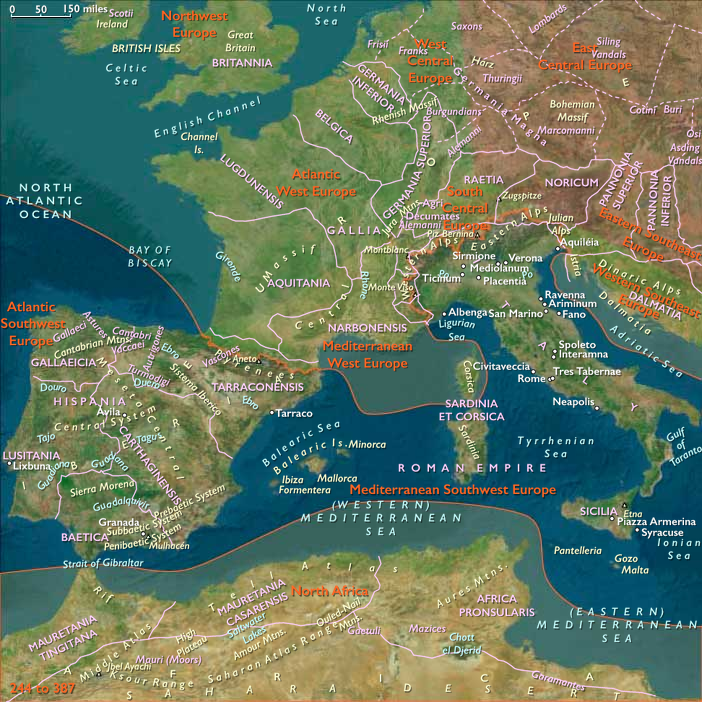
Between 340 and 351 CE, Atlantic Southwest Europe—encompassing northern and central Portugal, Galicia, Asturias, Cantabria, and northern Spain south of the Franco-Spanish border (43.05548° N, 1.22924° W)—maintained provincial stability despite renewed imperial tensions following the division and conflicts among Constantine’s sons, Constantine II, Constantius II, and Constans. This period saw continued economic prosperity, effective local governance, and the deepening consolidation of Christianity as a dominant cultural and religious force, reshaping social institutions and identities across the region.
Political and Military Developments
Provincial Stability Amid Imperial Rivalries
-
Following Constantine’s death (337 CE), the empire divided among his sons, sparking renewed imperial rivalries. Atlantic Southwest Europe, however, experienced limited direct impact due to its geographical distance and effective provincial governance. Local civic elites continued efficiently managing regional administration, preserving internal peace and administrative continuity despite external political instability.
-
Following Constantine II’s defeat and death in 340 CE, Constans (west) and Constantius II (east) remained, with Constans governing the western provinces, including Atlantic Southwest Europe. His relatively stable rule supported continued provincial tranquility and economic vitality until his assassination in 350 CE and subsequent rise of Magnentius, prompting new political uncertainty toward the period's end.
Stability and Continued Integration of Northern Tribes
-
Northern tribes—including the Gallaeci, Astures, and Cantabri—remained stable, prosperous, and fully integrated within provincial governance frameworks. Their collaboration with provincial authorities ensured regional stability and effective local governance.
-
The Vascones continued preserving their territorial autonomy, diplomatic neutrality, internal stability, and distinct cultural identity, significantly enhancing regional cohesion and resilience.
Economic and Technological Developments
Economic Prosperity and Sustained Regional Trade
-
Economic prosperity persisted, driven by continued robust agricultural production, livestock, mining (silver, copper, tin), timber, salt, textiles, pottery, and active Mediterranean trade. Provincial economies remained resilient, benefitting from established regional trade networks and stable local resource management.
-
Provincial elites effectively navigated new imperial taxation demands and shifting political conditions, sustaining economic stability through strengthened internal commerce and careful resource management.
Declining Slavery and Strengthening Local Labor Systems
-
The decline of widespread slavery continued, with local economies increasingly reliant on tenant farmers, free artisans, and semi-free laborers (coloni). This transformation reflected broader imperial economic restructuring, promoting more sustainable local labor arrangements.
Infrastructure Maintenance and Technological Advancements
-
Infrastructure—including roads, aqueducts, bridges, urban fortifications, temples, and public buildings—continued receiving essential maintenance and targeted enhancements, improving provincial connectivity, economic efficiency, and urban living standards.
-
Technological innovations persisted in agriculture, metallurgy, and construction, further supporting regional economic resilience and sustainability.
Cultural and Religious Developments
Deepening Consolidation of Christianity
-
Christianity strengthened significantly during this era, solidifying its presence among urban and rural populations, provincial elites, and broader regional communities. The establishment and expansion of churches, Christian communities, and Christian burial practices increasingly reshaped social customs, cultural identities, and regional religious landscapes.
-
Bishops and clergy began emerging as influential local leaders, contributing significantly to regional governance and community life, reflecting Christianity’s deepening institutional and cultural integration.
Continuing Indigenous Cultural Traditions and Syncretism
-
Indigenous Iberian and Celtic cultural traditions persisted strongly, blending dynamically with the growing Christian context. Material culture, including metalwork, jewelry, pottery, and ceremonial artifacts, continued reflecting vibrant regional identities.
-
Indigenous and traditional Roman religious practices persisted, particularly among rural and tribal communities, increasingly influenced by Christian beliefs, creating a complex syncretic religious landscape.
Civic Identity and Provincial Integration Amid Imperial Rivalries
-
Civic identity in Atlantic Southwest Europe reflected an increasingly complex blend of local traditions, Christian affiliations, and imperial integration amid renewed central rivalries. Universal citizenship remained foundational, yet local and regional identities adapted fluidly to political uncertainty and evolving religious frameworks.
Notable Tribal Groups and Settlements
-
Lusitanians: Maintained economic prosperity, vibrant cultural traditions, and significant integration of Christianity into local social and religious life.
-
Vettones and Vaccaei: Preserved autonomy, stability, and regional prosperity, managing political shifts and deepening Christian influences effectively.
-
Gallaeci, Astures, Cantabri: Continued prosperous integration, cultural resilience, and effective regional governance, actively preserving indigenous traditions alongside deepening Christianization.
-
Vascones: Successfully maintained diplomatic neutrality, territorial autonomy, cultural distinctiveness, and internal stability, significantly contributing to overall regional resilience.
Long-Term Significance and Legacy
Between 340 and 351 CE, Atlantic Southwest Europe:
-
Successfully maintained provincial stability and effective regional governance despite renewed imperial rivalries and shifting central authority, demonstrating substantial administrative resilience.
-
Experienced continued economic prosperity, adaptive local labor systems, and sustainable regional trade integration, facilitating long-term economic stability.
-
Saw profound consolidation of Christianity, reshaping cultural identities, religious practices, and social structures, significantly influencing the region’s subsequent historical and cultural evolution.
This era solidified Atlantic Southwest Europe's historical trajectory as a resilient, economically prosperous, and culturally adaptive region undergoing deepening religious transformation, laying enduring foundations for future regional identity, governance, and cultural continuity.
Groups
Commodities
Subjects
Regions
Southwest Europe
View →Subregions