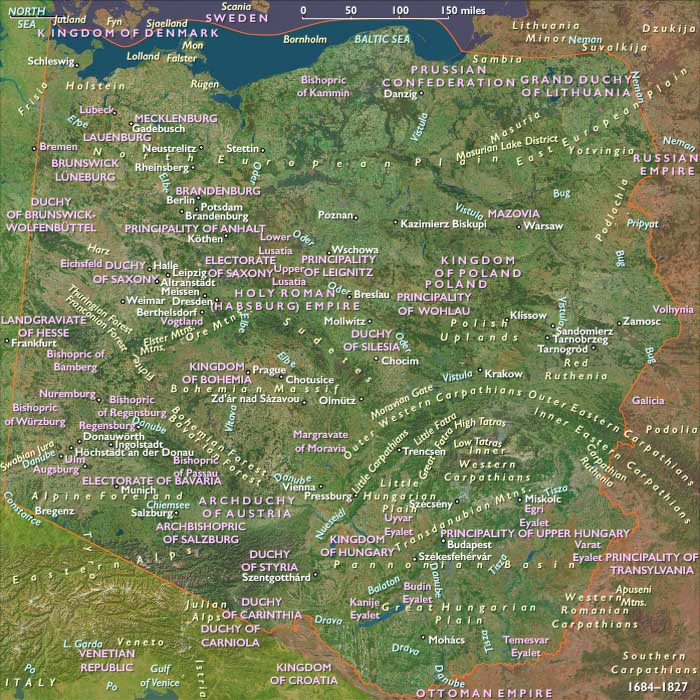
Frederick II has taken Silesia by storm…
April 1741 CE
Frederick II has taken Silesia by storm and nearly has the entire province occupied.
His Prussian troops have settled down into winter quarters and are expecting an easy land-grab when Maria Theresa sends an army of about twenty thousand men led by Wilhelm Reinhard von Neipperg to take back the province and assert herself as a strong monarch.
This army led by Neipperg catches Frederick II completely off-guard as he lingers in the province, and Neipperg's forces surge northwards past Frederick and his army in order to relieve the city of Neisse, which is being besieged by a small Prussian force and has not yet fallen.
Both Neipperg and Frederick race northwards in a rush to reach the city first, in parallel columns.
The weather is atrocious for both sides but von Neipperg reaches Neisse first and sets up camp there.
Frederick II and his entire army are now caught behind enemy lines with a large Austrian force lying between him and the rest of his kingdom and his supply and communication lines cut off.
Both sides know that battle is now inevitable.
The Prussian victory is actually the responsibility of Field Marshal Schwerin.
The Prussian king had fled from the battlefield when the Austrians seemed to be winning.
Later Frederick the Great will swear never again to leave his troops behind in battle and will adhere to this promise faithfully until his death in the late eighteenth century.
He annexes the province of Silesia from Austria, having learned a number of valuable lessons from Mollwitz.
He is quoted as saying "Mollwitz was my school".
Frederick had made several mistakes but his army still managed to win the battle due to the superior training of his soldiers.
From now on, he will be committed to aggressiveness, and gear his entire army towards an aggressive approach.
He gives a standing order that his cavalry commanders will never receive a cavalry charge while standing still.
He greatly increases the use of light cavalry, Hussars, who will act as skirmishers and scouts.
Afterwards he is quoted as saying "The Prussian army always attacks."
People
Groups
Regions
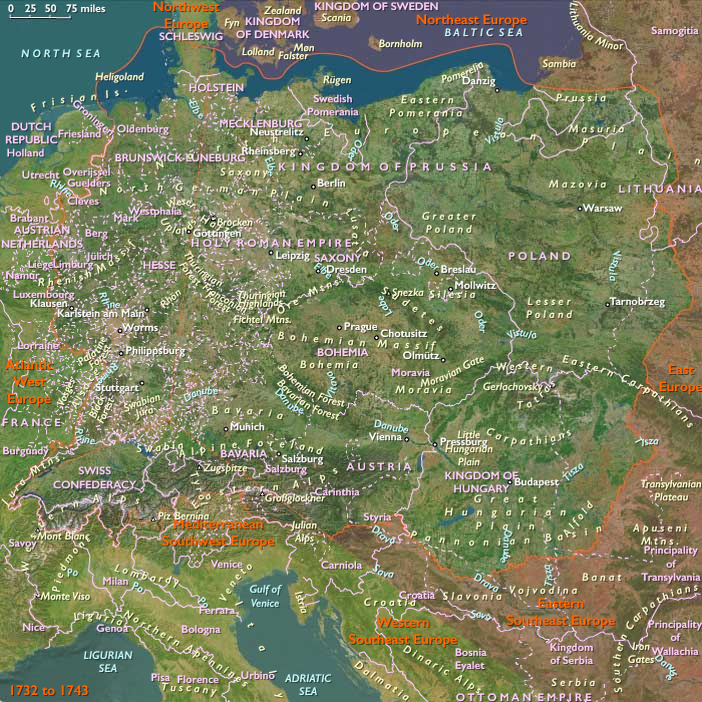
Central Europe
View →Subregions