Event
Isthmian America (7,821–6,094 BCE): Tropical Forest Gardens,…
Isthmian America (7,821–6,094 BCE): Tropical Forest Gardens, Mobile Foragers, and the Unpeopled Oceanic Islands.
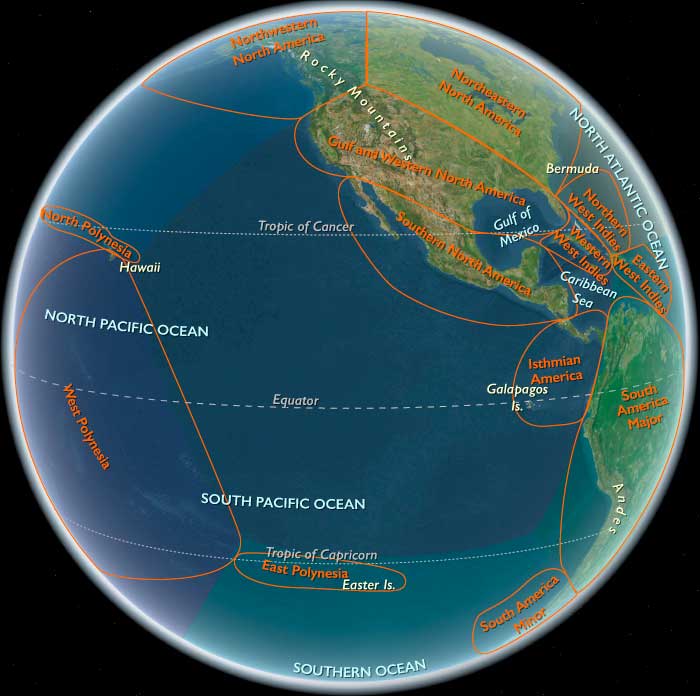
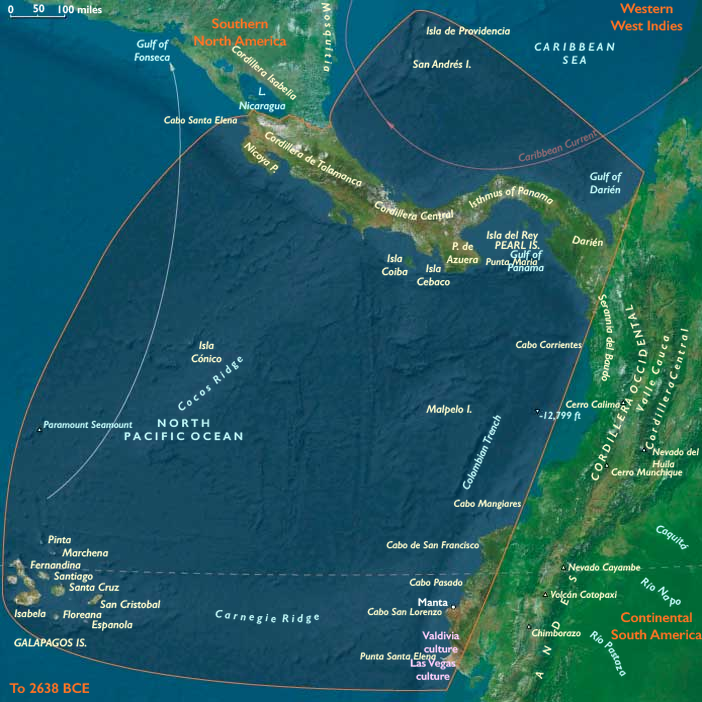
During the Early Holocene, Isthmian America extended across Costa Rica and Panama, the Darién and northern Chocó of northwestern Colombia, the San Andrés Archipelago, the Galápagos, and the Pacific Ecuadorian Capelands. Human communities were well established across the continental portions of this region, while its remote oceanic islands remained entirely unpeopled.
Across Costa Rica, hunter-gatherers moved through volcanic uplands, river valleys and contrasting Pacific and Caribbean forests. Earlier Paleoindian hunting traditions gave way to increasingly broad use of deer, smaller animals, wild fruits, roots and other plant foods as Early Holocene forests developed.
Settlement remained mobile. Open-air camps, stone-working places and rockshelters served groups moving seasonally among ecological zones rather than living in permanent villages. In some regions, repeated tending of useful plants began to supplement gathering, although direct evidence remains less detailed than farther east in Panama.
Central and western Panama preserve a clearer record of this transformation. Warmer and wetter conditions encouraged tropical forest expansion, but people had already begun creating small clearings and repeatedly disturbing favored areas through burning. Human influence therefore produced localized mosaics of mature forest, secondary growth and open ground.
Hunting and gathering remained fundamental. Deer, smaller mammals, tree fruits, roots and other wild plants contributed to broad subsistence systems, while rivers and changing coastal environments offered fish and aquatic resources where locally accessible.
Plant cultivation was nevertheless already underway. By approximately 6,650 BCE, communities in central Panama were tending squash, bottle gourd, lerén and arrowroot. These plants grew within small garden-like clearings and recurrently used forest-edge settings rather than extensive agricultural fields.
People remained mobile or semi-mobile even as cultivation increased. Camps and rockshelters could be revisited frequently, and planted or encouraged species could be harvested during seasonal rounds through several different habitats.
Maize had not yet become a defining part of these systems. Its stronger archaeological appearance in Panama falls mainly in the centuries following 6,094 BCE, when cultivation and forest clearance intensified further.
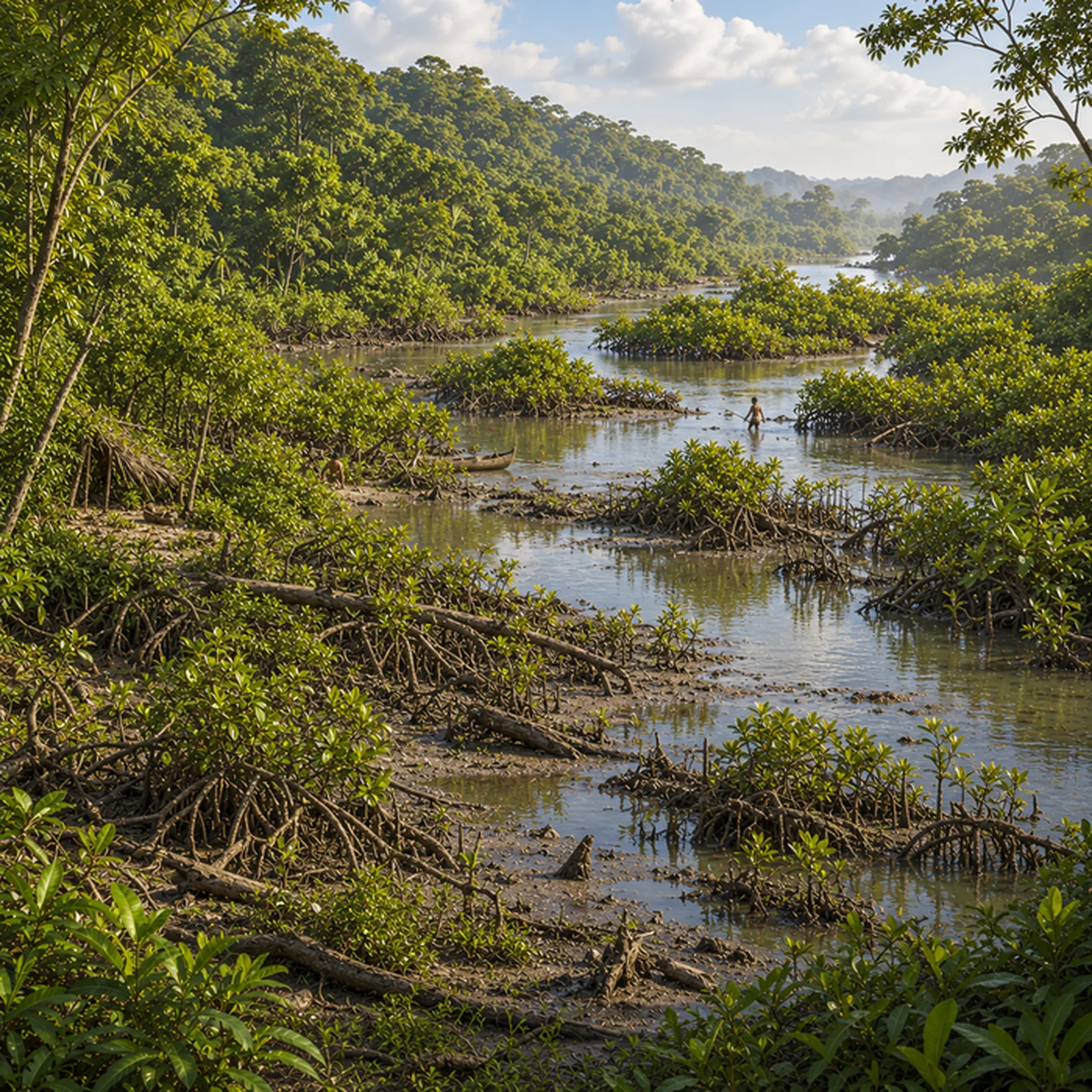
Along the Pacific coast, continued sea-level rise transformed estuaries, mangrove margins, bays and coastal plains. Some occupation sites and shorelines used earlier in the Holocene disappeared beneath the advancing sea, leaving the surviving archaeological record biased toward inland rockshelters and elevated terrain.
Farther east, the Darién, Gulf of Urabá and northern Chocó formed an exceptionally wet world of tropical forest, rivers, swamps and coastal margins. Mobile communities used waterways as movement corridors and exploited forest, river and wetland resources, although direct Early Holocene archaeological evidence remains less detailed than in central Panama.
The Ecuadorian Capelands contained another distinctive Early Holocene adaptation. On the Santa Elena Peninsula, Las Vegas communities occupied recurrent littoral settlements from which they used terrestrial, estuarine and marine resources.
Fishing and shellfish collecting accompanied hunting and the gathering of wild plants. At the same time, people cultivated useful species including squash and bottle gourd, adding tended plants to an economy still strongly dependent on naturally occurring resources.
Santa Elena's comparatively dry Pacific setting contrasted sharply with the humid forests of Chocó and Darién. Seasonally dry woodland, scrub, estuaries and open coastal terrain created a mosaic in which repeated settlement and plant tending could occur without permanent farming villages.
Formal burials at Las Vegas demonstrate recurrent community use of particular places, but the landscape remained preceramic and lacked the fields, dense villages and public architecture of later coastal societies.
Beyond the continental margin, the San Andrés Archipelago followed a different history. No secure evidence places human occupation there during the Early Holocene. Reefs, low island forests and coastal ecosystems therefore developed without settlement, burning or introduced species.
The Galápagos were even more isolated. Volcanic islands, arid coastal zones, wetter uplands and extraordinarily distinctive terrestrial and marine ecosystems remained entirely untouched by people. No archaeological evidence supports pre-Columbian settlement or visitation, and no canoe, camp or introduced organism belonged to these islands during the age.
Legacy of the Age
By 6,094 BCE, Isthmian America had become a highly varied tropical human landscape without becoming an agricultural one. Costa Rican and Panamanian communities remained mobile hunters and gatherers, yet in central Panama the deliberate cultivation of squash, gourds and root crops was already modifying favored forest patches. Along the Ecuadorian Capelands, Las Vegas communities similarly combined marine and terrestrial foraging with early plant cultivation in recurrent coastal settlements. Darién and Chocó remained humid river-and-forest worlds occupied more diffusely, while San Andrés and the Galápagos remained entirely beyond human settlement. The defining history of the age was therefore the emergence of localized cultivation and increasingly active forest management within still-mobile tropical foraging societies, set beside remote island ecosystems that remained completely prehuman.
-
{# Image navigates to the detail page; the magnifying-glass chip is the only Fancybox lightbox trigger (kept a separate sibling — anchors can't nest). #}
 The Far West
World
-
{# Image navigates to the detail page; the magnifying-glass chip is the only Fancybox lightbox trigger (kept a separate sibling — anchors can't nest). #}
 Middle America
Region
-
{# Image navigates to the detail page; the magnifying-glass chip is the only Fancybox lightbox trigger (kept a separate sibling — anchors can't nest). #}
 Isthmian America
Subregion