
Northeastern North America (100 to 243 CE):…
100 CE to 243 CE
Northeastern North America
(100 to 243 CE): Hopewell Cultural Fluorescence and Regional Integration
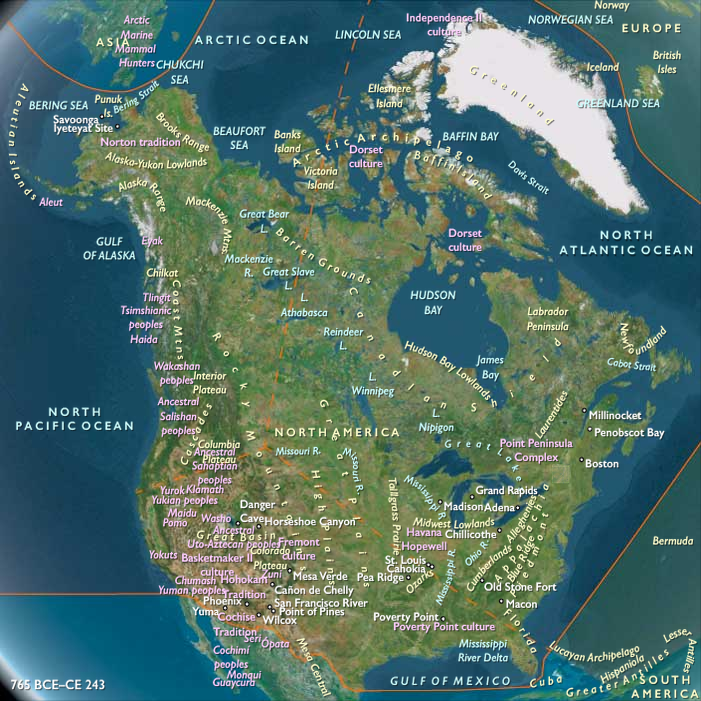
Between 100 and 243 CE, Northeastern North America experienced the peak of Middle Woodland cultural complexity, centered around the expansive influence of the Hopewell tradition. The period featured elaborate mound-building, advanced agricultural practices, sophisticated craftsmanship, and an unprecedented expansion of long-distance trade networks. Diverse regional societies became integrated through shared ceremonial traditions, artistic expression, and extensive material exchanges, shaping a vibrant era of social complexity and cultural cohesion.
Agricultural Intensification and Settlement Stability
Communities across the Ohio Valley, Great Lakes region, and adjacent territories increasingly relied on agriculture, cultivating maize, squash, pumpkins, sunflowers, gourds, marsh elder, and various indigenous grasses. While maize cultivation occurred, it remained limited and would only later become a regional staple. These agricultural developments supported larger, more sedentary populations, stabilizing settlement patterns and territorial boundaries.
Expansion of Hopewell into Wisconsin
By approximately 100 CE, Middle Woodland, or Hopewell, peoples migrated northward into southern Wisconsin from regions farther south, introducing agriculture focused on maize, pumpkins, and squash. Their presence marked the northern expansion of Hopewellian cultural elements, including mound-building, ceremonialism, and trade interactions. Wisconsin's Hopewell communities traded extensively, obtaining goods manufactured as far away as the Carolinas and the Gulf of Mexico, thus connecting northern communities to distant regional economies.
Hopewell Tradition at its Peak
The Hopewell cultural complex (circa 200 BCE–400 CE) flourished along major rivers in the northeastern and midwestern United States, at its peak extending from western New York to Missouri, from Wisconsin to Mississippi, and including Canadian and American shores of Lake Ontario. Originating possibly in western New York and subsequently expanding southward into Ohio—where it integrated and built upon the earlier Adena mortuary tradition—Hopewell society represented a cultural climax in Middle Woodland North America.
Another perspective suggests an origin in western Illinois, spreading eastward and southward into southern Ohio, possibly carried by migrating religious elites. This diffusion extended into southwestern Michigan, forming the Goodall Hopewell tradition, exemplifying Hopewell’s capacity to influence and reshape regional identities.
Distinctive Regional Hopewellian Cultures
In addition to the famed Ohio Hopewell, multiple "Hopewellian" cultures developed regionally, demonstrating shared ceremonial practices and trade patterns. Notable among these was the Swift Creek culture, beginning around 100 CEin the southeastern United States. Although practicing mound-building, Swift Creek peoples were generally non-sedentary, subsisting mainly through hunting, gathering, and fishing. Their type site in Bibb County, Georgia, is distinguished by intricately stamped earthenware pottery with complex curvilinear designs.
The related Santa Rosa-Swift Creek culture further illustrates regional variations within the broader Hopewellian cultural sphere, emphasizing the broad geographical scope and cultural flexibility of Hopewell traditions.
Sophisticated Mound-Building and Ceremonial Centers
Hopewell communities built monumental ceremonial landscapes, including geometrically precise earthen enclosures and burial complexes such as Newark Earthworks and Seip Mound Group in Ohio. These earthworks often aligned precisely with astronomical phenomena, reflecting sophisticated ritual knowledge and cultural symbolism. Elite burials within these mounds featured rich ceremonial goods, including finely crafted copper adornments, carved stone pipes with realistic animal and human representations, mica and obsidian artifacts, ornamental marine shells, and elaborate pottery vessels.
In Wisconsin and surrounding regions, the distinct effigy mound tradition continued to develop concurrently, with mounds shaped as animals embedding symbolic meanings within the landscape, reinforcing local identities and social hierarchies.
Artistry, Craftsmanship, and Symbolism
Hopewell artisans demonstrated remarkable craftsmanship in crafting ceremonial artifacts from diverse exotic materials, including native copper, silver, mica, meteoric iron, obsidian, and marine shells. These materials, often obtained from distant regions through extensive trade networks, enhanced ceremonial and social symbolism. Pottery traditions reached exceptional sophistication, featuring intricate cord-marked, incised, and stamped designs that distinguished regional communities and underscored cultural unity.
Expansive Long-Distance Trade Networks
Hopewell culture maintained extensive interregional trade networks spanning vast distances, linking communities from the Great Lakes to the Gulf Coast, and from the Atlantic seaboard westward toward the Rocky Mountains. These networks facilitated the circulation of copper, mica, obsidian, marine shells, exotic lithics, and ceremonial objects. Southern Wisconsin’s involvement in these exchanges exemplifies the extensive geographical reach and interconnectedness of Hopewell societies.
Tobacco Ritualism and Symbolic Ceremonialism
Ceremonial tobacco pipes retained a prominent role within Hopewell culture, intricately carved or molded into representations of animals and humans. These pipes appeared frequently in burial contexts and communal ceremonies, symbolizing social status, communal identity, and spiritual beliefs. Their widespread ceremonial use emphasized Hopewell’s elaborate ritual complexity and symbolic expression.
Arctic Continuity and Paleo-Eskimo Presence
Farther north, Arctic and subarctic Paleo-Eskimo cultures maintained their adaptations in harsh environments, subsisting through specialized hunting economies focused on musk oxen, caribou, marine mammals, and small game. Their sustained presence in Greenland, Labrador, and northern Quebec illustrates cultural resilience, adaptation, and ongoing northern occupation.
Coastal and Riverine Subsistence Strategies
Atlantic coastal and inland riverine communities maintained robust aquatic economies, utilizing advanced fishing techniques and infrastructure—including nets, weirs, and traps—to ensure stable food supplies. These aquatic-based strategies reinforced territorial permanence, supported structured social organizations, and sustained substantial populations.
Social Organization and Hierarchical Leadership
Hopewell societies increasingly structured their communities, establishing stable villages characterized by pole-frame and bark-covered dwellings. Leadership roles were clearly defined, overseeing mound construction, ceremonial activities, agricultural management, and long-distance trade relations. Social hierarchies became more pronounced, evident in elite burial practices and the presence of prestige goods.
Ritual Complexity and Symbolic Expression
Communities engaged in elaborate ceremonial practices, notably burial rituals featuring red ocher, copper ornaments, ceremonial pipes, polished obsidian and stone tools, intricate pottery vessels, and symbolic jewelry crafted from marine shells and mica. These artifacts symbolized communal identities, social status, and spiritual beliefs, reflecting the profound cultural sophistication of Hopewell traditions.
Legacy of the Age
The period from 100 to 243 CE represented the apex of Middle Woodland cultural complexity in Northeastern North America, driven by the expansive influence of the Hopewell tradition. Agricultural intensification, elaborate mound-building, remarkable craftsmanship, and expansive trade networks established enduring legacies of ceremonialism, social complexity, and regional integration. Diverse regional expressions, including Wisconsin Hopewell and the Swift Creek cultures, further illustrated Hopewell’s adaptability and cultural influence, profoundly shaping indigenous societies across the expansive northeastern landscapes for generations to come.
Topics
Commodities
Subjects
Regions
Northern North America
View →Subregions
