
Northeastern North America (676 to 819 CE):…
676 CE to 819 CE
Northeastern North America
(676 to 819 CE): Late Woodland Regionalization and the Rise of Maize-Based Societies
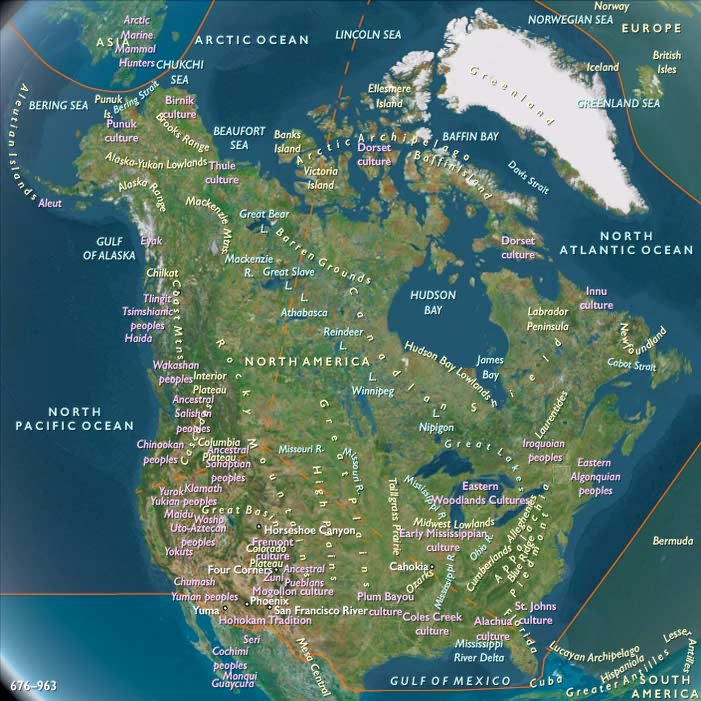
Between 676 and 819 CE, Northeastern North America fully transitioned into a period defined by regional cultural consolidation and profound economic transformation. The Woodland societies, traditionally reliant on hunting, gathering, and small-scale horticulture, underwent a significant agricultural revolution following 700 CE as maize cultivation took on a primary economic role. This shift was accompanied by increasingly permanent village settlements, enhanced social complexity, localized ceremonial practices, and significant technological innovations. This era also witnessed early developments in the Mississippi River Valley that foreshadowed the emergence of large-scale ceremonial sites such as Cahokia, reflecting broader trends toward regional integration and population expansion.
Agricultural Revolution: Maize Cultivation Intensifies
Prior to this period, Eastern North American societies traditionally cultivated gourds, squash, sunflowers, and various seed plants. However, after approximately 700 CE, Woodland cultures significantly intensified their reliance on maize, transitioning toward economies centered around this highly productive crop. Archaeologists suggest that improved varieties of maize introduced during this era produced higher yields, enabling substantial population growth, food surpluses, and more complex social structures.
Permanent Settlements and Structural Evolution
With maize cultivation becoming increasingly central, Woodland settlements grew more permanent. Housing structures transitioned gradually from traditional circular forms to rectangular dwellings better suited for larger, stable populations. To protect valuable resources and communities, some villages began constructing defensive stockades or fortifications, reflecting heightened territoriality and community organization prompted by expanding agricultural economies and growing populations.
Introduction of the Bow and Arrow
Concurrent with the transition toward maize-based economies, Woodland societies adopted the bow and arrow, introduced from western North America. This technological innovation dramatically improved hunting efficiency, altered warfare dynamics, and reinforced community defense strategies. The bow and arrow’s introduction marked a significant shift in subsistence practices and social interactions, providing communities with more effective means of resource procurement and territorial defense.
Decline of the Mound Builder Culture in Ohio
By approximately 800 CE, the once-prominent Mound Builder culture in Ohio had substantially faded. Monumental ceremonial centers, characteristic of earlier Hopewell traditions, were largely abandoned, replaced by smaller-scale, village-oriented ceremonial practices. This cultural shift reflected broader regional transitions toward localized community identities, agricultural intensification, and decreased reliance on extensive ceremonial networks.
Early Development of Cahokia
In the Mississippi River Valley, just east of present-day St. Louis, Missouri, a significant new phase of mound construction began, marking the earliest stages of the site later known as the Cahokia Mounds. These pyramidal earthworks, built in clusters covering several square miles between Wood River to the north and Dupo, Illinois, to the south, represented the initial formation of what would eventually become the largest pre-Columbian settlement north of Mexico. Although Cahokia reached its peak in later centuries, its earliest constructions during this era highlight the increasing nucleation of population centers and rising cultural complexity along the Mississippi River.
Effigy Mound Tradition Flourishes
Meanwhile, the effigy mound tradition continued to thrive prominently in the Upper Mississippi River region (Wisconsin, Iowa, Minnesota). Communities maintained extensive construction of animal-shaped earthen mounds, embedding spiritual symbolism, social hierarchy, and regional identity into local landscapes. Sites such as Effigy Mounds National Monument exemplify the continuing cultural significance of this tradition, distinct yet parallel to other regional developments.
Continued Ceremonial Significance of the Old Stone Fort
In eastern Tennessee, ceremonial use persisted at the Old Stone Fort, a complex stone-and-earth enclosure overlooking the Little Duck River. Originally constructed during the Middle Woodland period, this site continued to serve localized ceremonial functions, reflecting sustained cultural continuity and community autonomy even as broader regional ceremonialism receded.
Arctic Cultural Persistence in Newfoundland
Eskimo (Paleo-Eskimo) communities in northern Newfoundland persisted in their southernmost settlements, initially established in preceding centuries. Their continued presence underscored cultural resilience, adaptability to maritime resources, and the enduring significance of Arctic subsistence and social strategies at the southern edge of their range.
Great Lakes Regionalism: Goodall Tradition
In southwestern Michigan and northern Indiana, communities associated with the Goodall tradition further solidified distinct regional identities. Localized mound-building practices, burial customs, and specialized pottery styles continued evolving, reinforcing regional autonomy, cultural self-sufficiency, and community organization distinct from broader Hopewell influences.
Southeastern Continuity: Swift Creek Cultural Tradition
In the southeastern United States, the Swift Creek culture and related regional traditions persisted. Characterized by ceremonial mound-building and distinct pottery featuring intricate stamped curvilinear designs, Swift Creek groups maintained semi-sedentary lifestyles integrating agriculture, hunting, fishing, and gathering, reinforcing regional identities and cultural continuity.
Contraction of Long-Distance Trade Networks
Long-distance trade networks, previously extensive under Hopewell influence, continued to contract, replaced by intensified reliance on localized resources and exchanges. Reduced circulation of exotic ceremonial goods like copper, mica, obsidian, and marine shells indicated increased regional economic autonomy and localized cultural development.
Artistic Continuity and Specialized Regional Craftsmanship
Regional artisans continued sophisticated production of pottery, ceremonial artifacts, stone tools, and ritual objects, utilizing locally available materials. Pottery retained high craftsmanship and intricate decorative motifs reflecting distinct regional identities, symbolizing community cohesion and cultural continuity.
Tobacco Ceremonialism and Ritual Symbolism
Ceremonial tobacco pipes retained central ritual significance, crafted with distinct local styles. Tobacco rituals persisted as expressions of social hierarchy, community identity, and spiritual symbolism, prominently featured in localized ceremonies and burial contexts.
Coastal and Riverine Adaptations
Coastal and riverine communities maintained sophisticated aquatic economies, utilizing advanced fishing infrastructure—nets, weirs, and traps—to sustain stable settlements and structured social organization, reinforcing community stability and territorial boundaries.
Local Leadership and Village-Based Organization
Communities increasingly structured around clearly defined village leadership roles, overseeing local agriculture, ceremonial coordination, community defense, and resource management. Village leaders emphasized localized autonomy and internal cohesion, reinforcing distinct community identities and cultural specialization.
Ritual Adaptations and Localized Ceremonial Expression
Ceremonial practices adapted into smaller-scale community-oriented rituals. Burial customs retained symbolic complexity, incorporating red ocher, ornamental artifacts, ceremonial pipes, stone tools, and locally produced pottery vessels. These rituals expressed community identity, social hierarchies, spiritual beliefs, and cultural continuity.
Legacy of the Age
The period from 676 to 819 CE marked a significant turning point in Northeastern North America, characterized by a profound shift toward maize-based economies, permanent settlements, and increased population densities. The introduction of the bow and arrow, early developments at Cahokia, the sustained effigy mound tradition, and localized ceremonial sites such as the Old Stone Fort underscore the complexity and regionalization of Late Woodland societies. These transformations established critical foundations for future indigenous cultural developments, significantly shaping the trajectory toward greater social complexity, regional autonomy, and cultural innovation across Northeastern North America.
Topics
Commodities
Subjects
Regions
Northern North America
View →Subregions
