
Northwest Europe (1720–1731): Financial Crises, Maritime Consolidation,…
1720 CE to 1731 CE
Northwest Europe (1720–1731): Financial Crises, Maritime Consolidation, and Enlightenment Culture
The South Sea Bubble: Financial Crisis and Aftermath
The era opened dramatically with Britain’s South Sea Bubble of 1720, one of Europe's earliest major financial crises. The speculative frenzy around the South Sea Company—created to manage Britain's burgeoning national debt through monopolized trade in South America—led investors to unrealistic expectations, sharply inflating stock values. When the bubble burst, thousands were ruined overnight. The ensuing scandal provoked severe public outrage and parliamentary inquiries, reshaping British financial regulation. Key officials implicated faced disgrace, and the crisis instilled lasting caution toward speculative finance.
Continued Dominance of the United East India Company
During the 1720s, the United Company of Merchants of England Trading to the East Indies, formed in 1708 from the merger of competing companies, solidified its position as Britain's dominant commercial power in Asia. By 1720, fully fifteen percent of British imports originated from India, virtually all controlled by the company, further enhancing its influence within British political circles. This resurgence of influence enabled the company’s powerful lobby in Parliament to secure yet another legislative extension of its exclusive trading privileges in 1730, prolonging the license until 1766 and underscoring the company's lasting grip on Britain's Asian trade.
Maritime Expansion and Naval Dominance
Britain’s maritime dominance steadily expanded during this period, consolidating control over trade routes and colonial territories. The Royal Navy, reinforced through reforms begun under previous monarchs, effectively policed commercial lanes and protected British merchant interests against piracy and rival European powers. British merchant shipping prospered, particularly from lucrative routes connecting Britain, India, and the Americas, fueling the nation's rise as the preeminent Atlantic and Indian Ocean trading power.
However, maritime navigation remained perilous. After long ocean voyages, cumulative errors in dead reckoning frequently caused devastating shipwrecks. Determining a ship’s longitude accurately—its position east or west relative to the prime meridian—became increasingly vital as global trade expanded. Methods relying on astronomical observations, such as those first proposed by Gemma Frisius and supported by scientists including Isaac Newton and Christiaan Huygens, proved inadequate due to difficulties in estimating exact reference times.
Innovations in Longitude Measurement: Harrison and Sully
The challenge of solving the longitude problem attracted the attention of gifted clockmakers. In France, English-born Henry Sully had introduced the innovative Montre de la Mer marine clock in 1716, presenting it to the Académie des Sciences and subsequently publishing details in his Une Horloge inventée et executée par M. Sulli (1726). Sully’s design featured a vertically mounted balance wheel and friction rollers, with oscillations regulated by a pivoted horizontal lever weighted at one end to mitigate thermal expansion errors inherent in steel balance springs. Although his clocks marked pioneering efforts, Sully’s marine timepieces only kept accurate time in calm seas, as their mechanisms proved sensitive to ships' pitching and rolling.
In Britain, the inventive genius John Harrison began tackling the same problem directly through technological innovation. Recognizing the limitations of pendulum clocks affected by temperature, humidity, and the motion of ships, Harrison developed remarkable improvements such as the gridiron pendulum, which used alternating brass and iron rods arranged to offset each other’s thermal expansions and contractions. He also invented the nearly frictionless grasshopper escapement, an ingenious adaptation of the anchor escapement. Made with wooden pallets requiring no lubrication—a significant advantage given the poor understanding of lubricants at the time—this escapement enhanced clock accuracy and durability.
While Newton himself famously doubted that a sufficiently reliable marine clock could ever be devised, suggesting that celestial navigation was more promising, Harrison persevered. Ultimately, his pioneering work during these years set him on a path toward successfully solving the longitude problem, revolutionizing maritime navigation.
Danish-Norwegian Consolidation and Reforms
Under Frederick IV, Denmark-Norway implemented further economic reforms intended to strengthen its maritime economy. Efforts included improvements to shipping and naval infrastructure, and attempts to invigorate agriculture and industry. Trade policies encouraged greater commercial activity within Danish territories, notably through Copenhagen, which emerged as a significant North European trade hub, although still overshadowed by British and Dutch dominance.
The North Atlantic territories—Iceland, the Faroe Islands, Orkney, and Shetland—remained economically marginal and reliant upon fishing and sheep farming. While Danish authority grew incrementally stronger, these areas saw minimal improvement, remaining peripheral, isolated, and largely subsistence-based.
Gaol Fever: Judicial Tragedy and Public Health
In 1730, British society confronted a devastating public health tragedy. At the Lent assizes court in Taunton, a severe outbreak of gaol fever (typhus) swept through participants, killing the Lord Chief Baron, the High Sheriff, the sergeant, and hundreds more. This event highlighted severe prison overcrowding and abysmal sanitation conditions. At a time when executions were common for various capital offenses, far more prisoners succumbed to gaol fever than faced execution throughout the entire British realm, underscoring grave inadequacies in prison hygiene and public health.
Intellectual and Cultural Enlightenment
Northwest Europe experienced vibrant intellectual and cultural growth during these years. Figures such as Jonathan Swift, whose satirical masterpiece Gulliver’s Travels appeared in 1726, critically examined British politics and society, highlighting the Enlightenment’s characteristic blend of rational critique and social commentary.
In architecture and design, British society continued evolving refined tastes. The early eighteenth-century popularity of specialized furniture, exemplified by the reading chair (previously misnamed "cockfighting chair"), reflected a broader embrace of domestic comfort, intellectual pursuits, and sophisticated leisure activities among elites and rising middle classes.
Ireland: Economic Hardship and Emigration
Ireland continued suffering under restrictive British policies. The harsh enforcement of the Penal Laws severely limited Catholic rights and economic opportunity, resulting in widespread hardship and emigration. Many Irish sought better prospects abroad, particularly in North America. Dublin and Belfast saw modest urban growth, but the countryside languished under economic stagnation.
Jacobite Agitations and Stability of Hanoverian Rule
Though the major Jacobite rebellion of 1715 had been decisively suppressed, underlying unrest continued. Jacobite sentiment persisted in Scotland and parts of England, particularly among Highland clans and certain disaffected nobles. Still, the Hanoverian dynasty under George I (died 1727) and subsequently George II (ascended 1727) firmly maintained its position. The relative stability permitted Britain to focus outward, intensifying colonial and commercial expansion rather than internal strife.
Between 1720 and 1731, Northwest Europe faced dramatic economic upheaval, expanded maritime supremacy, and profound cultural and scientific advancements. Despite setbacks like the South Sea Bubble and public-health crises exemplified by gaol fever, Britain and Denmark-Norway pressed forward. Innovations such as Harrison’s groundbreaking work on marine chronometers laid the groundwork for safer global navigation, reinforcing Northwest Europe's role at the forefront of maritime commerce, technological innovation, and global influence.
People
Groups
Topics
Commodities
Subjects
Regions
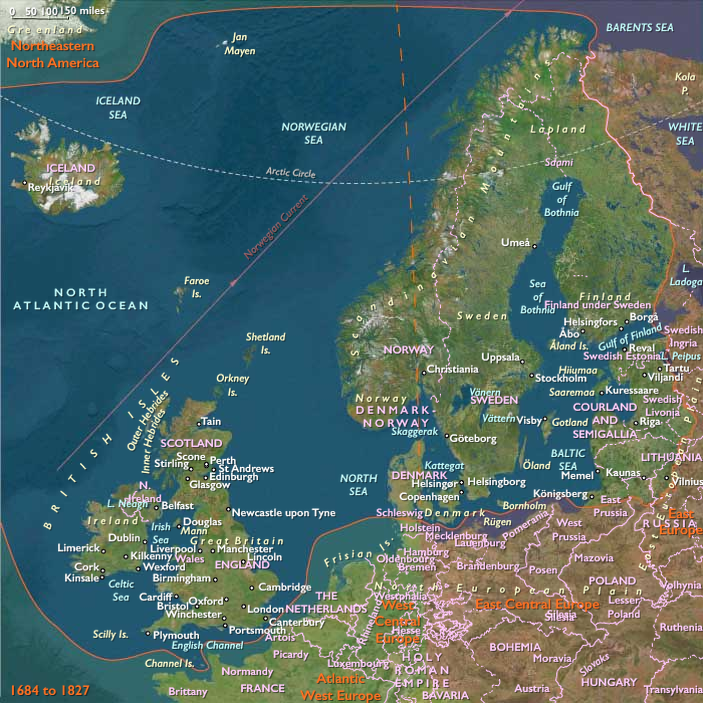
North Europe
View →Subregions
