
Event
Atlantic Southwest Europe (7,821–6,094 BCE): Forested Coasts,…
Atlantic Southwest Europe (7,821–6,094 BCE): Forested Coasts, Cantabrian Shell Gatherers, and the Estuaries Taking Shape.
During the Early Holocene, Atlantic Southwest Europe extended across Portugal and the northern Iberian Atlantic world, including Galicia, the Cantabrian coast and the Minho, Douro and Tagus basins. Throughout the age, human communities remained hunters and gatherers. Farming, domestic livestock and pottery-making Neolithic settlements still lay centuries in the future.
Across northern Iberia, postglacial warming encouraged the expansion of Atlantic woodland. Oak, hazel and other deciduous trees spread through valleys and uplands, while rocky coasts, estuaries, rivers and wetlands created open ecological corridors through the forest.
Along the Cantabrian coast, Mesolithic communities had already developed long traditions of intensive shoreline use. Caves and rockshelters overlooking the Atlantic contained accumulations of limpets and other shellfish together with stone tools, fish remains and hunted terrestrial animals.
Many of these occupations belonged to the Asturian tradition, whose characteristic heavy pebble tools accompanied smaller flaked-stone equipment. Coastal foods were important, but people also hunted red deer, roe deer and wild boar and gathered woodland plants, moving between shore, valley and upland environments.
Continued sea-level rise transformed the Cantabrian coastline throughout the age. Lower coastal plains and occupation zones disappeared beneath the advancing Atlantic, while caves and raised rockshelters preserved evidence that would otherwise have been lost.
Farther west in Galicia, hunter-gatherers used similarly varied landscapes of forest, rocky shore, estuary and river valley. The archaeological record remains less visible than along the Cantabrian coast, but no food-producing settlement system had yet appeared.
Across northern Portugal, the Minho and Douro rivers created major routes through increasingly wooded terrain. Riparian vegetation, wetlands, fish, terrestrial game and gathered plants supported mobile communities whose seasonal ranges linked river corridors with upland hunting grounds and the Atlantic margin.
The lower Tagus underwent a particularly important transformation during the closing centuries of the age. Rising sea level progressively pushed tidal conditions inland while sediment accumulated across the lower valley. Around 6,100 BCE, productive estuarine environments began extending into the mouth of the Muge valley.
Tidal flats, saltmarsh, freshwater springs and nearby open woodland created an exceptionally rich ecological junction. Shell beds expanded in the brackish waters while fish, birds, deer and gathered plants remained available within a short distance.
The famous large Muge shell middens had not yet become a mature settlement landscape for most of this age. Their principal accumulation began around 6,000 BCE, immediately after the closing boundary, as hunter-gatherers increasingly concentrated around the newly productive estuary.
A similar process affected the Sado and other Portuguese coastal systems. The Atlantic transgression created new lagoons, marshes and tidal environments that would soon support unusually persistent Mesolithic occupation, but the great shell-mound phase belongs mainly to the following period.
Throughout the subregion, material culture remained Mesolithic and aceramic. Flaked stone, composite hunting equipment and organic tools supported flexible subsistence, while no crops, livestock or pottery accompanied the increasingly intensive use of aquatic resources.
Near the end of the age, the climatic disturbance around 6,200 BCE overlapped with rapid shoreline and estuarine change. Human settlement reorganized in some regions, but rising sea level and the creation of new productive ecotones were at least as important as short-term climatic cooling.
Legacy of the Age
By 6,094 BCE, Atlantic Southwest Europe remained entirely a hunter-gatherer world, but its coastal geography had changed profoundly. Cantabrian communities continued long-established shellfish, fishing and hunting traditions within forested coastal landscapes, while Galicia and northern Portugal supported mobile riverine and woodland foragers. In the lower Tagus, rising seas had just created the productive estuarine environments that would soon sustain the great Muge shell-midden complexes. Farming, domestic animals, pottery and megalithic landscapes remained centuries or millennia ahead. The defining history of the age was therefore the restructuring of mature Mesolithic lifeways around expanding Atlantic forests and newly forming estuaries rather than the arrival of agriculture.

-
{# Image navigates to the detail page; the magnifying-glass chip is the only Fancybox lightbox trigger (kept a separate sibling — anchors can't nest). #}
 The North Atlantic Lands
World
-
{# Image navigates to the detail page; the magnifying-glass chip is the only Fancybox lightbox trigger (kept a separate sibling — anchors can't nest). #}
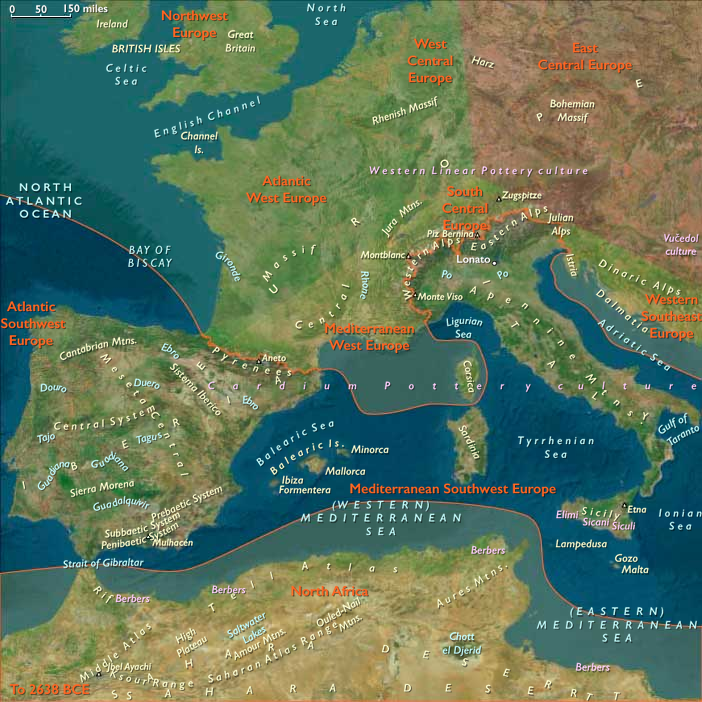 Southwest Europe
Region
-
{# Image navigates to the detail page; the magnifying-glass chip is the only Fancybox lightbox trigger (kept a separate sibling — anchors can't nest). #}
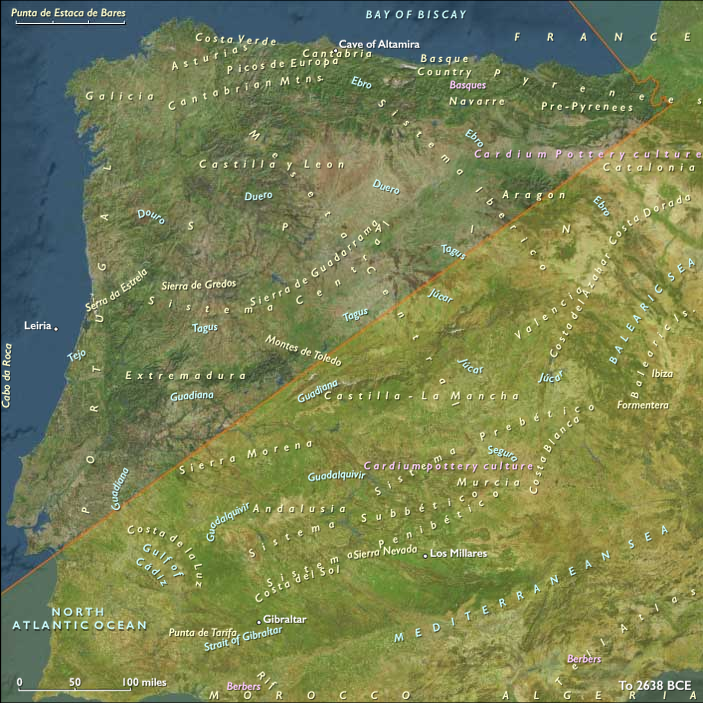 Atlantic Southwest Europe
Subregion
