Maria Theresa finds herself in a difficult…
November 1740 CE
Maria Theresa finds herself in a difficult situation.
Unschooled in matters of state and unaware of the weakness of her late father's ministers, she decides to rely on her father's advice to retain his councilors and defer to her husband, whom she considers to be more experienced, on other matters.
Both decisions, though natural, will prove to be unfortunate.
The Emperor, who had spent his entire reign securing the Pragmatic Sanction, has left Austria in an impoverished state, bankrupted by the recent Turkish war and the War of the Polish Succession; the treasury contains only one hundred thousand florins, which are claimed by his widow.
The army numbers only eighty thousand men, most of whom have not been paid in months; they are nevertheless remarkably loyal and devoted to their new sovereign.
Ten years later, Maria Theresa is to bitterly recall in her Political Testament the circumstances under which she had ascended: "I found myself without money, without credit, without army, without experience and knowledge of my own and finally, also without any counsel because each one of them at first wanted to wait and see how things would develop." (Browning, Reed: The War of the Austrian Succession p. 37. Palgrave Macmillan 1995).
She dismisses the possibility that other countries might try to seize her territories and immediately starts ensuring the imperial dignity for herself; since a woman cannot be elected Holy Roman Empress, Maria Theresa wants to secure the imperial office for her husband.
However, Francis Stephen does not possess enough land or rank within the Holy Roman Empire.
In order to make him eligible for the imperial throne and to enable to him to vote in the imperial elections as elector of Bohemia (which she can't due to her gender), Maria Theresa on November 21, 1740, makes Francis Stephen co-ruler of the Austrian and Bohemian lands. (It will take more than a year for the Diet of Hungary to accept Francis Stephen as co-ruler.)
Despite her love for him and his position as co-ruler, Maria Theresa will never allow her husband to decide about matters of state, often dismissing him from council meetings when they disagree.
The first display of the new queen's authority is the formal act of homage of the Lower Austrian Estates to her on November 22, 1740.
It is an elaborate public event that serves as a formal recognition and legitimization of her accession.
The oath of fealty to Maria Theresa is taken on the same day in Hofburg.
Immediately after her accession, a number of European sovereigns who had recognized Maria Theresa as heiress break their promises; Queen Elisabeth of Spain and Elector Charles Albert of Bavaria, married to Maria Theresa's deprived cousin Maria Amalia and supported by Empress Wilhelmine Amalia, want portions of her inheritance.
Maria Theresa secures the recognition of King Charles Emmanuel III of Sardinia, who hadn't accepted the Pragmatic Sanction during her father's lifetime, in November 1740.
Locations
People
Groups
Regions
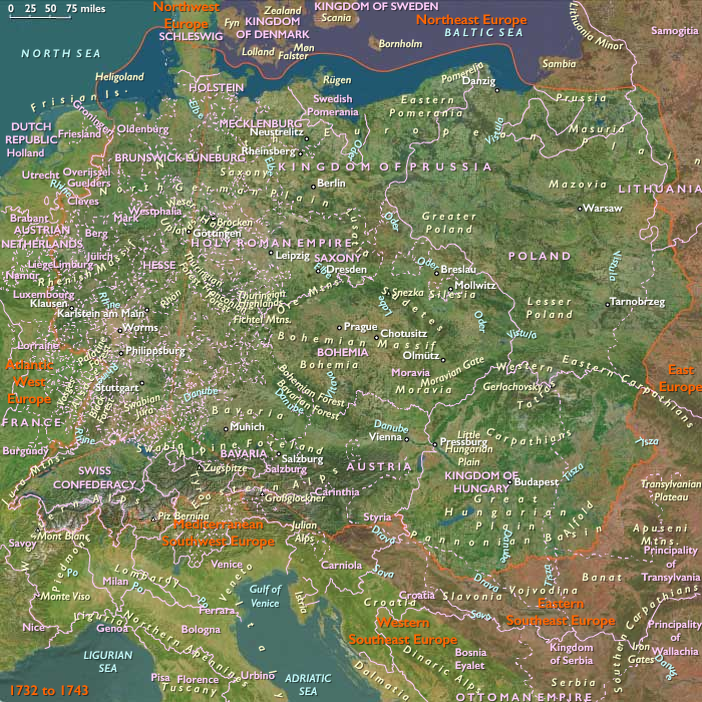
Central Europe
View →Subregions