
The cylinder seals of Susa I and…
3789 BCE to 3646 BCE
These cylinder seals, as well as bullae and clay tokens, indicate the rise of administration and of accounting techniques at Susa during the second half of the fourth millennium BCE.
Susa will also yield some of the most ancient writing tablets, making it a key site for our understanding of the origins of writing.
Other sites in Susiana also have archaeological levels belonging to this period, like Jaffarabad and Chogha Mish.
Locations
Commodities
Regions
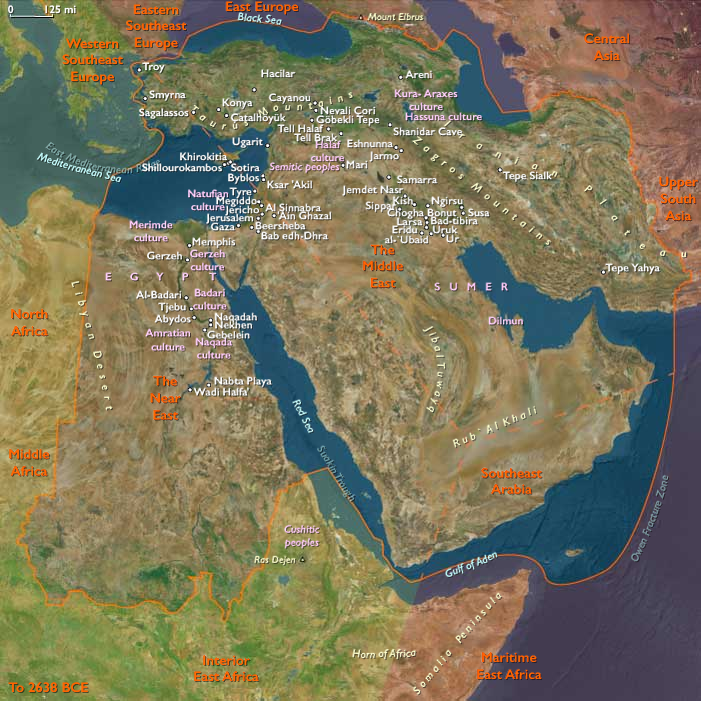
The Near and Middle East
View →Subregions
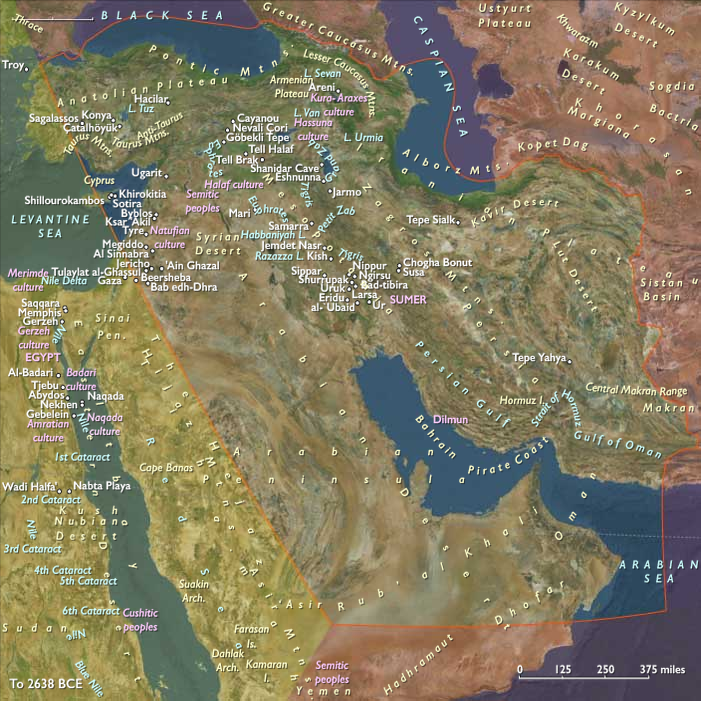
Middle East
View →Related Events
No active filters.
Showing 10 events out of 68800 total
The Middle East (3789–3646 BCE): Administration, Writing, and Early Urban Conflict
Cylinder Seals and Administration at Susa
Between 3789 and 3646 BCE, the cylinder seals of the Susa I and Susa II periods exhibited rich iconography, uniquely emphasizing scenes of everyday life, alongside depictions of a local figure identified by scholar P. Amiet as a "proto-royal figure," potentially an antecedent to the "priest-kings" of the Late Uruk era. These seals, together with bullae and clay tokens, suggest the growing importance of administrative practices and sophisticated accounting techniques at Susa during the second half of the fourth millennium BCE. Significantly, Susa also yielded some of the earliest known writing tablets, underscoring its critical role in the development of writing systems.
Broader Cultural Context in Susiana
Other regional sites in Susiana, such as Jaffarabad and Chogha Mish, similarly reflect substantial archaeological developments from this period, illustrating the widespread nature of these administrative and cultural transformations.
Tell Brak and Early Urbanization
Meanwhile, a small settlement existed at Tell Brak in northeastern Syria, in the present-day Al-Hasakah Governorate, as early as 6000 BCE, with materials indicating a continuous occupation through the Late Neolithic Halaf culture into the subsequent Ubaid and Uruk periods. Excavations and surface surveys indicate that Tell Brak developed into an urban center contemporaneously with, or even slightly earlier than, well-known cities of southern Mesopotamia, such as Uruk.
Recent archaeological excavations at Tell Brak have uncovered dramatic evidence, including a series of mass graves dating to approximately 3800–3600 BCE, suggesting that the urbanization process may have been accompanied by significant warfare. Additionally, a notable domestic structure from around 3700 BCE featured a long, narrow courtyard with a domed oven, suggesting social gatherings or communal activities. Skeletal remains from the site indicate that Tell Brak was later a notable source of donkey-onager mules utilized for pulling wheeled carts prior to the introduction of horses around 2300 BCE.
Metallurgical Advancements
During this period, the production of the earliest known bronze artifacts, such as those previously discovered at Tepe Yahya in Iran, marked significant advancements in metallurgy, contributing to the technological sophistication of the era.
This age highlights pivotal advancements in administrative and writing practices, the complexities associated with urbanization and warfare, and continuing metallurgical innovations, which collectively shaped the trajectory of early urban societies in the ancient Middle East.
A small settlement existed at the site of Tell Brak, in the present Upper Khabur area in Al-Hasakah Governorate, northeastern Syria, as early as 6000 BCE, and materials from the Late Neolithic Halaf culture have been found there.
Occupation has continued into the succeeding Ubaid and Uruk periods.
Excavations and surface survey of the site and its surroundings reveal a city that developed from the early fourth millennium BCE contemporaneously with (or even slightly earlier than) better-known cities of southern Mesopotamia, such as Uruk.
The most dramatic discoveries during recent excavations are a series of mass graves dating to circa 3800–3600 BCE, which suggest that the process of urbanization was accompanied by warfare.
A house in Tell Brak dating to around 3700 BCE would have had a long narrow courtyard with a domed oven, large enough for a gathering that would have tightly packed the space.
Skeletal remains show that the city was later a source for donkey-onager mules used for drawing wheeled carts before the introduction of the horse, about 2300 BCE.
The Near East (3789–3646 BCE): Calendrical Foundations and the Ghassulian Culture
Establishment of the Hebrew Calendar
This period witnesses a crucial event in the chronology of ancient Near Eastern civilizations: the establishment of the Hebrew calendar, a lunisolar system primarily used for Jewish religious observances. The calendar's epoch—the foundational date corresponding to the first day of Creation according to Jewish tradition—is set at 1 Tishrei 1 AM, equivalent to Monday, October 7, 3761 BCE, in the proleptic Julian calendar. This tabular date aligns closely with the traditionally recognized date of Creation, 25 Elul AM 1, derived from the second-century CE historical work, the Seder Olam Rabbah, composed by Rabbi Yossi ben Halafta. Today, adding 3760 years (before Rosh Hashanah) or 3761 years (after Rosh Hashanah) to a Julian or Gregorian year after 1 CE accurately determines the corresponding Hebrew year.
The Ghassulian Culture: Migration and Settlement
Around 3800 BCE, the Ghassulian culture begins migrating into Palestine, primarily settling in the southern regions with further extensions along the coastal plain and adjacent areas. Originating from an unknown source—though archaeological consensus suggests northern migrations from areas in modern Syria—this Middle Chalcolithic culture (circa 3800–3350 BCE) is named after its type-site, Tulaylat al-Ghassul, located in the Jordan Valley near the Dead Sea in contemporary Jordan, extensively excavated during the 1930s.
Ghassulian settlements comprise small hamlets inhabited by mixed farming communities practicing both agriculture and pastoralism. Architectural evidence includes distinct trapezoid-shaped houses constructed from mud-brick, notable for their exceptional polychrome wall paintings, indicative of both aesthetic sophistication and cultural expression.
Elaborate Pottery and Agricultural Innovation
Ghassulian ceramics represent significant cultural innovations, characterized by elaborate designs such as footed bowls and unique horn-shaped goblets. These pottery forms strongly suggest advanced agricultural practices, including the cultivation and consumption of wine. Some pottery samples exhibit refined artistic techniques, including sculptural embellishments and reserved slip decoration—where a thin clay-water coating is selectively wiped away to create intricate patterns.
These developments highlight a flourishing cultural period in the Near East, marked by calendrical innovation and agricultural sophistication, laying important foundations for subsequent cultural complexities in the region.
The first day (the Creation) of the Hebrew calendar, a lunisolar calendar used today predominantly for Jewish religious observances, corresponds to September 25, 3760 BCE.
The Jewish calendar's epoch (reference date), 1 Tishrei 1 AM, is equivalent to Monday, October 7, 3761 BCE in the proleptic Julian calendar, the equivalent tabular date (same daylight period).
It is about one year before the traditional Jewish date of Creation on 25 Elul AM 1, based upon the Seder Olam Rabbah of Rabbi Yossi ben Halafta, a sage of the second century CE.
Thus, adding 3760 before Rosh Hashanah or 3761 after to a Julian or Gregorian year number after 1 CE will yield the Hebrew year.
The Ghassulians, whose origin is unknown, immigrate beginning around 3800 BCE to Palestine, mainly in the south of Palestine, with an extension up the coastal plain and its fringes.
Ghassulian refers to a culture and an archaeological stage dating to the Middle Chalcolithic Period in the Southern Levant (around 3800 BCE to around 3350 BCE).
Its type-site, Tulaylat al-Ghassul, is located in the Jordan Valley near the Dead Sea in modern Jordan and was excavated in the 1930s.
The Ghassulian stage is characterized by small hamlet settlements of mixed farming peoples, and migrates southwards from Syria into Israel.
Houses are trapezoid-shaped and built of mud-brick, covered with remarkable polychrome wall paintings.
Their pottery is highly elaborate, including footed bowls and horn-shaped drinking goblets, indicating the cultivation of wine.
Several samples display the use of sculptural decoration or of a reserved slip (a clay and water coating partially wiped away while still wet).
Hunter-gatherers inhabit Chan-Chan, an archaeological site and beach on the coast of the commune of Mehuín in southern Chile, during two periods of the Middle Archaic, separated by a hiatus.
One period spans from 6420 to 6250 BP and the other from 6130 to 5730 BP.
Integration of the various societies and cultures in Europe, the Near East, and China increases during this age.
The earliest known Korean pottery dates back to around 8000 BCE or before, and evidence of Mesolithic Pit-Comb Ware culture or Yungimun Pottery is found throughout the peninsula.
An example of a Yungimun-era site is in Jeju-do.
Jeulmun or Comb-pattern Pottery is found after 7000 BCE, and pottery with comb-patterns over the whole vessel is found concentrated at sites in west-central Korea when a number of settlements such as Amsa-dong exist.
Jeulmun pottery bears basic design and form similarities to that of the Russian Maritime Province, Mongolia, and the Amur and Sungari River basins of Manchuria and the Jomon culture in Japan.
Examples of Early Jeulmun settlements include Seopohang, Amsa-dong, and Osan-ri.
Deep-sea fishing, hunting, and small semi-permanent settlements with pit-houses characterize the Early Jeulmun period (from about 6000 BCE to about 3500 BCE).
Radiocarbon evidence from coastal shell midden sites such as Ulsan Sejuk-ri, Dongsam-dong, and Ga-do Island indicates that shellfish were exploited, but many archaeologists maintain that shellmiddens (or shellmound sites) did not appear until the latter Early Jeulmun.
Old Europe is a term coined by archaeologist Marija Gimbutas to describe what she perceived as a relatively homogeneous and widespread pre-Indo-European Neolithic culture in Europe, particularly in Malta and the Balkans.
Archaeologists and ethnographers working within her framework believe that the evidence points to migrations of the peoples who spoke Indo-European languages at the beginning of the Bronze age (the Kurgan hypothesis).
For this reason, Gimbutas and her associates regard the terms Neolithic Europe, Old Europe, and Pre-Indo-European as synonymous.
The Old Europe civilization flourishes in the region of Macedonia, according to archaeological evidence, between 7000 and 3500 BCE.