
A coup begins after Sima Wei returns …
Years: 291 - 291
May
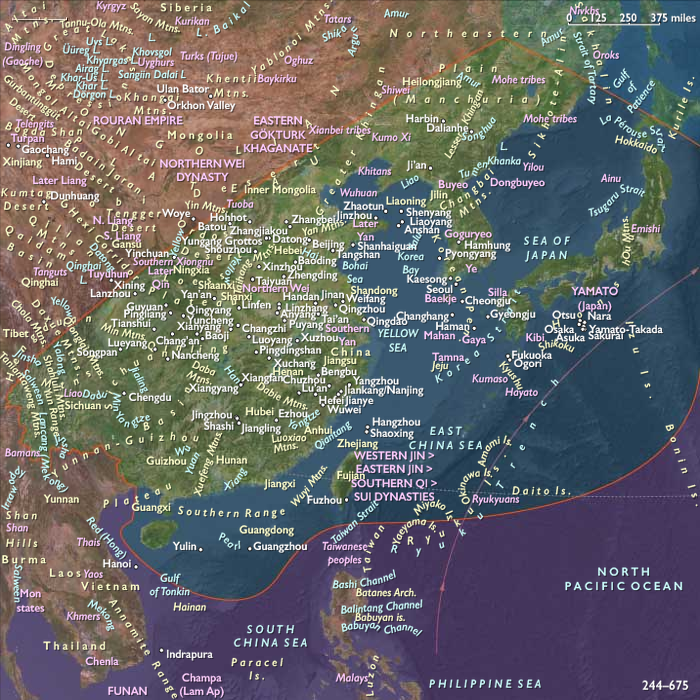
A coup begins after Sima Wei returns with his troops in 291 to Luoyang from his defense post in Jing Province—modern Hubei and Hunan.
Empress Jia, who has her husband easily under her control, has him issue an edict declaring that Yang Jun has committed crimes and should be removed from his posts.
It also orders Sima Wei and Sima Yao, the Duke of Dong'an, to attack Yang's forces and defend against counterattacks.
It quickly becomes clear that Yang is in trouble.
Empress Dowager Yang, trapped in the palace, writes an edict ordering assistance for Yang Jun and puts it on arrows, shooting them out of the palace.
Empress Jia now makes the bold declaration that Empress Dowager Yang is committing treason.
Yang Jun is quickly defeated, and his clan massacred.
Only his wife Lady Pang, the empress dowager's mother, is pardoned and allowed to live with the empress dowager.
However, Empress Jia continues to be resentful, and soon has Empress Dowager Yang deposed from her position and made a commoner, and then has Lady Pang executed, despite humble pleas from the empress dowager, who is put under house arrest inside the palace.
Initially, her closest servants are allowed to remain to serve her.
Locations
People
Groups
Topics
Commodoties
Subjects
Regions

Subregions
Related Events
Filter results
Showing 10 events out of 60115 total
Diocletian and Maximian meet in Milan on the five-year anniversary of their rule, either in late December 290 or January 291, to discuss their successes and failures.
The meeting is undertaken with a sense of solemn pageantry; the Emperors spend most of their time in public appearances.
It has been surmised by David Potter that the ceremonies were arranged to demonstrate Diocletian's continuing support for his faltering colleague.
(Potter, David S. The Roman Empire at Bay: AD 180–395.
New York: Routledge, 2005) A deputation from the Roman Senate meets with the Emperors, renewing that body's infrequent contact with the Imperial office.
The choice of Milan over Rome further snubs the capital's pride, but it is already a long established practice that Rome itself is only a ceremonial capital, as the actual seat of the Imperial administration is determined by the needs of defense.
Long before Diocletian, Gallienus (r. 253–68) had already chosen Milan as the seat of his headquarters.
If the panegyric detailing the ceremony implies that the true center of the Empire is not Rome, but where the Emperor sits ("...the capital of the Empire appeared to be there, where the two emperors met"), (Panegyrici Latini 11(3)12, qtd.
in Williams, 57.)
it simply echoes what had already been stated by the historian Herodian in the early third century: "Rome is where the emperor is".
During the meeting, decisions on matters of politics and war are probably made, but they are made in secret.
The Augusti will not meet again until 303.
Sima Liang and Wei Guan have reservations about Sima Wei's ferocity in overthrowing Yang, and they therefore try to strip him of his military command, but Sima Wei persuades Empress Jia to let him keep his military command.
Sima Wei's assistants Qi Sheng and Gongsun Hong then falsely tell Empress Jia that Sima Liang and Wei plan to depose the emperor.
Empress Jia, who already resents Wei for having, during Emperor Wu's reign, suggested that he change his heir selection, also wants more direct control over the government, and therefore resolves to undergo a second coup.
In summer 291, Jia has Emperor Hui personally write an edict to Wei, ordering him to have Sima Liang and Wei removed from their offices.
His forces surround Liang and Wei's mansions, and while both men's subordinates recommend resistance, each declines and is captured.
Against what the edict says, both are killed: Liang with his heir Sima Ju and Wei with nine of his sons and grandsons.
Qi then suggests to Sima Wei to take the opportunity to kill Empress Jia's relatives and take over the government, but Sima Wei hesitates.
At the same time, Empress Jia comes to the realization that killing Sima Liang and Wei, were her intentions to be discovered, could bring a political firestorm and that Sima Wei will not be easily controlled.
She therefore publicly declares that Sima Wei had falsely issued the edict.
Sima Wei's troops abandon him, and he is captured.
At his execution, he tries to show the edict to the official in charge of the execution, Liu Song, and Liu, knowing that Sima Wei had actually carried out the coup on Empress Jia's orders, is saddened, but still carries out the execution.
Gongsun and Qi are executed also, along with their clans.
From this point on, Empress Jia becomes the undisputed power behind the throne.
Jiaozhi had been the first name given to the land based around Hanoi and the Red River, but by 300 it has been renamed Annam (Pacified South) by its overlord, imperial China.
Galindians, Galindae, or Goliad, one of the western Baltic tribes, migrates to the Eastern end of Baltic realm around the fourth century CE, and settles around the region of present Moscow, Russia, according to one of the theories that has gained considerable traction over the years.
The Balts, defeated by the Goths around 300, remain in their ancestral homeland.
Tacitus in 98 CE had described one of the tribes living near the Baltic Sea (Mare Svebicum) as Aestiorum gentes and amber gatherers.
It is believed that these peoples were inhabitants of Sambia, the peninsula northwest of present Kaliningrad, although no other contemporary sources exist.
This homeland includes all historical Balts, and every location where Balts are thought to have been at different periods in time.
The huge area of Baltic habitation will shrink over time, due to assimilation by other groups, and to invasions.
The Influence of Egyptian Mummy Portraits on Roman Realistic Portraiture
By the late 2nd and 3rd centuries CE, Roman portraiture increasingly adopted a realistic style, emphasizing naturalistic facial features, individual expression, and depth. This shift was significantly influenced by Egyptian mummy portraits, a Greco-Roman funerary art form practiced in Roman Egypt, particularly in the Faiyum region.
1. Characteristics of Egyptian Mummy Portraits
- Mummy portraits, dating from the 1st century BCE to the 3rd century CE, were painted on wooden panels and placed over mummified bodies.
- They featured lifelike depictions, using realistic shading, depth, and individualized features, a stark contrast to the idealized sculptures of earlier Roman art.
- Techniques such as encaustic painting (pigments mixed with hot wax) and tempera allowed for a rich color palette and expressive detail.
2. The Transition to Realism in Roman Portraiture
- Earlier Roman portraiture, particularly during the Republic and early Empire, often reflected veristic (hyper-realistic) traditions, emphasizing wrinkles, age lines, and individual imperfections to highlight wisdom and experience.
- During the Antonine and Severan periods (2nd–3rd centuries CE), Roman portraits evolved further, incorporating techniques from Egyptian mummy paintings:
- More naturalistic facial features with softer modeling and shading.
- Deep-set eyes and melancholic expressions, emphasizing individual character over idealization.
- The use of painted or sculpted pupils and irises, bringing a sense of liveliness to Roman busts and statues.
3. Cultural Exchange and the Blending of Artistic Traditions
- Egypt had been under Roman control since 30 BCE, allowing for significant artistic and cultural exchanges between Greco-Egyptian and Roman traditions.
- The realism of mummy portraits found resonance in Roman society, particularly in portrait busts of emperors, senators, and elites, who sought to be remembered in a lifelike and personal manner.
- The spiritual and commemorative aspects of mummy portraits may have also influenced the Roman approach to memorial portraiture, reinforcing the idea of preserving identity beyond death.
4. Long-Term Impact on Roman Art
- The fusion of Egyptian and Roman artistic styles contributed to the evolution of Late Antique and Byzantine portraiture, where naturalism remained an important element.
- This trend influenced later European artistic movements, including Renaissance portraiture, which revived realistic shading and individualized expressions.
Conclusion: A Defining Moment in Roman Artistic Evolution
The realistic style in Roman portraiture, dominant by the 2nd and 3rd centuries CE, was deeply shaped by Egyptian mummy portraits, reflecting a broader artistic and cultural exchange within the Roman Empire. This cross-cultural influence helped define the transition from Classical idealism to Late Antique realism, leaving a lasting impact on the visual representation of identity in Western art.
Diocletian’s Persecution of Christians: The Most Extensive in Roman History (303–311 CE)
Diocletian’s commitment to an activist government and his self-image as a restorer of Rome’s past glory led him to enforce state religious unity, viewing Christianity as a threat to Roman traditions and imperial stability. This culminated in the Great Persecution (303–311 CE), the most severe and widespread persecution of Christians in Roman history.
1. Diocletian’s Vision: Restoring Roman Religious Identity
- Diocletian sought to strengthen the empire by reviving traditional Roman religious practices and reinforcing pagan cults, particularly the imperial cult.
- Christianity, which had grown significantly by the late 3rd century, was increasingly seen as subversivebecause:
- Christians refused to participate in state sacrifices and imperial worship.
- Many Christian officials and soldiers openly practiced their faith, challenging Roman authority.
- The church operated as a separate power structure, independent of imperial control.
2. The Great Persecution (303–311 CE): Imperial Decrees Against Christians
Diocletian, with encouragement from Galerius, issued a series of edicts aimed at suppressing Christianity:
- First Edict (February 303 CE)
- Ordered the destruction of Christian churches and scriptures.
- Banned Christian gatherings and removed Christians from public offices.
- Second Edict (Later in 303 CE)
- Ordered the arrest of Christian clergy, forcing them to renounce their faith or face punishment.
- Third Edict (Late 303 CE)
- Introduced amnesty for Christians who made sacrifices to Roman gods.
- Fourth Edict (304 CE)
- Required all Roman citizens to offer sacrifices to the gods, effectively criminalizing Christianity.
These edicts led to widespread persecution, including:
- Imprisonment and execution of bishops and Christian leaders.
- Destruction of churches and confiscation of Christian property.
- Torture and forced apostasy as Christians were pressured to abandon their faith.
3. The Persecution’s Effectiveness and Its Limits
- The persecution was enforced most harshly in the Eastern Roman Empire, where Galerius and Maximian ruled.
- In the West, Constantius Chlorus (father of Constantine the Great) was more lenient, destroying churches but avoiding mass executions.
- Many Christians went underground, continuing their worship in secret gatherings.
- Despite the brutality, the persecution failed to eradicate Christianity, and in many cases, martyrdom strengthened the faith.
4. The End of the Persecution and the Rise of Constantine
- In 311 CE, Galerius issued the Edict of Toleration, acknowledging that the persecution had failed and granting Christians the right to worship openly.
- In 312 CE, Constantine the Great won the Battle of the Milvian Bridge, later attributing his victory to the Christian God.
- In 313 CE, the Edict of Milan, issued by Constantine and Licinius, fully legalized Christianity, marking a turning point in Roman religious policy.
5. Conclusion: A Failed Suppression That Strengthened Christianity
Diocletian’s persecution was the largest and most systematic effort to suppress Christianity, but it ultimately failed. Instead, it:
- Created Christian martyrs, solidifying Christian identity.
- Demonstrated the limits of imperial control, as Christianity continued to spread despite official repression.
- Set the stage for Constantine’s embrace of Christianity, leading to its eventual dominance as the imperial religion of Rome.
While Diocletian sought to restore Rome’s traditional religious order, his persecution inadvertently accelerated Christianity’s rise, marking the beginning of Rome’s transformation into a Christian empire.
Diocletian’s Reforms: Strengthening the Roman Empire (Late 3rd–Early 4th Century CE)
After securing Rome’s borders through successful military campaigns, Emperor Diocletian (r. 284–305 CE)implemented a series of sweeping reforms aimed at stabilizing and strengthening the empire’s bureaucracy, military, and economy. These reforms laid the foundation for the Late Roman Empire and influenced imperial governance for centuries.
1. Administrative Reorganization: Decentralizing Power
- Diocletian restructured the provinces, creating smaller, more manageable units to prevent governors from amassing too much power.
- He expanded the number of provinces from about 50 to over 100, grouping them into larger dioceses, each overseen by a vicarius (imperial deputy).
- This system improved local governance while ensuring imperial control remained strong.
2. Military Expansion and Mobility
- Diocletian expanded the Roman army, increasing its size and mobility to better respond to threats on multiple fronts.
- He divided the military into two forces:
- Limitanei (border troops) who defended fortifications along frontiers.
- Comitatenses (mobile field armies) who could rapidly deploy to crises.
- These reforms helped secure Rome’s borders, reducing the empire’s vulnerability to external invasions.
3. Economic and Tax Reforms: A Stable Financial System
- Diocletian introduced a uniform tax code, making the system more efficient and predictable.
- He implemented the capitatio-iugatio system, which calculated taxes based on land, population, and economic productivity.
- To combat inflation, he issued the Edict on Maximum Prices (301 CE) to control wages and commodity prices, though its effectiveness was limited.
4. Legacy of Diocletian’s Reforms
- His administrative and military policies created a more centralized and efficient empire.
- While some of his economic measures failed, they set the stage for later fiscal reforms under Constantine the Great.
- His policies delayed the collapse of the Western Roman Empire and allowed the Eastern Roman (Byzantine) Empire to thrive for centuries.
Diocletian’s reforms transformed the Roman state, ensuring greater stability, security, and control, making him one of the most significant emperors in Late Antiquity.
East Central Europe (292–303 CE): Diocletian, the Tetrarchy, and Frontier Renewal
Between 292 and 303 CE, East Central Europe—covering Poland, Czechia, Slovakia, Hungary, and those portions of Germany and Austria lying east of 10°E and north of a line stretching from roughly 48.2°N at 10°E southeastward to the Austro-Slovenian border near 46.7°N, 15.4°E—ntered a significant era of stabilization and recovery under Emperor Diocletian (284–305 CE) and the newly established Tetrarchy system. The Roman provinces of Pannonia Superior, Pannonia Inferior, and Noricum experienced renewed frontier defenses, administrative reforms, and enhanced diplomatic relationships with neighboring tribal groups, significantly strengthening regional security and prosperity.
Political and Military Developments
Diocletian's Reforms and the Tetrarchy
-
Emperor Diocletian's establishment of the Tetrarchy (293 CE)—a four-emperor system—dramatically improved administrative efficiency, military responsiveness, and governance along the Danube frontier.
-
Roman military presence intensified, fortifications were systematically rebuilt or expanded, and strategic military reforms greatly improved frontier security against incursions.
Administrative Reorganization of Pannonia (296 CE)
-
In 296 CE, as part of Diocletian’s comprehensive provincial reorganization, the two previous Roman provinces of Pannonia were divided into four smaller and more manageable provinces: Pannonia Prima, Pannonia Secunda, Pannonia Savia, and Pannonia Valeria. This administrative restructuring significantly enhanced local governance, allowed more effective frontier defenses, and improved responsiveness to military and diplomatic challenges.
Strengthened Diplomatic Relations
-
Diplomatic engagements with major tribal confederations—particularly the Marcomanni, Quadi, and Iazyges—remained stable and productive under clear and effective Roman provincial management.
-
Improved diplomatic management limited incursions by the Goths and Vandals, stabilizing the region and facilitating peaceful coexistence.
Economic and Technological Developments
Economic Stability and Regional Prosperity
-
The strengthened Roman administration and security facilitated thriving cross-border commerce. Trade routes became safer and more reliable, increasing economic prosperity in frontier settlements and adjacent tribal territories.
Frontier Infrastructure Revitalization
-
Significant investments were made in roads, fortresses, bridges, and settlements, reflecting the Tetrarchy's emphasis on frontier security and economic stability. Infrastructure improvements supported commerce and military logistics.
Cultural and Artistic Developments
Cultural Renewal and Integration
-
Renewed stability encouraged vibrant cultural interactions between Roman frontier communities and neighboring tribal groups. Artistic production—ceramics, jewelry, metalwork—flourished, reflecting creative synthesis of Roman and Germanic artistic traditions.
Artistic Innovation and Flourishing
-
Stability enabled artisans to produce increasingly sophisticated and decorative objects, blending Roman craftsmanship with tribal aesthetics, creating unique cultural expressions along the frontier.
Settlement and Urban Development
Urban Expansion and Fortification
-
Frontier towns—such as Carnuntum, Vindobona, and Aquincum—experienced significant growth, fortified infrastructure expansion, and vibrant commercial revival, emerging as critical centers for trade, administration, and military logistics.
Tribal Settlement Stabilization
-
Neighboring tribal settlements consolidated their territorial and economic positions, benefiting from stable trade relations and improved diplomatic ties with Roman authorities.
Social and Religious Developments
Tribal Leadership Stability
-
Germanic and Sarmatian societies maintained stable leadership structures, increasingly focused on diplomacy, economic growth, and peaceful coexistence alongside strengthened Roman provinces.
Religious and Cultural Continuity
-
Tribal religious practices and cultural traditions continued strongly, emphasizing community cohesion, prosperity, and peaceful relationships, reflecting the relative stability of this period.
Long-Term Consequences and Historical Significance
The era 292–303 CE represented a pivotal period of frontier renewal and stabilization in East Central Europe. Diocletian’s Tetrarchic reforms, including the essential administrative restructuring of Pannonia, significantly improved Roman administrative and military effectiveness, ensuring regional stability and economic prosperity. Strengthened diplomatic relationships and revitalized cultural interactions set the foundations for sustainable regional security, influencing the subsequent historical trajectory of East Central Europe well into the fourth century.
The proto-Slavic peoples of Eastern Europe, defeated by the Goths, appear to have mostly remained where they were, although a portion of them escapes to live among the Finnish peoples of the northern forests.
