
Agrippa II, while at Rome, has voiced …
Years: 48 - 48
Agrippa II, while at Rome, has voiced his support for the Jews to Claudius, and against the Samaritans and the new procurator, Ventidius Cumanus, who was lately thought to have been the cause of some disturbances there.
On the death of Herod of Chalkis in 48 his small principality (Chalcis, Syria) is given to Agrippa, with the right of superintending the Temple in Jerusalem and appointing its high priest.
The province of Iudaea under Tiberias Julius Alexander had enjoyed a period of relative peace, but that proves to be transient, as the term of his successor Cumanus, which begins in 48, is marked by a series of serious public disturbances.
Trouble starts while Jewish pilgrims are gathered in Jerusalem for the Passover feast.
Following the precedent set by earlier governors, Cumanus assembles a detachment of Roman soldiers on the roof of the Temple portico to maintain order among the crowds, but one causes chaos by exposing himself to the Jews in the courtyard while calling out insults.
Some of the Jews bring their complaints to Cumanus, but others begin to retaliate by hurling stones at the soldiers.
Some openly accuse Cumanus of being responsible for the provocation—a sign that relations between governor and provincials may already have been poor.
Finding himself unable to calm the angry crowd, Cumanus calls for fully armed reinforcements, who assemble either in the Temple courtyard or on the roof of the Antonia Fortress, overlooking the Temple.
In the ensuing stampede, according to Josephus' estimates, between twenty and thirty thousand people are crushed to death.
These numbers may be exaggerated, but the loss of life is substantial; the feast, says Josephus, "became the cause of mourning to the whole nation". (Josephus, The Jewish War 2.223-247)
Locations
People
Groups
- Samaritans
- Jews
- Greeks, Hellenistic
- Judea (Roman province)
- Roman Empire (Rome): Julio-Claudian dynasty
Topics
Commodoties
Subjects
Regions
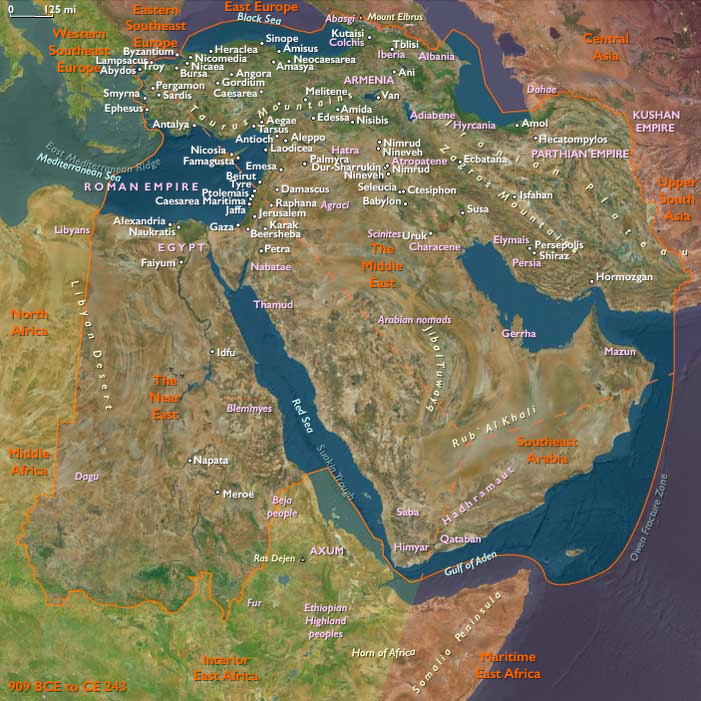
Subregions
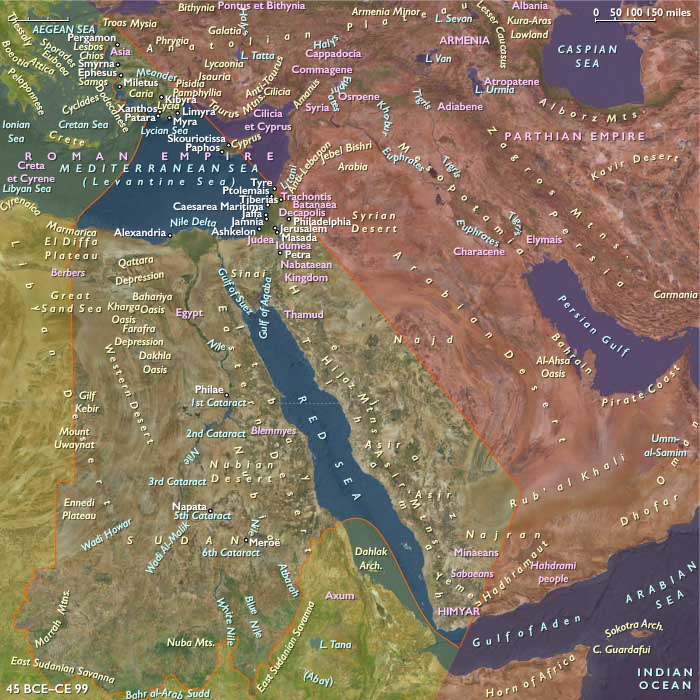
Years: 48 - 48
Locations
People
Groups
- Samaritans
- Jews
- Greeks, Hellenistic
- Judea (Roman province)
- Roman Empire (Rome): Julio-Claudian dynasty
Topics
Commodoties
Subjects
Regions
Subregions