Al-Kindi, known as al-Arab because of his …
Years: 879 - 879
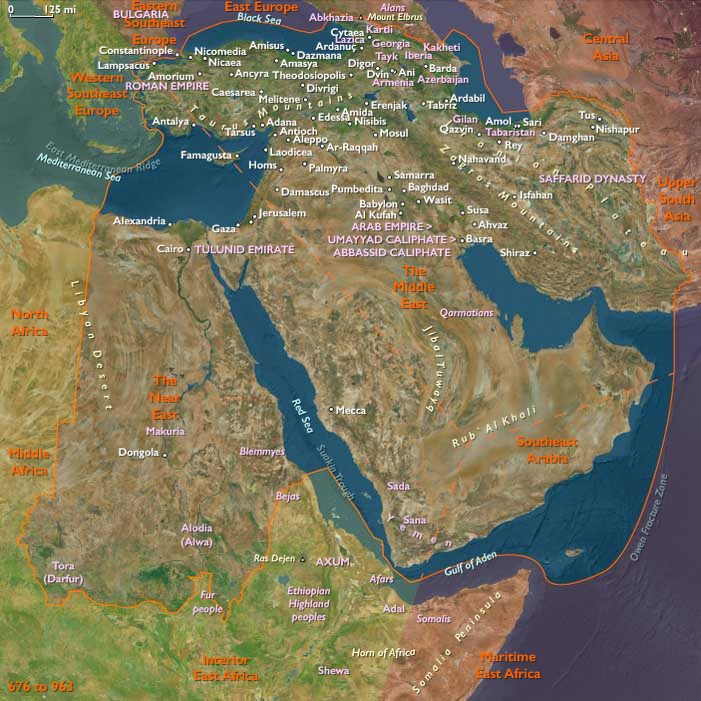
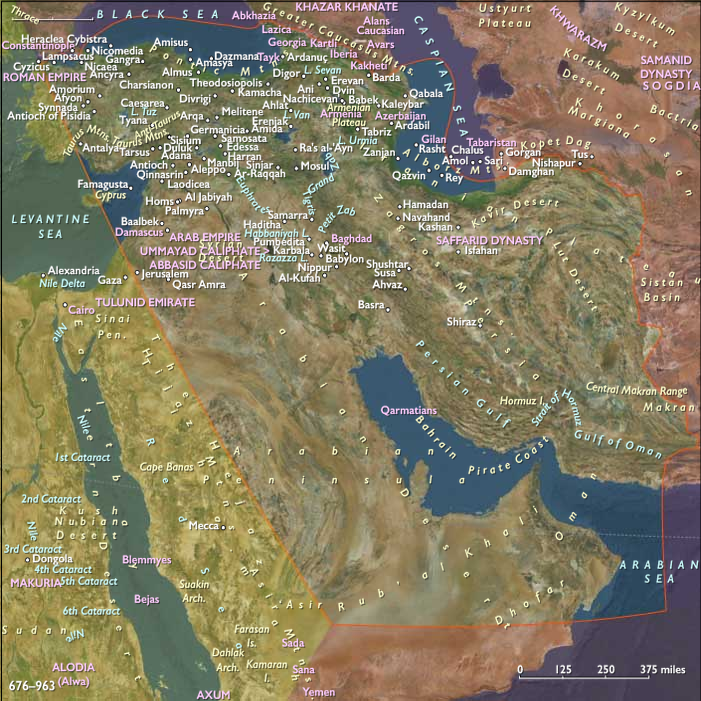
Al-Kindi, known as al-Arab because of his southern Arabian origins, serves as translator and editor of Greek philosophical works at the court of the Abbasid caliphs al-Ma'mun and al-Mutasim.
Steeped in ancient learning, he has devoted his life to its dissemination in all areas of Muslim culture.
Although eclectic in his philosophical and scientific writings, al-Kindi regards Neopythagorean mathematics as the foundation of all science; and attempts to reconcile the views of Plato and Aristotle.
Al-Kindi maintains that philosophy is inferior to revelation, but allows that revealed theology reaches the same conclusions as natural theology (philosophy).
A believer in the immortality of the individual human soul, he is unable to supply philosophical proofs for the resurrection of the body, which, he holds to be a matter of faith, not reason.
Locations
People
Groups
Topics
Subjects
Regions
Subregions
Related Events
Filter results
Showing 10 events out of 53850 total
Wang Duo had by this point volunteered to oversee the operations against Huang, and Wang is thus made the overall commander of the operations as well as the military governor of Jingnan Circuit (headquartered in modern Jingzhou, Hubei).
In reaction to Huang's movement, he commissions Li Xi to be his deputy commander, as well as the governor of Hunan Circuit (headquartered in modern Changsha, Hunan), in order to block a potential northerly return route for Huang.
Meanwhile, Huang writes Cui Qiu, the governor of Zhedong Circuit and Li Tiao, the military governor of Lingnan East Circuit (headquartered in modern Guangzhou, Guangdong), to ask them to intercede for him, offering to submit to Tang imperial authority if he were made the military governor of Tianping.
Cui and Li Tiao relay his request, but Emperor Xizong refuses.
Huang then makes a direct offer to Emperor Xizong, requesting to be the military governor of Lingnan East.
Under the opposition of the senior official Yu Cong, however, Emperor Xizong also refuses, instead, at the chancellors' advice, offering to make Huang an imperial guard general.
Huang, receiving the offer, is incensed by what he perceives to be an insult.
He attacks Lingnan East's capital Guang Prefecture in fall 879, capturing it after a one-day siege and taking Li Tiao captive.
He orders Li Tiao to submit a petition to Emperor Xizong on his behalf again, but this time, Li Tiao refuses, so he executes Li Tiao.
The Arab historian Abu Zayd Hasan of Siraf reports that when Huang Chao captured Guang Prefecture, his army killed a large number of foreign merchants resident there: Muslims, Jews, Christians, and Parsees.
The ethnicity of the killed were reported to be Persians, Arabs, and Jews.
However Chinese sources do not mention the alleged massacre, stating only that mulberry groves were ruined by his army.
However, Huang Chao's army in the Lingnan region is stricken by illnesses, and some 30-40% die.
His chief subordinates suggest that he march back north, and he agrees.
Rurik, according to the twelfth-century Russian Primary Chronicle, was one of the Rus, a Varangian tribe likened by the chronicler to Danes, Swedes, English and Gotlanders.
Twentieth century archaeologists will find that earthenware, household utensils, and types of buildings from the period of Rurik's foundation correspond to patterns then prevalent in Jutland.
There is a debate over how Rurik came to control Ladoga and Novgorod.
The only information about him is contained in the Primary Chronicle, which states that Chuds, Slavs, Merians, Vepses and Krivichs "…drove the Varangians back beyond the sea, refused to pay them tribute, and set out to govern themselves".
Afterwards the tribes started fighting each other and decided to invite Rurik to reestablish order.
The only Hrörek described in Western chronicles is Rorik of Dorestad, a konung from the royal Scylding house of Haithabu.
Since the nineteenth century, there have been attempts to identify him with the Viking prince Rurik of Russian chronicles.
Roerik of Dorestad was born about 810/820 to Ali Anulo, ninth King of Haithabu.
Frankish chroniclers mention that he received lands in Friesland from the Emperor Louis I.
This was not enough for him, and he started to plunder neighboring lands: he took Dorestad in 850, captured Haithabu in 857 and looted Bremen in 859.
The Emperor was enraged and stripped him of all his possessions in 860.
After that Roerik disappears from the Western sources for a considerable period of time.
And at that very moment, in 862, the Russian Rurik arrives in the Eastern Baltic, builds the fortress of Ladoga and later moves to Novgorod.
Roerik of Dorestad reappeared in Frankish chronicles in 870, when his Friesland demesne was returned to him by Charles the Bald; in 882 he is already mentioned as dead.
The Russian chronicle places the death of Rurik of Novgorod at 879.
According to Western sources, the ruler of Friesland was converted to Christianity by the Franks.
This may have parallels with the Christianization of the Rus', as reported by Patriarch Photius in 867.
Rurik’s successors (the Rurik Dynasty), will soon move the capital to Kiev and found the state of Kievan Rus (which will persist until 1240, the time of Mongol invasion) and ultimately the Tsardom of Russia, which they will rule until 1598.
Photios is restored to the patriarchate of Constantinople following the death of Ignatius in 878 or 879.
He convenes a great ecumenical council here at Hagia Sophia, with legates of Pope John VII present, to confirm the original form of the Nicene Creed.
Al-Muwaffaq organizes a major offensive against the Zanj in 879.
Constantinople has lost much of its former naval supremacy in the Mediterranean, but the empire under Basil still has an effective fleet, and apparently regains Cyprus, which is established as a theme, but after seven years the island will revert to the previous status quo.
Lower Burgundy is sometimes called the Kingdom of Arelat, the Kingdom of Cisjurane Burgundy, or the Kingdom of Provence.
The borders of Lower Burgundy are the Mediterranean Sea to the south, Septimania to the southwest, Aquitaine to the west, the Kingdom of Upper Burgundy to the north, and the Kingdom of Italy to the east.
Louis the Stammerer, who dies on April 10, 879, is survived by two adult sons, Louis and Carloman.
Boso renounces allegiance to both brothers and in July claims independence of the Kingdom of Provence.
On 15 October 879, the bishops and nobles of the region around the rivers Rhône and Saône assemble in the Synod of Mantaille and elect Boso king as successor to Louis the Stammerer, the first non-Carolingian king in Western Europe in more than a century.
This is the first "free election" of a king among the Franks, without regard to royal descent, though his mother was a Carolingian.
The Kingdom comprises the ecclesiastical provinces of the archbishops of Arles, Aix, Vienne, Lyon (without Langres), and probably Besançon, as well as the dioceses of Tarentaise, Uzès, and Viviers.
Charles the Fat, the twenty-eight-year-old youngest son of Louis the German, had inherited from him Alemannia (Swabia with Rhaetia) in 876.
In 879, on the resignation of his ailing brother Carloman, Charles becomes king of Italy.
Máel Sechnaill mac Máele Ruanaid, who had died November 20, 862, was on that occasion described in the Annals of Ulster as ri h-Erenn uile, king of all Ireland.
This title will never be used for Áed Findliath, king of Ailech, even though he assumes the kingship of Tara following Máel Sechnaill's death, and has also been counted in the lists of High Kings of Ireland.
His kingship will be disputed throughout his seventeen year-long reign, and he does not even have support from the southern clans of Uí Néill.
The annals show that the Taillten Fair on was not held in six of those seventeen years, which is a strong indication of strife and unrest.
The Norse Dublin had, by the beginning of Áed's reign, become an important, if not very trustworthy, ally in the struggle for power in Meath.
Máel Sechnaill's successor as head of Clann Cholmain and king of Meath, Lorcán mac Cathail, had allied himself with Amlaib, Ímar and Auisle against Flann of Brega, a former ally of Dublin, who had remained Áed's most important ally in the central part of Ireland.
Lorcán and his Norse allies had plundered Brega in 863, and in 864 Conchobar mac Donnchada, king of Lagore (southern Brega) and presumably an ally of Flann against Lorcán, had been captured and drowned near Clonard on Amlaibhs order.
Áed had led an host to Míde, captured Lorcán, and blinded him.
Áed has had some notable victories against the Norse, but the main reason for his success is probably neither that he was a military genius or a particularly gifted politician.
He had defeated the Vikings at Lough Foyle in 866 and uprooted their settlements.
Amlaíb and Auslie had left Ireland in 866 with the larger part of the Norse forces, and in cooperation with the Norse-Gaels from present day Scotland they had attacked the Picts.
Áed had seized this opportunity, plundering and burning all the Norse bases (longphorts) in the northern part of Ireland.
Áed in 868 had again been confronted by a coalition of his Irish rivals and the Norse-Gaels.
According to the Annals of Ulster, he defeated "the Uí Neíll of Brega, and the Laigin, and a large force of the foreigners" in a battle at a place called Cell Ua nDaigri.
Flann of Brega had been killed in this battle, which will later be presented as a decisive victory over the Norse.
Amlaibh and Ímar are, however, very active in Ireland during the following years and do not in any way seem to be seriously weakened, neither in ambition nor in strength.
It is probably more accurate to regard this battle as a victory over the southern Uí Neíll and Leinster.
Áed in 870 had followed up his victory by invading Leinster with the support of his new ally Cerball of Osraige, and in 874 again invaded Leinster.
Áed Findliath dies on November 20, 879, at Druim Inasclainn in the territory of Conaille.
On this occasion he is described as "king of Tara" (rex Temorie).
He is buried at Armagh.
His first cousin and stepson Flann Sinna, king of Meath from 877, succeeds to the High Kingship of Ireland.

Stela 11, the last monument ever erected at Tikal, is dedicated by Jasaw Chan K'awiil II.
It seems the great drought that ravages Central America in the ninth century, internal wars, ecological disasters and famine, have destroyed the Mayan political system, leading to popular uprisings and the defeat of the dominant political groups.
Jayavarman II, the first king of Angkor, had declared the sovereignty of the Khmer state in 802, eventually establishing his capital at Hariharalaya near modern Siem Reap in Cambodia.
A few decades later, his successors had begun constructing Bakong in stages as the first temple mountain of sandstone at Angkor, its large brick structure elaborately ornamented and filled with stonecut images.
Located in the capital’s center and surrounded by double-walled moats, the inscription on its stele (classified K.826) says that in 881 King Indravarman I dedicated the temple to the god Shiva and consecrated its central religious image, a lingam whose name Sri Indresvara is a combination of the king's own and the suffix "-esvara", which stands for Shiva ("Iśvara").
The Bakong, with one hundred and eight tower-shrines around its central sanctuary, is his state shrine; therefore, it also houses the official Śiva's liṅga.
Although his shrines are bigger than his predecessors, they are modest compared to the later shrines.
It is also the first time in Khmer architecture where nāgas—a deity or class of entity or being, taking the form of a very great snake, specifically the king cobra, found in Hinduism, Buddhism and Jainism—are employed as guardians for the bridge between the human world and the temple, house of god.