
…'Ala'-ud-Din attacks Gujarat in 1297 and subdues …
Years: 1297 - 1297
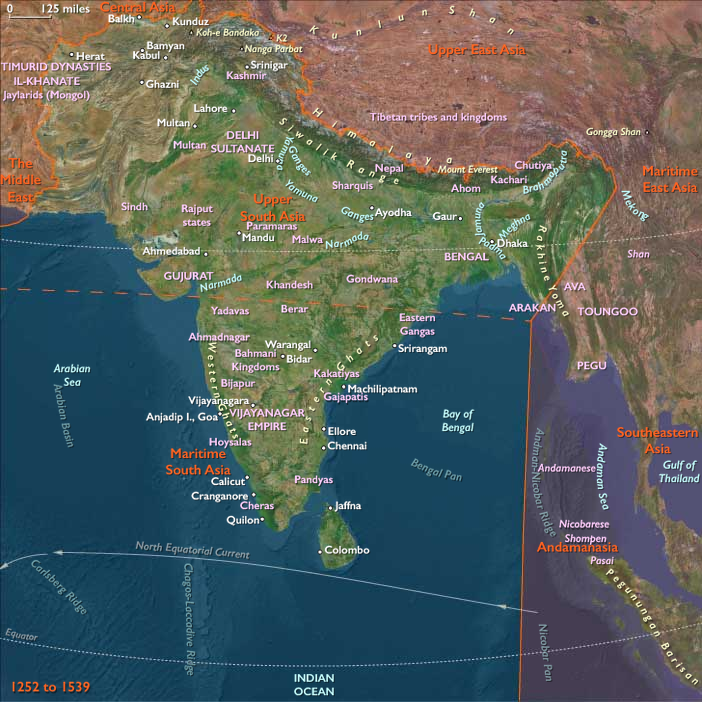
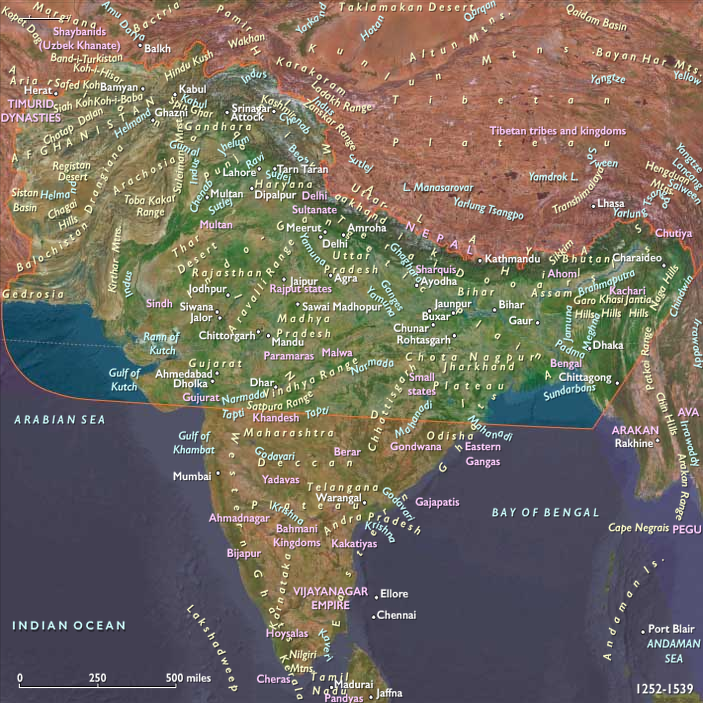
…'Ala'-ud-Din attacks Gujarat in 1297 and subdues it within the year.
With the defeat of Karandev of the Vaghela dynasty, the last Hindu ruler of Gujuarat, the region not only becomes part of the Muslim empire but the Rajput hold over Gujarat is lost forever.
Locations
People
Groups
Topics
Commodoties
Subjects
Regions
Subregions
Related Events
Filter results
Showing 10 events out of 45206 total
The Chinese diplomat Zhou Daguan, having spent a year at the court of the Khmer King Indravarman III at Angkor, sets forth his observations in a personal journal.
Ghazan arrests the Nawrūz partisans for treason in May 1297, then later in the year marches against Nawrūz himself, who is at this time the commander of the army of Khorasan.
Ghazan's forces are victorious at a battle near Nishapur.
Nawrūz takes refuge at the court of the Malik (king) of Herat in northern Afghanistan, but the Malik betrays him and delivers Nawruz to Ghazan, who has Nawruz executed immediately on August 13.
The Turks, the ultimate victors in the contest for control of the Delhi Sultanate, had established the ruling Khalji dynasty in 1290 under the elderly Jalal-ud-Din Firuz Khalji.
The second Khalji ruler, 'Ala'-ud-Din Khalji, who had assassinated his uncle to usurp his throne, determines to replenish Delhi’s treasury by subjugating the rebellious Hindu princes.
Initiating a series of raids and sieges, …
Louis IX of France, revered as a saint not long after his death on crusade in 1270, is canonized by the church in 1297.
A Portuguese Water Dog, a breed native to the Algarve, is first described in 1297 in a monk’s account of a drowning sailor who was pulled from the sea by a dog with a "black coat, the hair long and rough, cut to the first rib and with a tail tuft".
The Poodle and the Portuguese Water Dog may have developed from the same ancient genetic pool.
At one time the Poodle was a longer-coated dog, as is one variety of the Portuguese Water Dog.
The possibility also exists that some of the long-coated water dogs grew up with the ancient Iberians.
In early times, Celtiberians migrated from lands which now belong to southwestern Germany.
Swarming over the Pyrenees, circulating over the whole of western Europe, they established bases in Iberia, as well as in Ireland, Wales, and Brittany.
The Irish Water Spaniel and Kerry Blue Terrier are believed by some to be descendants of the Portuguese Water Dog.
A quarrel begins between Pope Boniface VIII and King Philip IV of France in 1296 over the question of royal taxation of the French church.
Boniface, in the bull Clericis laicos, prohibits clergy from paying taxes to secular power, arguing that taxing the church is grounds for excommunication, but threats of action against Italian banking houses—specifically, Philip’s threat to forbid the export of coins—force Boniface to give way.
Issuing, in 1297, Et si de statu, he admits the propriety of voluntary grants by churches to the state.
The king of Aragon is recognized as ruler of the Kingdom of Sardinia and Corsica by the pope As part of the treaty of Anagni, but both islands remain in practice under Pisan and Genoese control.
King Denis of Portugal: The Farmer King and the Treaty of Alcañices (1297)
King Denis (r. 1279–1325) earned the title "O Lavrador" (The Farmer King) due to his commitment to agricultural development and economic reforms, which strengthened Portugal’s self-sufficiency and trade networks.
Agricultural Reforms and Rural Development
- Denis ordered the drainage of swamps to increase arable land, improving food production.
- He promoted afforestation, particularly with the planting of pine forests, such as the Pinhal de Leiria, which later provided timber for shipbuilding.
- He implemented land redistribution policies, breaking up large estates and distributing them among peasants, increasing the number of small landowners and reducing feudal concentration of land.
Economic Growth: Fairs, Shipbuilding, and International Trade
- Denis encouraged the expansion of fairs and markets, strengthening internal commerce.
- He actively promoted shipbuilding, laying the foundation for Portugal’s maritime tradition.
- Portugal’s international trade flourished under his rule, with commercial ties established with France, England, Italy, and Flanders, securing economic prosperity and strengthening Portugal’s role in European commerce.
The Treaty of Alcañices (1297): Securing Portugal’s Borders
After years of tension with Castile, Denis achieved a historic diplomatic success by signing the Treaty of Alcañiceswith Ferdinand IV of Castile in 1297.
- This treaty defined the modern borders of Portugal, which have remained virtually unchanged to this day—making Portugal’s borders some of the oldest stable frontiers in Europe.
- Portugal secured its sovereignty, with Castile fully recognizing Portugal’s independence.
- The treaty granted Portugal definitive control over key frontier towns, including Olivença, Campo Maior, and Almeida.
- It also reinforced a mutual alliance between the two kingdoms, ensuring peace and stability.
Legacy of King Denis
Through agricultural development, economic expansion, and diplomatic achievements, King Denis secured Portugal’s stability and prosperity. His policies in land management, trade, and shipbuilding laid the groundwork for Portugal’s later dominance in maritime exploration, while the Treaty of Alcañices ensured territorial security for generations to come.
Edward I’s Failed Campaign in Flanders and the Battle of Furnes (1297)
Amid the escalating Anglo-French War (1294–1303), King Edward I of England, allied with the Count of Flanders, launched an offensive against France in an effort to reassert English rights in Gascony and Guienne, which had been seized by Philip IV of France. However, Edward’s attempt to coordinate with Flemish forces ended in failure at the Battle of Furnes (Veurne) in 1297.
Edward’s Strategy and Alliance with Flanders
- After Philip IV’s occupation of English Gascon territory (1294–1295), Edward sought continental allies to counter France’s growing power.
- In 1297, he allied with Guy of Dampierre, Count of Flanders, who had his own grievances against Philip IV due to the French king’s direct interference in Flemish affairs.
- Edward planned to cross the English Channel and link up with the Flemish army, hoping to launch a joint offensive against French forces.
The Battle of Furnes (1297): English-Flemish Coordination Fails
- As Edward crossed into Flanders, French troops under Robert II of Artois moved quickly to intercept his forces before he could join the Flemish army.
- In August 1297, at Furnes (modern-day Veurne, Belgium), the French army successfully blocked Edward's advance, disrupting the planned coordination with the Flemish troops.
- The engagement forced Edward to halt his campaign, undermining his efforts to reclaim Gascony through military means.
Consequences of the Failed Campaign
- Edward’s ambitions in France stalled, forcing him to reconsider his war strategy.
- The French victory at Furnes solidified Philip IV’s position in Flanders, weakening Flemish resistance to French rule.
- The war dragged on until 1303, leading both sides to eventually negotiate a settlement, with Edward ultimately recovering Gascony in exchange for reaffirming his vassalage to the French king.
Legacy
The defeat at Furnes exposed the logistical difficulties of English military campaigns on the continent and highlighted France’s superior ability to project power in Flanders. This Anglo-French conflict foreshadowed the tensions that would erupt into the Hundred Years’ War (1337–1453).
William Wallace, a Scottish patriot, is involved in a brawl with English soldiers, the instruments of King Edward’s recently imposed rule by calculated terror.
As an outgrowth of this incident, Wallace leads a group of men who assassinate the English sheriff of Lanark in 1297.
A rapidly spreading movement of national resistance develops.
