Andriscus’ conquest of Thessaly and alliance with …
Years: 148BCE - 148BCE
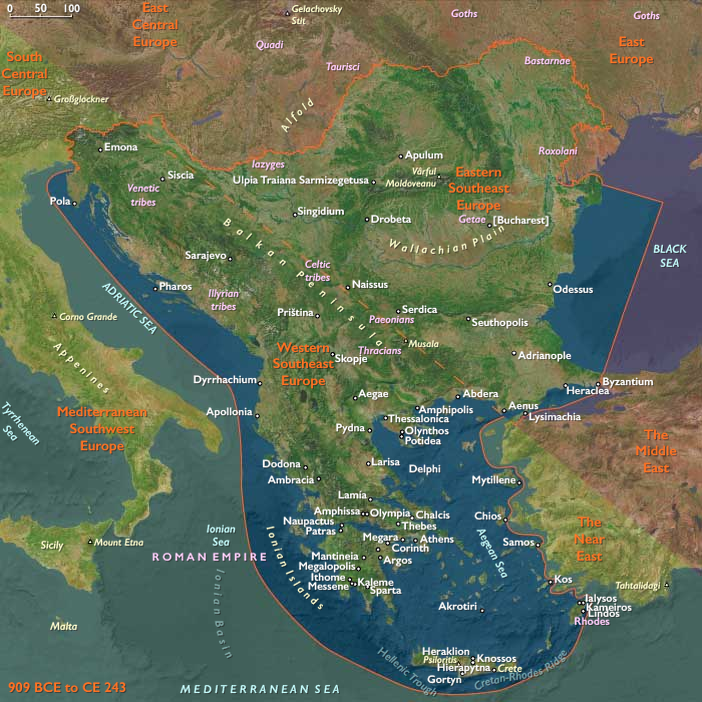
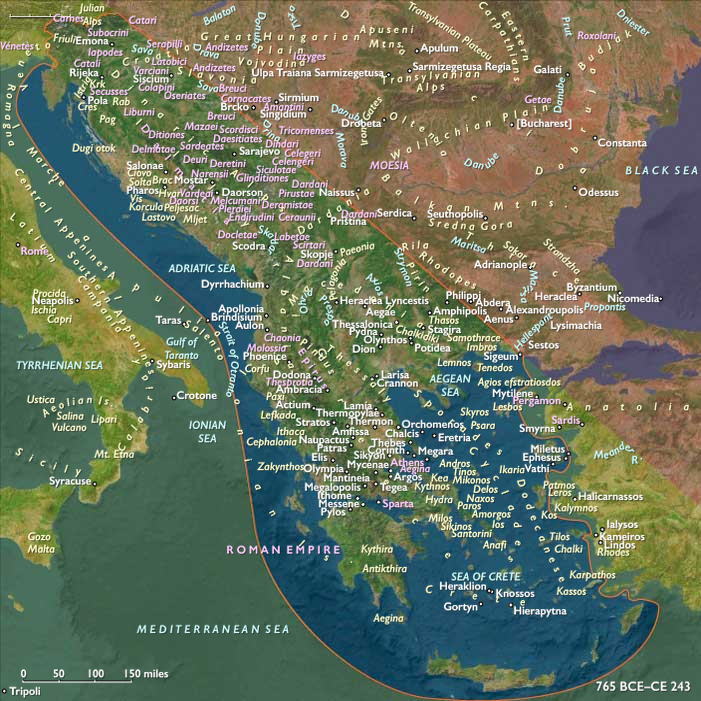
Andriscus’ conquest of Thessaly and alliance with Carthage makes the Macedonian situation dangerous.
A second Roman army under the praetor Quintus Caecilius Metellus in 148 defeats the pretender in the Second Battle of Pydna with relative ease and crushes the rebellion.
Andriscus, his brief reign marked by cruelty and extortion, flees to Thrace, whose prince gives him up to Rome.
Locations
People
Groups
Topics
Commodoties
Subjects
Regions
Subregions
Related Events
Filter results
Showing 8 events out of 8 total
Near East (1108 – 1251 CE): Ayyubid Cairo, Crusader Tyre, Nubian Resilience, and the Nicaean–Seljuk Shore
Geographic and Environmental Context
The Near East includes Israel, Egypt, Sudan, western Saudi Arabia, western Yemen, most of Jordan, southwestern Cyprus, and western Turkey (Aeolia, Ionia, Doria, Lydia, Caria, Lycia, and the Troad), plus Tyre in extreme southwest Lebanon.
-
Anchors: the Nile Valley (Egypt–Sudan), the southern Levant (with Tyre as the Near East’s sole Levantine polity), Hejaz and western Yemen along Red Sea corridors, southwestern Cyprus, and western Anatolia’s Aegean littoral.
Climate and Environmental Shifts
-
The Medieval Warm Period (c. 950–1250) modestly lengthened growing seasons in the Nile Delta and Aegean valleys.
-
Nile flood variability peaked in the late 12th century but recovered under Ayyubid hydraulic repairs.
-
Red Sea monsoon timing underpinned predictable sailing between Yemen and Egypt.
Societies and Political Developments
-
Egypt (Fatimids → Ayyubids):
-
Fatimid rule ended in 1171; Ṣalāḥ al-Dīn (Saladin) founded the Ayyubid dynasty, recentralizing Egypt, Syria, and the Hejaz under Sunni rule.
-
Cairo remained the capital; al-Azhar continued as a major center of learning.
-
-
Sudan (Nubia):
-
Christian Makuria and Alodia endured south of Egypt under the Baqṭ framework; diplomacy and intermittent raids marked the frontier.
-
-
Southern Levant (Tyre):
-
Tyre fell to the Kingdom of Jerusalem in 1124, becoming a key Crusader port and artisanal hub (glass, textiles).
-
After 1187, Ayyubid–Crusader truces and wars alternated; by 1251, Tyre remained a principal Latin stronghold and brokerage point with Egypt and Cyprus.
-
-
Western Arabia (Hejaz):
-
Mecca and Medina acknowledged Ayyubid suzerainty; Hajj caravans tied the Hejaz into Cairo’s fiscal–logistics system.
-
-
Western Yemen:
-
Sulayhids waned after Queen Arwa (d. 1138).
-
Ayyubids conquered Yemen in 1174, then Rasulids (from 1229) established a durable sultanate centered on Aden/Zabid, allied to Red Sea trade.
-
-
Southwestern Cyprus:
-
After 1191–1192, the Lusignan Kingdom of Cyprus controlled the island; its southwestern ports provisioned Crusader Syria and traded with Egypt (overtly or via truces).
-
-
Western Anatolia (Aegean coast):
-
The Komnenian recovery (to 1180) secured the littoral; Myriokephalon (1176) checked Byzantine inland advances.
-
Post-1204, the Empire of Nicaea held the Ionian/Carian coast against the Seljuks of Rum and Latin enclaves; by 1251, Nicaea dominated the Aegean shore while interior Anatolia remained Turkish.
-
Economy and Trade
-
Cairo–Nile: grain, flax, and sugar surpluses financed the Ayyubid realm; waqf endowments sustained schools and hospitals.
-
Red Sea–Indian Ocean: Aden/Zabid funneled spices, aromatics, cottons, and Indian goods to Aydhab and Qūṣfor Cairo; Yemen exported sāqiya-irrigated produce.
-
Tyre: exported fine glassware, dyed textiles, and served as a transshipment port between Egypt, Cyprus, and Crusader Syria.
-
Western Anatolia & Cyprus: wine, oil, timber, and manufactures moved through Ionian harbors and Cypriot ports, with Nicaean/Latin convoys policing lanes.
-
Nubia: traded ivory, gold, and slaves for Egyptian grain and textiles.
Subsistence and Technology
-
Hydraulics: Ayyubids dredged canals and maintained barrages after flood failures; Yemeni terraces and sāqiyawheels stabilized highland yields.
-
Institutions: Sunni education expanded via madrasas (Ayyubid patronage), while al-Azhar remained a major scholarly forum.
-
Military–fiscal: Ayyubids balanced iqṭāʿ-like land assignments with cash pay; Nicaea fielded professional troops and revived shipyards.
-
Shipbuilding: lateen-rigged merchantmen and galleys plied the Red Sea and Aegean.
Movement and Interaction Corridors
-
Nile corridor: Upper Egypt ⇄ Fusṭāṭ–Cairo ⇄ Alexandria.
-
Red Sea: Aden/Zabid ⇄ Aydhab/Qūṣ ⇄ Cairo, keyed to monsoon cycles.
-
Aegean littoral: Nicaean and Latin fleets contested Smyrna–Ephesus–Rhodes routes; southwestern Cyprus provisioned Levantine ports.
-
Pilgrimage: Hajj caravans crossed the Hejaz; Coptic and Nubian pilgrimages linked Upper Egypt and Nubia.
-
Tyre’s roadstead: remained Egypt’s key Levantine interface after 1187.
Belief and Symbolism
-
Sunni revival: Ayyubids strengthened Sunni law and institutions; jurists and Sufi networks expanded.
-
Coptic and Nubian Christianity: persisted across the Nile and Sudan; Nubian cathedrals and monasteries retained regional influence.
-
Latin Christianity: entrenched in Tyre and Cyprus; Latin and Greek rites met in contested ports.
-
Judaism: communities in Cairo and Tyre sustained trade finance and scholarship.
Adaptation and Resilience
-
Hydraulic recovery in Egypt after the 1060s crises restored agrarian stability.
-
Maritime redundancy: with much of the Levant in Latin hands after 1099, Tyre and Cyprus kept Egyptian–Aegean trade viable via truces and convoying.
-
Frontier strategy: Byzantium (Nicaea) pivoted to coastal control; Seljuk iqṭāʿ funded cavalry in interior Anatolia.
-
Hejaz–Yemen integration: monsoon schedules and Hajj logistics stabilized Red Sea commerce despite shifting overlords.
Long-Term Significance
By 1251, the Near East formed a polycentric web:
-
Ayyubid Cairo dominated Nile–Red Sea exchange and Sunni learning.
-
Tyre—now Latin—anchored Levantine trade, linking Egypt and Cyprus to Crusader and Byzantine markets.
-
Nubia remained a Christian buffer south of Egypt.
-
Western Anatolia (under Nicaea) sustained Aegean commerce while the interior Turkified under Rum Seljuks.
-
Western Yemen’s Rasulids secured Aden’s role in Indian Ocean trade.
These strands bound Nile, Hejaz–Yemen, Tyre–Cyprus, and the Aegean coast into a resilient system that would frame 13th-century confrontations and exchanges among Ayyubids/Mamluks, Crusaders, and Nicaea/Rum Seljuks.
Kilij Arslan, Sultan of Rüm, had conquered Mosul in 1107, but had been defeated in the Battle of the Khabur River by Emir Jawali al-Saqawu for Muhammad I of Great Seljuq, supported by the Artuqids and Radwan of Aleppo, at the Battle of Mosul.
He had drowned in the river while retreating from Mosul.
His son, Malik Shah, kept prisoner in Isfahan, returns to Anatolia in 1100 to assume his father's succession in Konya.
The Turks have resumed their offensive operations against the Empire following the success of the First Crusade and the failure of the Crusade of 1101.
Emperor Alexios, aged and suffering from an illness that will prove to be terminal, is unable to deal with the swift Turkish raids into what remains of Roman Anatolia, penetrating as far as the Bosporus, but internal dissension has caused disunity following the death of Sultan Kilij Arslan.
Nonetheless, in the aftermath of the Frankish invasions, much land has been reconsolidated by the Seljuq Turks under the centralized authority of Iconium, where the Sultanate of Rum has established itself under Malik Shah.
After the imperial forces thwart an attempt to take Nicaea in 1113, the Seljuq Turks make a forced withdrawal across Anatolia.
Fakhr al-Muk Radwan, Seljuq ruler of Aleppo, had frequently come into conflict with Tancred until the latter reduced Aleppo to a tributary state in 1111.
The qadi of Aleppo, Ibn al-Khashshab, had traveled to Baghdad to meet with the Abbasid caliph when Radwan was unwilling to pursue war with Tancred.
Ibn al-Khashshab had succeeded in having Mawdud of Mosul sent to Aleppo's aid, but Radwan was also antagbeen murdered by the Hashshashin, possibly with Radwan's approval.
Upon his death on December 10, 1113, Radwan is succeeded by his teenage son Alp Arslan al-Akhras, under the regency of Lulu and ibn al-Khashshab.
Lulu does not continue Radwan's policy of support for the Hashshashin, and has them all expelled or killed, although this leaves Aleppo without any powerful allies.
The city falls into near chaos, and soon comes under the control of Sulaiman, Ilghazi's son, who had married Radwan's daughter.
Alexios is able to personally take the field in 1116 and is engaged in defensive operations in northwest Anatolia.
Basing his army at Lopadion, and later at Nicomedia, he conducts a series of defensive operations in Bithynia and Mysia to defend his Anatolian territories against the inroads of Malik Shah.
He succeeds in defeating raiding Turks in a minor battle at Poemanenon and, after receiving reinforcements to his army, decides to move onto the offensive.
Alexios leads a sizable imperial army deep into the Anatolian interior in the campaign of Philomelion.
Anna Komnene, the primary source for the campaign, implies that the Seljuq capital of Iconium was the goal of the expedition, but evidently Alexios abandoned this plan and contented himself with staging a conspicuous show of force and evacuating the native Christian population from the Turkish dominated areas his army passed through.
The imperial forces are to employ a new battle formation of Alexios' devising, the parataxis.
Anna Komnene's description of this formation is so imprecise as to be useless.
However, from her account of the army in action, it is obvious that the parataxis was a defensive formation, a hollow square with the baggage in the center, infantry on the outside and cavalry in-between, from whence they could mount attacks.
This is an ideal formation for tackling the fluid Turkish battle tactics, reliant on swarm attacks by horse-archers.
A similar formation will later be employed by Richard I of England at the Battle of Arsuf.
The imperial army moves through Santabaris, sending detachments via Polybotos and Kedros, and, after dispersing Turkish resistance, takes Philomelion by assault.
Parties of scouts are then sent out to round up the local Christian population for evacuation to areas under firm imperial control.
Alexios becomes aware that a substantial Seljuq army is approaching from the north and begins his retreat to his own territory.
His army resumes its defensive formation with the civilians accompanying the baggage in the center.
The Turks, under an officer called Manalugh, are initially baffled by the imperial formation and do not attack with any vigor.
However, the following day Sultan Malik Shah arrives and the imperial army is attacked in earnest.
The Turks mount a simultaneous attack on the van and rear of the army.
The imperial cavalry makes two counterattacks: the first seems to have been unsuccessful, with Alexios' son Andronikos being killed.
A further counterattack is more fortunate, led by Nikephoros Bryennios the Younger (Anna Komnene's husband and Alexios' son-in-law) the leader of the imperial right wing, it breaks that part of the Turkish force led in person by the Sultan, which then turns to flight.
Malik Shah narrowly escapes capture.
The Seljuqs then make a night attack, but the imperial dispositions again frustrate them.
The following day, Malik Shah again attacks, his troops completely surrounding the Byzantine army on all sides.
The Turks are once more repulsed with loss, having achieved nothing.
The next day Malik-Shah sends to Alexios with proposals for peace.
Alexios and Malik Shah meet, Alexios throwing his own costly cloak around the sultan's shoulders.
A peace involving an undertaking by Malik Shah to stop Turkish raiding and an admission by the sultan of some measure of, largely theoretical, dependence on the emperor is made.
Anna Komnene records that the peace treaty involved an undertaking by Malik Shah to evacuate Anatolia, but this is unlikely in the extreme and must represent hyperbole on her part.
The campaign is remarkable for the high level of discipline shown by the imperial army.
Alexios has demonstrated that he can march his army with impunity through Turkish dominated territory.

The reverse suffered by Malik Shah at Philomelion has caused him to lose prestige.
Amir Gazi Gümüshtigin Danishmend, who had come to power in Sivas after the death of his father, intervenes in dynastic struggles among the sons of Qïlïj Arslan and helps his son-in-law Rukn al-Dīn Masud to seize power at Konya in 1116; Masud later blinds his brother and eventually murders him.
The acceptance by the Seljuqs of Rüm of a truce with Constantinople permits the empire to reclaim all the coastal areas by 1117.
Imperial prestige is higher than it has been for many years, but the empire can barely afford to sustain the part of a great power.
Alexios has reconstituted the army and recreated the fleet, but only by means of stabilizing the gold coinage at one-third of its original value and by imposing a number of supplementary taxes.
It has become normal practice for taxes to be farmed out, which means that the collectors recoup their outlay on their own terms.
People in the provinces have the added burden of providing materials and labor for defense, communications, and provisions for the army, which now includes very large numbers of foreigners.
The supply of native soldiers has virtually ceased with the disappearance or absorption of their military holdings.
Alexios promotes an alternative source of native manpower by extending the system of granting estates in pronoia (by favor of the emperor) and tying the grant to the military obligation.
The recipient of a pronoia is entitled to all the revenues of his estate and to the taxes payable by his tenants (paroikoi), on condition of equipping himself as a mounted cavalryman with a varying number of troops.
He is in absolute possession of his property until it reverts to the crown upon his death.
Similarly, Alexios tries to promote more profitable development of the estates of the church by granting them to the management of laymen as charistikia or benefices.
As an expedient, the pronoia system has advantages both for the state and for the military aristocracy who are its main beneficiaries, but in the long term, it will hasten the fragmentation of the empire among the landed families and the breakdown of centralized government that the tenth-century emperors had labored to avert.