Angad, one of the disciples of Nanak, …
Years: 1539 - 1539
Angad, one of the disciples of Nanak, founder of Sikhism, is chosen by Nanak as his spiritual successor, and following Nanak’s death at Kartapur in 1538 or 1539, Angad assumes the leadership of the young Sikh community as Guru Angad.
Locations
People
Groups
Topics
Subjects
Regions
Subregions
Related Events
Filter results
Showing 10 events out of 37518 total
King Tabinshwehti attacks the Mon people inhabiting Chiang Kran, a vassal state of Ayuttahya, in 1539.
Marching against Chiang Kran with the aid of one hundred and twenty Portuguese traders in Ayutthaya, Chairachathirat drives the Burmese back.
Tabinshwehti now allows the Portuguese to build a church near the Takhian Canal, south of Ayutthaya's city island, to practice their religion.
Narapati has remained a nominal vassal to Confederation-controlled Ava.
Although his authority does not extend beyond the immediate region around Prome, he has become ensnarled in the Toungoo–Hanthawaddy War.
An ally of King Takayutpi of Hanthawaddy, Narapati is married to Takayutpi's sister, and provides shelter to the fleeing Hanthawaddy troops in 1539.
When Toungoo troops attack the heavily fortified Prome, Narapati asks for help from the Confederation in Ava, which has neglected to intervene in the first four years of Toungoo–Hanthawaddy Wa in Lower Burma.
Now finally appreciating the gravity of the situation, the saophas finally band together and send in a force to relieve Prome.
The Confederation troops break the siege, then refuse to follow up on the retreating Toungoo armies.
Narapati forms an alliance with the Mrauk U Kingdom of Arakan by sending his sister and his queen (Takayutpi's sister) to King Min Bin of Mrauk U.
(Takayutpi had died soon after the battle.)
Narapati too dies soon after and is succeeded by Minkhaung.
Min Bin has turned Mrauk-U into a serious regional power by the late 1530s.
Not only does he control the entire Arakan littoral to Chittagong but he also has built up a powerful navy and an army that includes many Portuguese mercenaries.
He closely monitors the developments in mainland Burma with great concern, however,especially after Toungoo's unlikely victory over Hanthawaddy that gives upstart the upstart Burmese principality control of Lower Burma.
He does not want to see a strong, united Irrawaddy valley, which in the past had interfered with the coastal kingdom.
When King Minkhaung of Prome, the only holdout in Lower Burma and a vassal of the Confederation of Shan States, asks for an alliance by presenting his sister, the former queen of Hanthawaddy, Min Bin readily agrees.
Pegu becomes the capital of Tabinshwehti’s united Burmese kingdom in 1539.
Italian printmaker, goldsmith, medalist, and gem engraver Giovanni Jacopo Caraglio, a pupil of Marcantonio Raimondi, achieves distinction as an engraver.
His copperplates (seventy of which are extant) are chiefly reproductions of the Italian masters, such as Raphael, Titian, and Michelangelo.
Active in Parma and in Rome, he moves in 1539 to Kraków, where he enters the service of the Polish court.
King Sigismund of Poland had in 1518 married Bona Sforza d'Aragona, a young, strong-minded Italian princess.
Bona's sway over the king and the magnates, her efforts to strengthen the monarch's political position, financial situation, and especially the measures she took to advance her personal and dynastic interests, including the forced royal election of the minor Sigismund Augustus in 1529 and his premature coronation in 1530, have increased the discontent among szlachta activists.
The opposition middle szlachta movement comes up with a constructive reform program during the Kraków sejm of 1538/1539.
Among the movement's demands are termination of the kings' practice of alienation of royal domain, giving or selling land estates to great lords at the monarch' discretion, and a ban on concurrent holding of multiple state offices by the same person, both legislated initially in 1504.
Sigismund I's unwillingness to move toward the implementation of the reformers' goals negatively affects the country's financial and defensive capabilities.
John, who neither consults nor informs Süleyman of his agreement with Ferdinand, marries within the year.
Mimar Sinan, a Greek Orthodox Christian by birth, had been conscripted at twenty in 1512 under the devshirme system.
Sinan had grown up helping his father, a stonemason and carpenter by the name of Christos, in his work, and by the time that he was conscripted would have had a good grounding in the practicalities of building work.
Sent to Constantinople to be trained as an officer of the Janissary Corps and converted to Islam, hewas too old to be admitted to the imperial Enderun School in the Topkapı Palace but was sent instead to an auxiliary school.
Some records claim that he might have served the Grand Vizier Pargalı İbrahim Pasha as a novice of the Ibrahim Pasha School.
Possibly, he was given the Islamic name Sinan there.
He initially learned carpentry and mathematics but through his intellectual qualities and ambitions, he soon assisted the leading architects and got his training as an architect.
During the next six years, he had also trained to be a Janissary officer (acemioğlan).
He possibly joined Selim I in his last military campaign, Rhodes, according to some sources, but when the Sultan died, this project ended.
Two years later he witnessed the conquest of Belgrade.
Under the new sultan, Suleiman the Magnificent, he had been present, as a member of the Household Cavalry, at the Battle of Mohács.
He was promoted to captain of the Royal Guard and then given command of the Infantry Cadet Corps.
He was later stationed in Austria, where he commanded the 62nd Orta of the Rifle Corps.
He became a master of archery, while at the same time, as an architect, learning the weak points of structures when gunning them down.
In 1535 he had participated in the Baghdad campaign as a commanding officer of the Royal Guard.
In 1537 he had gone on expeditions to Corfu and Apulia and Moldavia.
During these campaigns he has proved himself an able architect and engineer.
During the campaign in the East, he had assisted in the building of defenses and bridges, such as a bridge across the Danube.
He has converted churches into mosques.
During the Persian campaign in 1535 he had built ships for the army and the artillery to cross Lake Van.
For this he had been given the title Haseki'i, Sergeant-at-Arms in the body guard of the Sultan, a rank equivalent to that of the Janissary Ağa.
When Chelebi Lütfi Pasha becomes Grand Vizier in 1539, he appoints Sinan, who had previously served under his command, to the office of Architect of the Abode of Felicity.
This is the start of a remarkable career.
The job entails the supervision infrastructure construction and the flow of supplies within the Ottoman Empire.
He is also responsible for the design and construction of public works, such as roads, waterworks and bridges.
Through the years he transforms his office into that of Architect of the Empire, an elaborate government department, with greater powers than his supervising minister.
He becomes the head of a whole Corps of architects, training a team of assistants, deputies and pupils.
Sinan is primarily concerned with the solution of the spatial problems inherent in flanking the central domes of mosques with minor domes in order to extend the breadth of the principal hall.

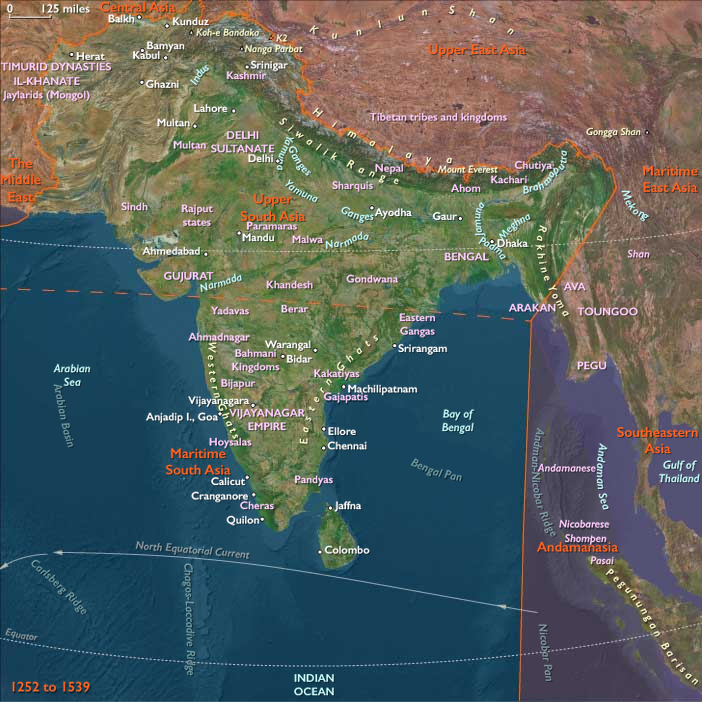
Sher Khan conquers Bengal in early 1539 and, through clever deception, the Rohtas stronghold southwest of Bengal.
Sher Khan defeats Humayun at the Battle of Chausa on June 26, 1539; Humayun escapes to Agra.