
Antoine Watteau was born in the town …
Years: 1717 - 1717
August
Antoine Watteau was born in the town of Valenciennes, which had recently passed from the Spanish Netherlands to France.
His father was a master tiler.
Showing an early interest in painting, he had been apprenticed to Jacques-Albert Gérin, a local painter.
Having little to learn from Gérin, Watteau had left n about 1702 for Paris, where he had found employment in a workshop at Pont Notre-Dame, making copies of popular genre paintings in the Flemish and Dutch tradition; it was in this period that he had developed his characteristic sketchlike technique.
He was employed in 1703 as an assistant by the painter Claude Gillot, whose work represented a reaction against the turgid official art of Louis XIV's reign.
Watteau had become acquainted in Gillot's studio with the characters of the commedia dell'arte (its actors had been expelled from France several years before), a favorite subject of Gillot's that will become one of Watteau's lifelong passions.
Afterward, he had moved to the workshop of Claude Audran III, an interior decorator, under whose influence he began to make drawings admired for their consummate elegance.
Audran is the curator of the Palais du Luxembourg, where Watteau has been able to see the magnificent series of canvases painted by Peter Paul Rubens for Queen Marie de Medici.
The Flemish painter will become one of his major influences, together with the Venetian masters he will later study in the collection of his patron and friend, the banker Pierre Crozat.
Watteau had tried in 1709 to obtain the Prix de Rome and was rejected by the Academy.
He tried again in 1712 and was by then considered so good that, rather than receiving the one-year stay in Rome for which he had applied, he had been accepted as a full member of the Academy.
Watteau is expected to present the customary reception piece.
Although he has been given unusual freedom in choosing a subject for his painting, his failure to submit a work has brought several reprimands.Meanwhile, Watteau has worked on numerous private commissions that his rising reputation have brought him.
Finally, in January, 1717, the Academy calls Watteau to task, and in August of this year he presents his painting, which had been painted quickly in the preceding eight months.
Once submitted, the painting causes the Academy to invent a new classification for it, since the subject is so striking and new.
This results in the fête galantes (elegant fêtes or outdoor entertainments), a genre that will subsequently be practiced by imitators of Watteau, such as Jean-Baptiste Pater and Nicolas Lancret.
The painting portrays a "fête galante"; an amorous celebration or party enjoyed by the aristocracy of France during the Régence after the death of Louis XIV, which is generally seen as a period of dissipation and pleasure, and peace, after the somber last years of the previous reign.
The work celebrates love, with many cupids flying around the couples and pushing them closer together, as well as the statue of Venus (the goddess of sexual love).
There are three pairs of lovers in the foreground.
While the couple on the right by the statue are still engaged in their passionate tryst, another couple rises to follow a third pair down the hill, although the woman of the third pair glances back fondly at the goddess’s sacred grove.
At the foot of the hill, several more happy couples are preparing to board the golden boat at the left.
With its light and wispy brushstrokes, the hazy landscape in the background does not give to any clues whether it is spring or fall, dawn or dusk.
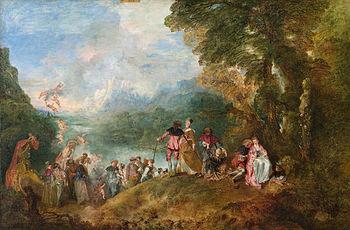
Jean-Antoine Watteau: The Embarkation for Cythera (Louvre version): Many commentators note that it depicts a departure from the island of Cythera, the birthplace of Venus, thus symbolizing the brevity of love.
Locations
People
Groups
Topics
Subjects
Regions
Subregions
Related Events
Showing 4 events out of 4 total
Years: 1717 - 1717
August
Jean-Antoine Watteau: The Embarkation for Cythera (Louvre version): Many commentators note that it depicts a departure from the island of Cythera, the birthplace of Venus, thus symbolizing the brevity of love.
Locations
People
Groups
Topics
Subjects
Regions
Subregions