
Argovia or Argowe had been a disputed …
Years: 1416 - 1416
Argovia or Argowe had been a disputed border region between the duchies of Alamannia and Burgundy in early medieval times.
A line of the von Wetterau (Conradines) had intermittently held the countship of Aargau from 750 until about 1030, when they lost it (having in the meantime taken the name von Tegerfelden).
From the extinction in 1254 of the Hohenstaufen dynasty, the area has been ruled by the Habsburgs.(Many castles from this time still stand; examples include Habsburg, Lenzburg, Tegerfelden, Bobikon, Stin and Wildegg. The Habsburgs had founded a number of monasteries, with some structures enduring, e.g., in Wettingen and Muri, the closing of which by the government in 1841 was a contributing factor to the outbreak of the Swiss civil war—the "Sonderbund War”—in 1847.)
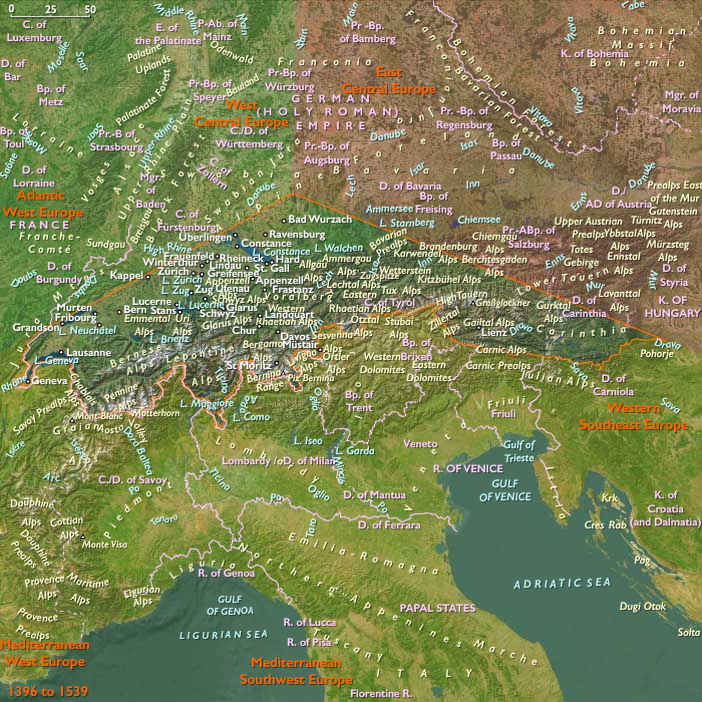
When Frederick IV of Habsburg, Duke of Further Austria, sides with Antipope John XXIII at the Council of Constance, Emperor Sigismund places him under the Imperial ban.
Shortly thereafter in 1415, Bern and the rest of the Swiss Confederation use the ban as a pretext to invade Aargau.
The Confederation is able to quickly conquer the towns of Aarau, Lenzburg, Brugg and Zofingen along with most of the Habsburg castles.
Bern keeps the southwest portion (Zofingen, Aarburg, Aarau, Lenzburg, and Brugg).
Some districts, named the Freie Ämter (free bailiwicks) – Mellingen, Muri, Villmergen, and Bremgarten), with the countship of Baden – are governed as "subject lands" by all or some of the Confederates.
The rest of the Freie Ämter are collectively administered as subject territories by the rest of the Confederation.
Muri Amt is assigned to Zurich, Lucerne, Schwyz, Unterwalden, Zug and Glarus, while the Ämter of Meienberg, Richensee and Villmergen are first given to Lucerne alone.
Locations
People
Groups
- Austria, Archduchy of
- Holy Roman Empire
- Swiss Confederacy, Old (Swiss Confederation)
- Schwyz, Imperial (Free) City of
- Lucerne, Swiss Canton of
- Obwalden, Swiss Canton of
- Nidwalden, Swiss Canton of
- Zürich, Swiss Canton of
- Bern, Swiss Canton of
- Glarus, Swiss Canton of
- Zug, Swiss Canton of
Topics
Commodoties
Subjects
Regions

Subregions
Years: 1416 - 1416
Locations
People
Groups
- Austria, Archduchy of
- Holy Roman Empire
- Swiss Confederacy, Old (Swiss Confederation)
- Schwyz, Imperial (Free) City of
- Lucerne, Swiss Canton of
- Obwalden, Swiss Canton of
- Nidwalden, Swiss Canton of
- Zürich, Swiss Canton of
- Bern, Swiss Canton of
- Glarus, Swiss Canton of
- Zug, Swiss Canton of
Topics
Commodoties
Subjects
Regions
Subregions