
Arnulf, later known as Arnulf the Bad, …
Years: 907 - 907
Arnulf, later known as Arnulf the Bad, was born into the Luitpolding dynasty.
The year of his birth is unknown, but it is said that he was the namesake of other Arnulfs and so would have been born around the time of the reign of Arnulf the seventh century bishop of Metz and the Carolingian king Arnulf of Carinthia.
Arnulf is the son of Margrave Luitpold of Bavaria and Cunigunda, daughter of Berthold I, the count palatine of Swabia.
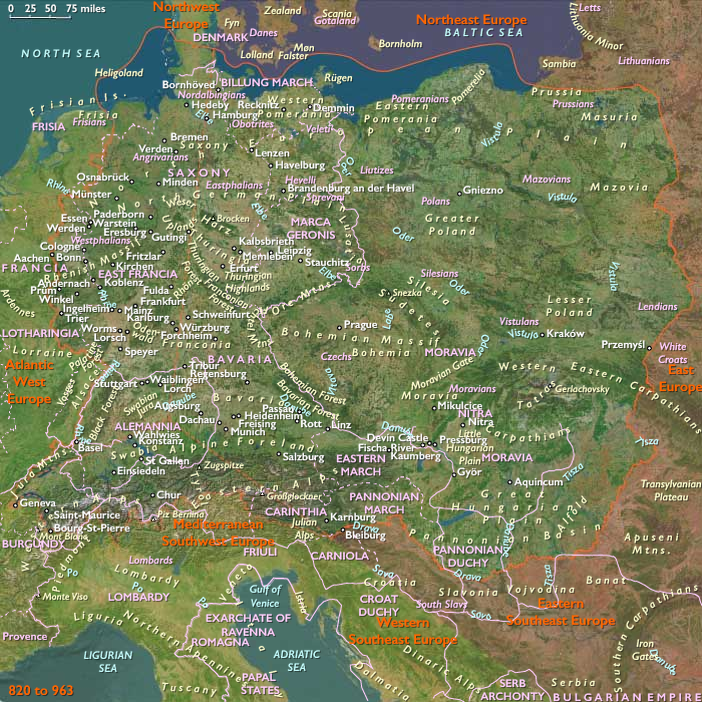
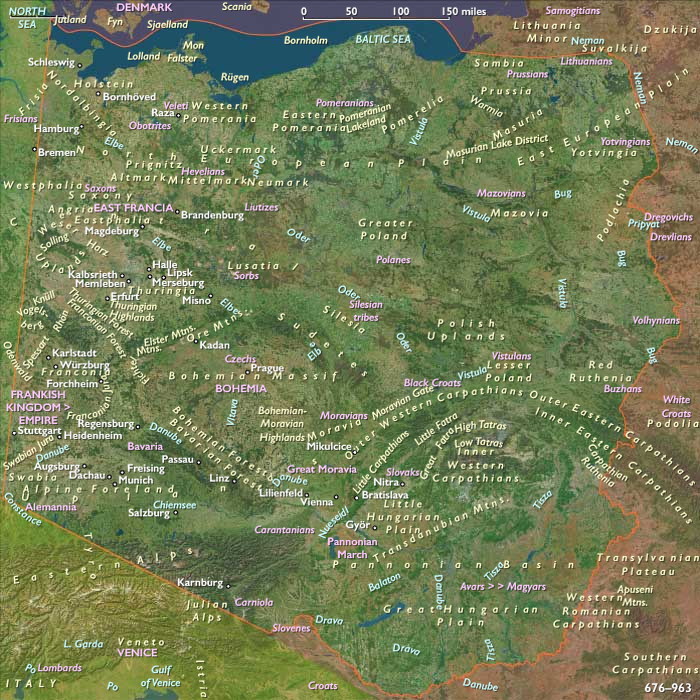
During the Battle of Pressburg (Bratislava) in 907, the Bavarian lead forces under the command of his father Luitpold are defeated in an attack against the Magyars, who kill Liutpold and many high nobles.
The Hungarian victory stabilizes the situation of the Hungarian state.
The Germans will not attack Hungary for more than a hundred years.
The Hungarian threat to the emerging German kingdom will persist for decades.
Locations
People
Groups
- Franks
- Bavaria, Carolingian Duchy of
- Saxony, Duchy of
- Francia Orientalis (East Francia), Kingdom of
- Pannonia, March of
- Hungary, Principality of
- Bavaria, Luitpolding Duchy of
Topics
Commodoties
Subjects
Regions
Subregions
Related Events
Filter results
Showing 10 events out of 13 total
The Foundation of the Abbaye aux Dames in Caen (1066)
In 1066, Matilda of Flanders, the wife of Duke William of Normandy (later William the Conqueror), established the Abbaye aux Dames ("Women's Abbey") in Caen, the Norman capital. This abbey, dedicated to the Holy Trinity, became one of the most important religious institutions in Normandy, serving both spiritual and political functions.
Context: A Penance for William and Matilda’s Marriage
- William and Matilda’s marriage had initially been forbidden by Pope Leo IX in 1049 on the grounds of consanguinity (they were distant cousins).
- To secure papal approval, William and Matilda had agreed to perform penance, which led to the founding of two great monastic houses in Caen:
- Abbaye aux Hommes ("Men’s Abbey"), founded by William.
- Abbaye aux Dames ("Women’s Abbey"), founded by Matilda.
Architecture and Influence
- Built in the Norman Romanesque style, the abbey features:
- Massive stone construction, characteristic of Norman architecture.
- Round arches and a symmetrical layout, reflecting the evolving Romanesque tradition.
- A large nave and semicircular apse, designed to accommodate pilgrims and religious ceremonies.
- The abbey was dedicated to the Holy Trinity, reinforcing its religious significance.
- Alongside the Abbaye aux Hommes, it stood as a symbol of Norman power and piety.
Legacy and Importance
- Matilda of Flanders was buried in the Abbaye aux Dames in 1083, making it a dynastic resting place for the Norman ruling family.
- The abbey became a major center of female monasticism in Normandy, housing Benedictine nuns and playing a role in educating noblewomen.
- The Norman Conquest of England in 1066 increased the abbey’s prestige, as it was closely linked to William’s dynasty and his rise to kingship.
- The twin abbeys in Caen—both Abbaye aux Hommes and Abbaye aux Dames—stood as lasting monuments to the Norman ducal family, reinforcing their ties to the Church and their political legitimacy.
The foundation of the Abbaye aux Dames in 1066 was not only a religious act of devotion by Matilda, but also a crucial part of Norman statecraft, solidifying the dynasty’s spiritual and political legacy in Normandy and beyond.
Baldwin V of Flanders: Power Broker of France and England (1060–1067)
By the 1060s, Baldwin V of Flanders had risen to prominence as one of the most influential political figures in Western Europe, playing a crucial role in French, English, and Norman affairs. His position as co-regent of France, Count of Maine, and father-in-law to William of Normandy placed him at the center of major geopolitical events leading up to the Norman Conquest of England.
Baldwin as Co-Regent of France (1060–1066)
- Upon the death of King Henry I of France in 1060, Baldwin was appointed co-regent alongside Queen Anne of Kiev, for the young Philip I of France.
- His selection as regent highlights his diplomatic influence and the strategic importance of Flanders in Capetian politics.
- While Baldwin generally supported the Capetian crown, his position was complicated by his close ties to William of Normandy, who had married Baldwin’s daughter, Matilda of Flanders.
Baldwin’s Influence on English Affairs
- Flanders played a key role in Edward the Confessor’s foreign policy, as Edward had familial and diplomatic ties to Baldwin’s court.
- Harold Godwinson may have passed through Flanders on his way to Germany in 1064, possibly to negotiate the return of Edward the Atheling from Hungary.
- Baldwin’s half-sister had married Tostig Godwinson, further intertwining Flemish and Anglo-Saxon noble families.
Baldwin’s Position on the Norman Conquest of England (1066)
- Despite his close connections to both England and Normandy, Baldwin did not intervene to stop William’s invasion in 1066.
- This was likely because Baldwin had lost control of Ponthieu, making it less feasible to challenge William militarily.
- By 1066, Baldwin was aging, and his diplomatic influence was waning, though his alliances still shaped the political landscape of the era.
Death and Legacy (1067)
- Baldwin V died in 1067, shortly after William’s victory at the Battle of Hastings (1066).
- His daughter, Matilda, became Queen of England, strengthening Norman-Flemish ties.
- His role as regent of France, supporter of Edward the Confessor, and father-in-law to William of Normandy made him a key player in 11th-century European politics.
Baldwin V’s political maneuvering, strategic marriages, and influence in France, England, and Normandy secured his legacy as a kingmaker, helping to shape the power struggles that culminated in the Norman Conquest of England.
William had taken Stigand with him to Normandy in 1067, although whether this was because William did not trust the archbishop, as the medieval chronicler William of Poitiers alleges, is not certain.
When William was preparing to invade England, his wife Matilda had outfitted a ship, the Mora, out of her own money and gave it to him.
This indicates that she must have owned rich lands in Normandy to be able to do so.
Additionally, William had entrusted Normandy to his wife during his absence.
Matilda had successfully guided the duchy through this period in the name of her fourteen-year-old son; no major uprisings or unrest had occurred.
Even after William conquered England and became its king, it takes her more than a year to visit her new kingdom.
Matilda is crowned queen on May 11, 1068, in Westminster during the feast of Pentecost, in a ceremony presided over by the archbishop of York; Stigand is present as well.
Three new phrases are incorporated to cement the importance of English consorts, stating that the Queen is divinely placed by God, shares in royal power, and blesses her people by her power and virtue.
William had adopted a policy of conciliation towards the church after the first rebellions broke out in late 1067, giving Stigand a place at court, as well as giving administrative positions to Ealdred of York and Æthelwig, Abbot of Evesham.
Archbishop Stigand appears on a number of royal charters in 1069, along with both Norman and English leaders.
He even consecrated Remigius de Fécamp in 1067 as Bishop of Dorcester.
Once the danger of rebellion is past, however, William has no further need of Stigand.
At a council held at Winchester at Easter 1070, the bishops meet with papal legates from Alexander II.
Stigand is deposed on April 11, 1070, by the papal legate, Ermenfrid, Bishop of Sion in the Alps, and is imprisoned at Winchester.
His brother Æthelmær, Bishop of Elmham, is also deposed at the same council.
Shortly afterwards, Aethelric the Bishop of Selsey, Ethelwin the Bishop of Durham and Leofwin Bishop of Lichfield, who is married, sre deposed at a council held at Windsor.
There are three reasons given for Stigand's deposition: that he held the bishopric of Winchester in plurality with Canterbury; that he not only occupied Canterbury after Robert of Jumièges fled but also seized Robert's pallium which was left behind; and that he received his own pallium from Benedict X, an antipope.
Some accounts state that Stigand did appear at the council which deposed him, but nothing is recorded of any defense that he attempted.
The charges against his brother are nowhere stated, leading to a belief that the depositions were mainly political.
That spring he had deposited his personal wealth at Ely Abbey for safekeeping, but King William confiscates it after his deposition, along with his estates.
The king appoints Lanfranc, a native of Italy and a scholar and abbot in Normandy, as the new archbishop.
King William appears to have left the initiative for Stigand's deposition to the papacy, and had done nothing to hinder Stigand's authority until the papal legates arrived in England to depose the archbishop and reform the English Church.
Besides witnessing charters and consecrating Remigius, Stigand appears to have been a member of the royal council, and able to move freely about the country.
But after the arrival of the legates, William had done nothing to protect Stigand from deposition, and the archbishop will later accuse the king of acting with bad faith.
Stigand may even have been surprised that the legates wished him deposed.
It was probably the death of Ealdred in 1069 that had moved the pope to send the legates, as that left only one archbishop in England; and he is not considered legitimate and unable to consecrate bishops.
The historian George Garnett draws the parallel between the treatment of King Harold in Domesday Book, where he is essentially ignored as king, and Stigand's treatment after his deposition, where his time as archbishop is as much as possible treated as not occurring.
William had faced more troubles in 1069 from Northumbrian rebels, an invading Danish fleet, and rebellions in the south and west of England.
He has ruthlessly put down the various risings, culminating in the Harrying of the North in late 1069 and early 1070 that devastates parts of northern England.
Sweyn II of Denmark had in the autumn of 1069 invaded England, in support of the forces of Edgar the Atheling, the last remaining member of the House of Wessex with a claim to the throne of England.
The Danes with their English allies had been able to break the Norman hold on the north.
William's response has been to systematically devastate the countryside west and north of York, with the intention of isolating his enemies in the city of York.
William had made peace with the invading Danes and paid them off to return home.
With the Danes gone, William has continued his 'harrying' through the winter as far north as the river Tees.
It seems that the main objective of the harrying is to lay waste the northern shires and eliminate the possibility of further revolts.
To this end, William's army carries out a campaign of general destruction of homes, stock and crops as well as the means of food production.
Men, women and children are slaughtered and many thousands are said to have died due to the famine that followed.
Large areas of Yorkshire and other northern counties will still be lying in waste in 1086 according to the Domesday Book.
Although it is evident that William's army is responsible for a large portion of the death and destruction in the north, some historians have suggested that the damage incurred by William's forces may not have been as extensive as once thought.
William had been able to secure the departure of Sweyn and his fleet in 1070, allowing him to return to the continent to deal with troubles in Maine, where in 1069 the town of Le Mans had revolted.
Another concern is the death of Count Baldwin VI of Flanders in July 1070, which has led to a succession crisis as his widow is ruling for her two young sons, but her rule is contested by Robert, Baldwin's brother.
Matilda, even after she has been crowned queen, will spend most of her time in Normandy, governing the duchy, supporting her brother's interests in Flanders, and sponsoring ecclesiastic houses there.
She has just one of her children in England; Henry is born in Yorkshire when Matilda accompanies her husband in the Harrying of the North.
The Flemish Succession Crisis: Robert the Frisian vs. Richilde and Arnulf III (1067–1071)
Following the death of Baldwin VI of Flanders in 1070, a succession crisis erupted, pitting Robert the Frisian, Baldwin’s younger brother, against Richilde of Hainaut, Baldwin’s widow and regent for their young son, Arnulf III. The conflict would draw in France, Normandy, and other regional powers, culminating in a major battle for control of Flanders.
Robert the Frisian’s Background and Early Career
- Robert was the younger son of Baldwin V of Flanders and Adèle of France, making him the brother of Baldwin VI and the brother-in-law of William the Conqueror through their sister, Queen Matilda of England.
- In 1063, Robert had married Gertrude of Saxony, the widow of Floris I, Count of Holland, becoming stepfather to Dirk V, Count of Holland.
- His nickname, "the Frisian," stemmed from his role as regent for Dirk V, as Holland was then commonly referred to as Frisia.
Baldwin VI’s Succession Plan and Robert’s Betrayal (1067–1070)
- On his deathbed in 1067, Baldwin VI entrusted Flanders to his son, Arnulf III, with Hainaut assigned to his younger son, Baldwin II.
- Baldwin also made Robert the guardian of Arnulf, expecting him to protect his young nephew’s inheritance.
- However, Robert soon betrayed this agreement, rejecting his oath of homage and invading Ghent in 1070, declaring himself Count of Flanders.
Richilde Appeals to France and Normandy (1070–1071)
- Richilde of Hainaut, Arnulf’s mother, sought aid from King Philip I of France, who summoned Robert to appear before him.
- Robert refused, instead continuing his military campaign to claim Flanders for himself.
- In response, Philip I led an army into Flanders, aiming to restore Arnulf III’s rule.
- Richilde secured further military support from Normandy, with Queen Matilda (Robert’s sister) sending Norman knights to support Philip I and Arnulf III.
- The Norman forces were led by William FitzOsbern, a trusted ally of William the Conqueror, who had also accepted a marriage proposal from Richilde.
The War for Flanders: The Road to Cassel (1071)
- The confrontation between Robert and Richilde’s forces, now backed by France and Normandy, would culminate in the Battle of Cassel (1071).
- Count Eustace II of Boulogne and other pro-Capetian nobles also joined Arnulf’s side, making this a significant war over Flemish succession.
- The outcome of the battle would determine the future ruler of Flanders, deciding whether Baldwin VI’s son or his brother Robert would control the county.
The Flemish succession war (1070–1071) was one of the most significant power struggles of 11th-century France, shaping the political future of Flanders and its relationship with both France and Normandy.
The Battle of Cassel (February 2, 1071) and the Flemish Succession War
The Battle of Cassel on February 2, 1071, was the decisive confrontation in the Flemish succession war, where Robert the Frisian emerged victorious over Countess Richilde of Hainaut and her allies, including King Philip I of France and Norman forces led by William FitzOsbern. The battle reshaped the political landscape of Flanders and northern France, weakening Norman and Capetian influence on the continent.
The Course of the Battle
- William FitzOsbern, Earl of Hereford, a close ally of King William I of England, fought on behalf of Richilde and her son Baldwin II of Hainaut, as part of a pro-Capetian and Norman coalition.
- During the battle, FitzOsbern was killed in action, ending his ambitions of marrying Countess Richilde and securing a foothold in Flanders.
- Robert the Frisian’s forces ultimately triumphed, but Robert himself was briefly captured.
- Meanwhile, Richilde was also taken prisoner, leading to a temporary halt in the fighting while both captives were exchanged for one another.
- The battle resumed, culminating in a major victory for Robert.
The Death of Arnulf III and the Fate of Gerbod the Fleming
- Arnulf III of Flanders, Richilde’s son and rightful heir, was killed during the battle, reportedly by Gerbod the Fleming, the first Earl of Chester.
- Gerbod, though a Flemish noble, fought for Robert, suggesting that he had either switched sides or acted independently.
- The killing of Arnulf III—possibly an accident—shocked the Flemish nobility, as Gerbod had effectively slain his own liege lord.
Consequences of the Battle
- With Arnulf dead, Robert the Frisian claimed the Countship of Flanders, solidifying his rule over the county.
- Richilde and Baldwin II fled back to Hainaut, where they continued to resist Robert, though with diminished power.
- King William I of England lost an important continental ally, as Robert was hostile to Norman influence in Flanders and northern France.
- The battle shifted the balance of power, weakening Norman expansion in Flanders while strengthening Robert’s independent rule.
Gerbod the Fleming’s Fate: A Life of Penance
- After killing Arnulf III, Gerbod reportedly fled to Rome, seeking papal forgiveness for the sin of killing his rightful lord.
- Pope Gregory VII granted Gerbod absolution but ordered him to enter monastic life, sending him to Hugh, Abbot of Cluny.
- Gerbod became a monk at Cluny, where he lived out his days in religious devotion.
- English and Norman chroniclers (Orderic Vitalis and the Hyde Chronicle) mistakenly recorded that Gerbod had been captured and imprisoned, unaware of his self-imposed exile and monastic life.
Legacy of the Battle of Cassel
- Flanders emerged as a dominant power under Robert the Frisian, marking the decline of Capetian and Norman influence in the region.
- The death of Arnulf III and the exile of Gerbod reinforced the final shift in Flemish leadership, ending Richilde’s hopes of restoring her son to power.
- The battle marked one of the last major setbacks for King William I’s continental ambitions, as Robert’s hostility toward Normandy made further expansion difficult.
The Battle of Cassel in 1071 had far-reaching consequences for Flanders, Normandy, and England, shaping the power struggles of northern France for years to come.
Robert Curthose's First Revolt Against William the Conqueror (1077–1079)
By 1077 or early 1078, Robert Curthose, the eldest son of William the Conqueror, launched his first major insurrection against his father, after feeling powerless and dissatisfied with his share of authority. His rebellion, though fueled by long-standing frustrations, was sparked by a seemingly trivial prank played by his younger brothers, William Rufus and Henry, which escalated into a full-scale conflict involving foreign alliances and military engagements.
Background: Robert’s Discontent and Early Titles
- Robert was named Count of Maine in 1063 due to his betrothal to Margaret of Maine, but with her early death, his control over the county never materialized.
- The county was likely administered by his father, William, until it revolted in 1069 and reverted to Hugh V of Maine.
- By the late 1070s, Robert resented his lack of real power, particularly in Normandy and Maine, and tensions between him and his father grew steadily.
The Chamber-Pot Incident and the Start of Robert’s Revolt (1077–1078)
- According to Orderic Vitalis, Robert had demanded control of Normandy and Maine, but his request was denied by William.
- A prank played by his younger brothers, William Rufus and Henry, where they dumped a chamber-pot over Robert’s head, humiliated him in front of his peers.
- Enraged, Robert began fighting with his brothers, forcing King William to intervene.
- When William failed to punish his younger sons, Robert felt his dignity had been insulted and decided to take matters into his own hands.
Robert’s Attempted Coup and Flight to Flanders
- The next day, Robert and his young noble followers attempted to seize Rouen Castle, hoping to establish a base of power within Normandy.
- His companions included prominent young nobles, such as:
- Robert of Bellême
- William de Breteuil
- Roger, son of Richard fitzGilbert
- The siege failed, and when King William ordered their arrest, Robert and his followers fled Normandy.
- They sought refuge at the court of Robert I of Flanders, Robert’s maternal uncle, and later found sanctuary with Hugh of Châteauneuf-en-Thymerais at the castle of Rémalard.
Raiding Normandy and the Support of William’s Enemies
- From Rémalard, Robert and his supporters began raiding into Normandy, harassing Norman garrisons and supporters of King William.
- Their rebellion was encouraged by many of William’s enemies, who saw Robert as a useful tool against the Normans.
- William’s discovery that his wife, Queen Matilda, was secretly sending Robert money further strained relations within the family.
William’s Response and the French Intervention
- Furious at Matilda’s secret support for Robert, William immediately moved to suppress the rebellion, launching a swift attack on Rémalard, driving the rebels out of their refuge.
- However, King Philip I of France, seeking to weaken Norman influence, provided Robert and his followers with the castle at Gerberoi, strengthening their position.
- New supporters began to flock to Robert’s banner, escalating the conflict into a full-scale war.
Consequences and Legacy
- Robert’s rebellion revealed deep divisions within William’s dynasty, especially between father and son.
- The involvement of Flanders and France foreshadowed future conflicts between Normandy and the Capetian monarchy.
- Though this first rebellion failed, it was only the beginning of Robert’s lifelong struggle against his father and later his brothers, which would ultimately lead to the absorption of Normandy by England.
The rebellion of 1077–1079 marked Robert Curthose’s first real challenge to William the Conqueror, setting the stage for decades of internal strife within the Norman dynasty.
Years: 907 - 907
Locations
People
Groups
- Franks
- Bavaria, Carolingian Duchy of
- Saxony, Duchy of
- Francia Orientalis (East Francia), Kingdom of
- Pannonia, March of
- Hungary, Principality of
- Bavaria, Luitpolding Duchy of
