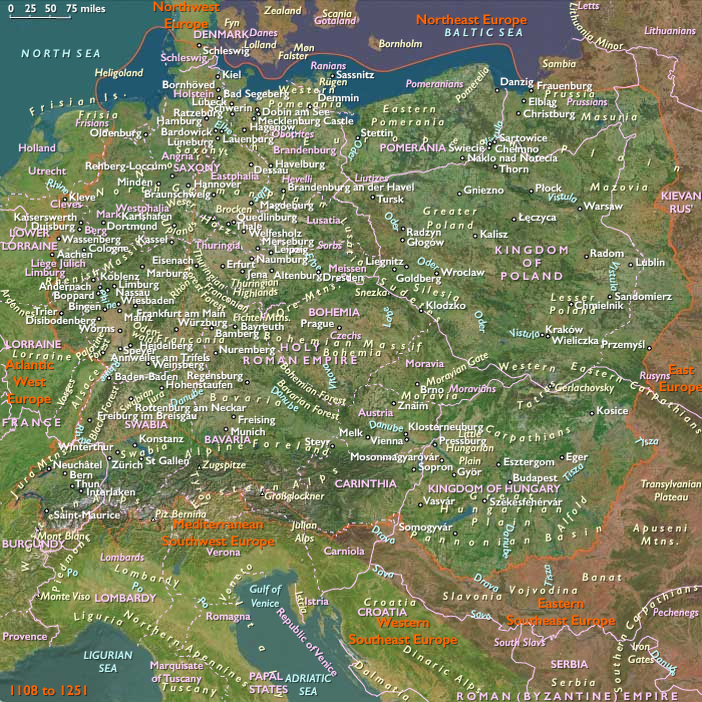
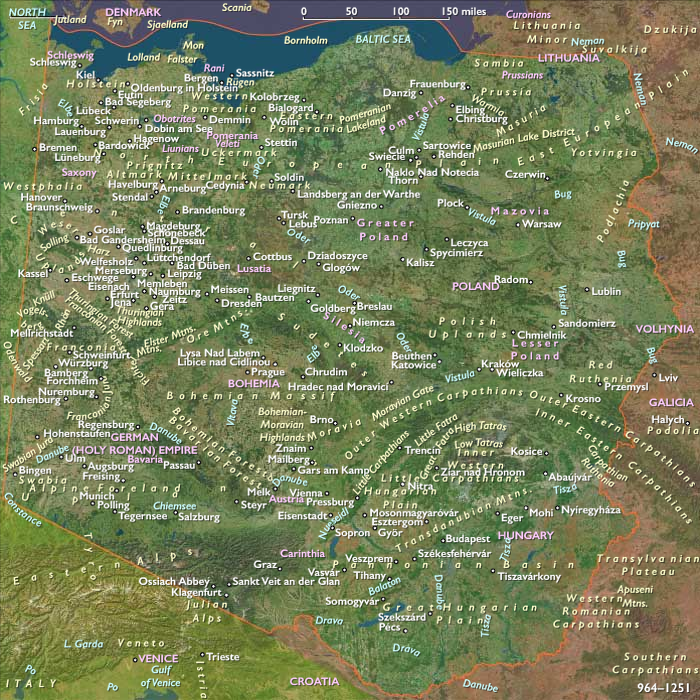
…as Duke of Sandomierz in Lesser Poland …
Years: 1173 - 1173
…as Duke of Sandomierz in Lesser Poland by Casimir II.
Locations
People
Groups
Topics
Commodoties
Subjects
Regions
Subregions
Related Events
Filter results
Showing 10 events out of 11 total
The most important of these in medieval times is Adal, whose influence at the height of its power and prosperity in the sixteenth century extends from Zeila, the capital, through the fertile valleys of the Jijiga and the Harer plateau to the Ethiopian highlands.
Adal's fame derives not only from the prosperity and cosmopolitanism of its people, its architectural sophistication, graceful mosques, and high learning, but also from its conflicts with the expansionist Ethiopians.
For hundreds of years before the fifteenth century, goodwill had existed between the dominant new civilization of Islam and the Christian neguses of Ethiopia.
One tradition holds that Muhammad blessed Ethiopia and enjoined his disciples from ever conducting jihad (holy war) against the Christian kingdom in gratitude for the protection early Muslims had received from the Ethiopian negus.
Whereas Muslim armies rapidly overran the more powerful Persian empire and much of Byzantium soon after the birth of Islam, there would be no jihad against Christian Ethiopia for centuries.
The forbidding Ethiopian terrain of deep gorges, sharp escarpments, and perpendicular massifs that rise more than fort-five hundred meters also discourages the Muslims from attempting a campaign of conquest against so inaccessible a kingdom.
Early in the Prophet's ministry, a band of persecuted Muslims had fled, with the Prophet's encouragement, across the Red Sea into the Horn of Africa, where the Muslims were afforded protection by the Ethiopian negus, or king.
Thus, Islam may have been introduced into the Horn of Africa well before the faith took root in its Arabian native soil.
The large-scale conversion of the Somalis had to await the arrival in the eleventh, twelfth, and thirteenth centuries of Muslim patriarchs, in particular, the renowned Shaykh Daarood Jabarti and Shaykh Isahaaq, or Isaaq.
Daarood married Doombira Dir, the daughter of a local patriarch.
Their issue gave rise to the confederacy that forms the largest clan-family in Somalia, the Daarood.
For his part, Shaykh Isaaq founds the numerous Isaaq clan-family in northern Somalia.
Along with the clan system of lineages, the Arabian shaykhs probably introduced into Somalia the patriarchal ethos and patrilineal genealogy typical of Semitic societies, and gradually replaced the indigenous Somali social organization, which, like that of many other African societies, may have been matrilineal.
Islam's penetration of the Somali coast, along with the immigration of Arabian elements, inspired a second great population movement reversing the flow of migration from northward to southward.
This massive movement, which will ultimately takw the Somalis to the banks of the Tana River and to the fertile plains of Harer in Ethiopia, had commenced in the thirteenth century and continues to the nineteenth century.
At this point, European interlopers appear on the East African scene, ending Somali migration onto the East African plateau.
Forces of his rapidly expanding empire descend from Ethiopia's highlands to despoil Muslim settlements in the valley east of the ancient city of Harar.
Having branded the Muslims "enemies of the Lord," Yeshaq invades the Muslim kingdom of Ifat in 1415.
He crushes the armies of Ifat and puts to flight in the wastes along the Gulf of Tadjoura (in present- day Djibouti) Ifat's king Saa'd ad Din.
Yeshaq follows Sa'ad ad Din to the island off the coast of Zeila (which still bears his name), where the Muslim king is killed.
Yeshaq compels the Muslims to offer tribute, and also orders his singers to compose a gloating hymn of thanksgiving for his victory.
In the hymn's lyrics, the word Somali appears for the first time in written record.
Led by the charismatic Imam Ahmad ibn Ibrahim al-Ghazi (1506-43), the Muslims pour into Ethiopia, using scorched-earth tactics that decimated the population of the country.
A Portuguese expedition led by Cristóvão da Gama, a son of Vasco da Gama who is looking for the Prester John of medieval European folklore—a Christian, African monarch of vast dominions—arrives from the sea and saves Ethiopia.
The joint Portuguese-Ethiopian force uses cannon to rout the Muslims, whose imam dies on the battlefield.
By the middle of the sixteenth century, Saylac and Berbera have become dependencies of the sharifs of Mecca and in the seventeenth century pass to the Ottoman Turks, who exercise authority over them through locally recruited Somali governors.
Zeila in the sixteenth century becomes the principal outlet for trade in coffee, gold, ostrich feathers, civet, and enslaved Ethiopians for the Middle East, China, and India.
The city emerges over time as the center of Muslim culture and learning, famed for its schools and mosques.
Eventually it becomes the capital of the medieval state of Adal, which in the sixteenth century fights off Christian Ethiopian domination of the highlands.
Between 1560 and 1660, Ethiopian expeditions repeatedly harried Zeila, which sinks into decay.
The Ottoman Empire is a world power when Suleyman dies in 1566.
Most of the great cities of Islam—Mecca, Medina, Jerusalem, Damascus, Cairo, Tunis, and Baghdad— are under the sultan's crescent flag.
The Porte exercises direct control over Anatolia, the sub-Danubian Balkan provinces, Syria, Palestine, and Mesopotamia.
Egypt, Mecca, and the North African provinces are governed under special regulations, as are satellite domains in Arabia and the Caucasus, and among the Crimean Tartars.
In addition, the native rulers of Wallachia, Moldavia, Transylvania, and Ragusa (Dubrovnik) are vassals of the sultan.
Fasilides, on hearing that the Portuguese had bombarded Mombasa, assumes that the prelate Mendes had been behind the act, and banishes the remaining Jesuits from his lands.
Mendes and most of his followers make their way back to Goa, being robbed or imprisoned several times on the way.
The land of Palestine remains part of the Ottoman Empire.
However, this area does not constitute a single political unit.
The northern districts of Acre and ...
The indigenous Arab population of Palestine had worked for and generally cooperated with the small number of Jewish colonies before the Second Aliyah.
The increased Jewish presence and the different policies of the new colonists of the Second Aliyah arouse Arab hostility.
The increasing tension between Jewish colonist and Arab peasant does not, however, lead to the establishment of Arab nationalist organizations.
In the Ottoman-controlled Arab lands, family, tribal, and Islamic ties bind the Arab masses; the concepts of nationalism and nation-state are viewed as alien Western categories.
Thus, an imbalance evolves between the highly organized and nationalistic colonists of the Second Aliyah and the indigenous Arab population, who lack the organizational sophistication of the Zionists.
The First World War sees the end of the centuries-old Ottoman Empire, and its rule in Palestine replaced by the British Mandatory Government.
Initially, the Jews of Palestine think it best serves their interests to cooperate with the British administration.
The Zionist Organization is regarded as the de facto Jewish Agency stipulated in the mandate, although Chaim Weizmann, its president, remains in London, close to the British government; David Ben-Gurion becomes the leader of a standing executive in Palestine.
Labor Zionism, the dominant form of Zionism, seeks to link socialism and nationalism.
By the 1920s, Labor Zionists in Palestine have established the kibbutz movement, the Jewish trade union and cooperative movement, the main Zionist militia (the Haganah) and the political parties that will ultimately coalesce in the Israeli Labor Party in 1968.