
Most British subjects who had served with …
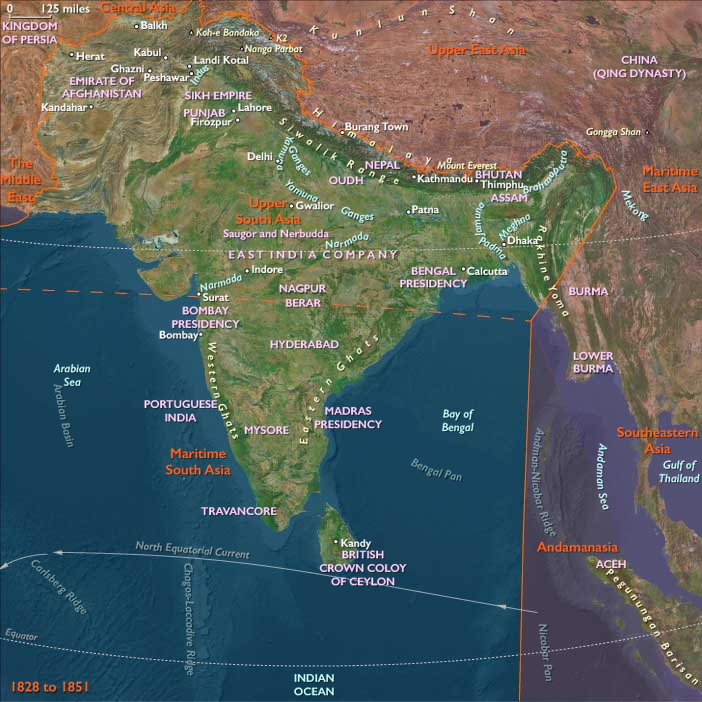
Years: 1828 - 1839
Most British subjects who had served with the British East India Company until the end of the eighteenth century had been content with making profits and leaving the Indian social institutions untouched.
A growing number of Anglican and Baptist evangelicals in Britain, however, feel that social institutions should be reformed.
There is also the demand in Britain, first articulated by member of Parliament and political theorist Edmund Burke, that the company's government balance its exploitative practices with concern for the welfare of the Indian people.
The influential utilitarian theories of Jeremy Bentham and James Mill state that societies can be reformed by proper laws.
Influenced in part by these factors, British administrators in India have embarked on a series of social and administrative reforms that are not well received by the conservative elements of Bengali society.
Emphasis is placed on the introduction of Western philosophy, technology, and institutions rather than on the reconstruction of native institutions.
The early attempts by the British East India Company to encourage the use of Sanskrit and Persian have been abandoned in favor of Western science and literature; elementary education is taught in the vernacular, but higher education in English.
The stated purpose of secular education is to produce a class of Indians instilled with British cultural values.
Persian has been replaced with English as the official language of the government.
A code of civil and criminal procedure has been fashioned after British legal formulas.
In the field of social reforms, the British suppress what they consider to be inhumane practices, such as suttee (self-immolation of widows on the funeral pyres of their husbands), female infanticide, and human sacrifice.
Locations
People
Groups
- Bengalis
- East India Company, British (United Company of Merchants of England Trading to the East Indies)
- Bengal, Nawabs of
- India, East India Company rule in
- Bengal Presidency
- Britain (United Kingdom of Great Britain and Ireland)
Topics
Subjects
Regions
Subregions
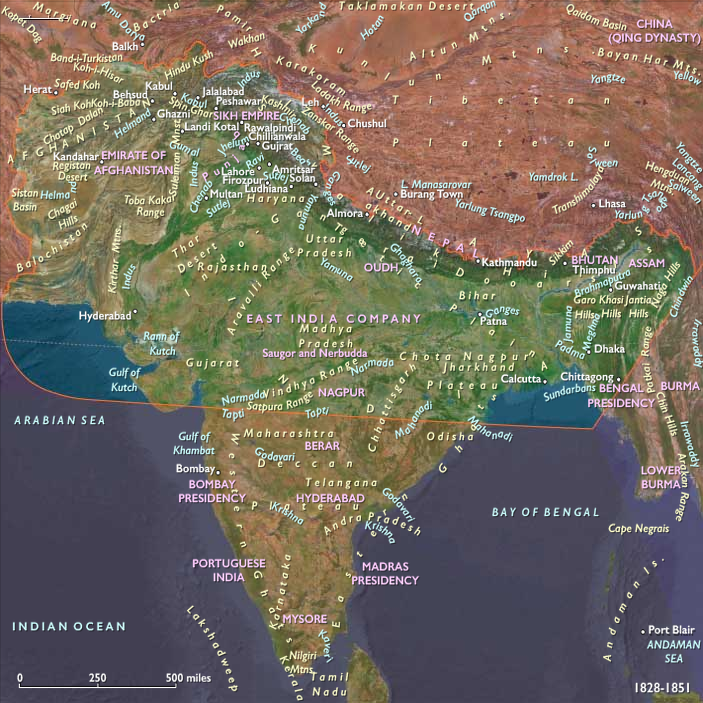
Years: 1828 - 1839
Locations
People
Groups
- Bengalis
- East India Company, British (United Company of Merchants of England Trading to the East Indies)
- Bengal, Nawabs of
- India, East India Company rule in
- Bengal Presidency
- Britain (United Kingdom of Great Britain and Ireland)
Topics
Subjects
Regions
Subregions