
Uruartri is first mentioned in Assyrian inscriptions …
Years: 765BCE - 754BCE
Uruartri is first mentioned in Assyrian inscriptions of Shalmaneser I from around 1270 BCE as one of the states of Nairi—a loose confederation of small kingdoms and tribal states in eastern Anatolia’s Armenian Highland in the thirteenth to eleventh centuries BCE.
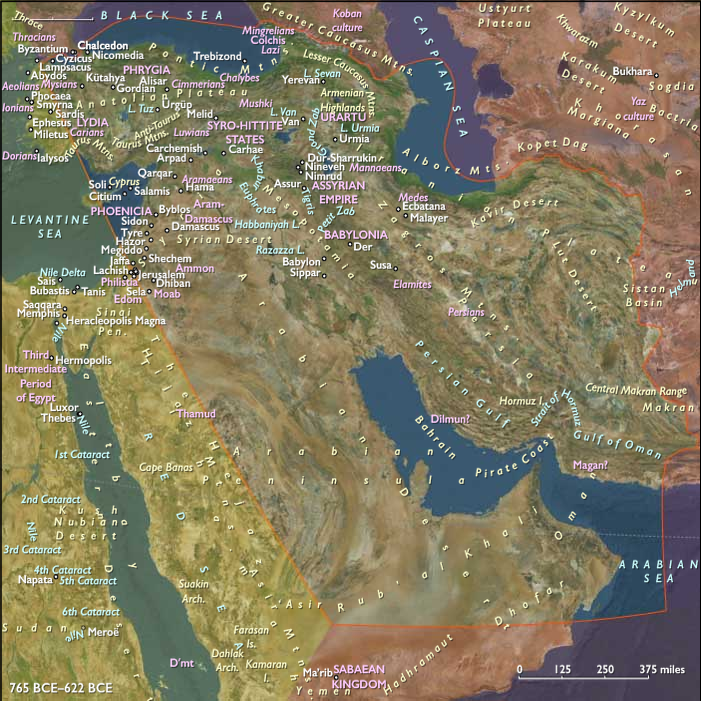
Uruartri itself was in the region around Lake Van.
The Nairi states have been repeatedly subjected to attacks by the Assyrians.
Urartu re-emerges in Assyrian inscriptions in the ninth century BCE as a powerful northern rival of Assyria.
The Nairi states and tribes had become a unified kingdom under king Aramu, who reigned
about 860 BCE to 843 BCE, and whose capital at Arzashkun was captured by Shalmaneser III.
Roughly contemporaries of the Uruartri, living just to the west along the southern shore of the Black Sea, were the Kaskas known from Hittite sources.
Sardur I, who reigned from about 832 BCE to 820 BCE, son of Lutipri, had moved the capital to the ancient city of Tushpa (modern Van, on the shore of Lake Van), fortifying it.
His son, Ispuini, who reigned from about 820 BCE to 800 BCE, had annexed the neighboring state of Musasir and made his son Sarduri II viceroy; Ispuini was in turn attacked by Shamshi-Adad V. His successor Menua, who reigned from about 800 BCE to about 785 BCE, also enlarged the kingdom greatly and left inscriptions over a wide area.
Urartu reaches the highest point of its military might under Menua's son Argishtis, the sixth known king of Urartu, Reigning from 785 BCE to 763 BCE, he had founded the citadel of Erebouni in 782 BCE, which is the present capital of Armenia, Yerevan, and the fortress of Argishtikhinili in 776 BCE.
A son and successor of Menuas, he had continued the series of conquests initiated by his predecessors.
Victorious against Assyria, he has conquered the northern part of Syria and made Urartu the most powerful state in the post-Hittite Near East.
He has also expanded his kingdom north to Lake Sevan, conquering much of Diauehi and the Ararat Valley.
Argishti has frustrated Shalmaneser IV's campaigns against him: at some point the Urartuan armies reach all the way to Babylon, taking the city.
Little is known of Argishti’s successor, Sarduris II.
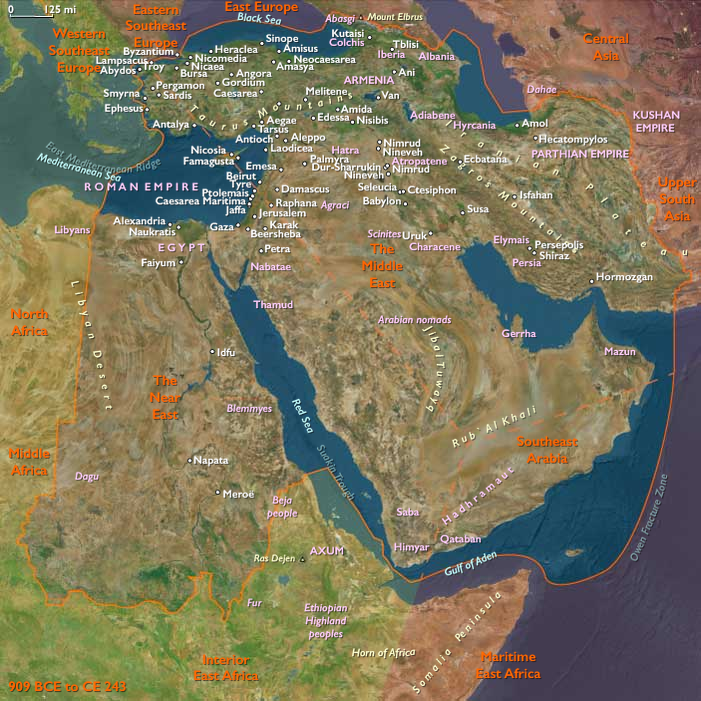
The Urartu kingdom at its height may have stretched North beyond the Aras River (Greek Araxes) and Lake Sevan, encompassing present-day Armenia and even the southern part of Georgia (e.g., Qulha) almost to the shores of the Black Sea; west to the sources of the Euphrates; east to present-day Tabriz, Lake Urmia, and beyond; and south to the sources of the Tigris.
This would become the first known Armenian empire.
Locations
People
Groups
- Babylon, Kingdom of
- Assyria, (New) Kingdom of (Neo-Assyrian Empire)
- Assyrian people
- Urartu, Kingdom of
Topics
- Younger Subboreal Period
- Iron Age, Near and Middle East
- Assyrian Wars of c. 909-c. 746 BCE
- Iron Age Cold Epoch
- Classical antiquity
Commodoties
Subjects
Regions
Subregions
Related Events
Showing 10 events out of 22 total
Years: 765BCE - 754BCE
Locations
People
Groups
- Babylon, Kingdom of
- Assyria, (New) Kingdom of (Neo-Assyrian Empire)
- Assyrian people
- Urartu, Kingdom of
Topics
- Younger Subboreal Period
- Iron Age, Near and Middle East
- Assyrian Wars of c. 909-c. 746 BCE
- Iron Age Cold Epoch
- Classical antiquity
Commodoties
Subjects
Regions
Subregions