John Whitgift, Archbishop of Canterbury, from 1583, …
Years: 1596 - 1596
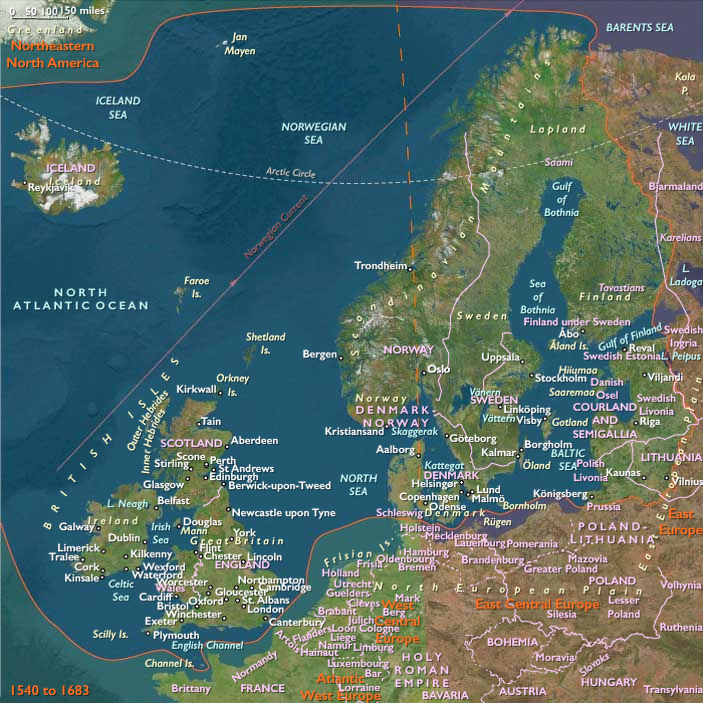
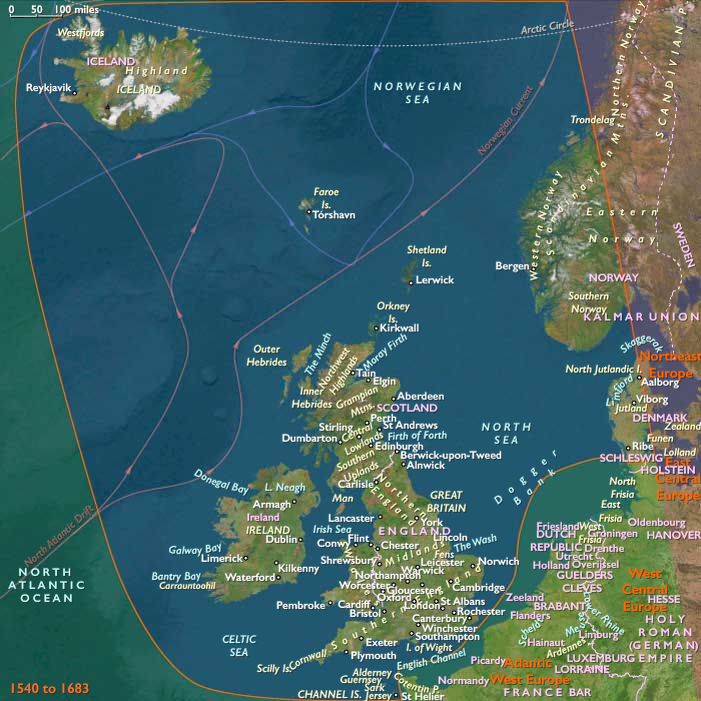
John Whitgift, Archbishop of Canterbury, from 1583, establishes at Croydon, long used as a summer retreat by the Archbishops of Canterbury, a charitable foundation, which exists today as The Whitgift Foundation.
It supports homes for the elderly and infirm, and runs three independent schools—Whitgift School, founded in 1596, Trinity School of John Whitgift and, more recently, Old Palace School for Girls, which is housed in the palace buildings once used by him.
Locations
Groups
Topics
Subjects
Regions
Subregions
Related Events
Filter results
Showing 10 events out of 34230 total
The nobility of Finland, led by the Sigismund-appointed Governor, Klaus Fleming, rejects the decisions made by Duke Charles, sympathizing with the King and considering Charles a rebel.
As a counterattack, Charles instigates a rebellion against Fleming among the farmers in Ostrobothnia.
This dispute over the Swedish crown, combined with quarrels over social conditions, foreign policy, and religion (Roman Catholic versus Lutheran), lead to the last peasant revolt in Europe, the so-called Club War, or Cudgel War.
King Dominicus Corea (Edirille Bandara), after rebelling against the Portuguese, is captured and beheaded in Colombo by his enemies.
The maritime explorer Ioánnis Fokás/Juan de Fuca, the discoverer of the Pacific Northwest straits named for him, has never received the great rewards he claims as his due, despite the repeated promises of the late Velasco.
After two years, and on the viceroy's urging, Fuca had traveled to Spain to make his case to the court in person.
Disappointed again and disgusted with the Spanish, the aging Greek had determined to retire to his home in Kefallonia but is in 1596 persuaded by an Englishman, Michael Locke, to offer his services to Spain's archenemy, Queen Elizabeth.
Nothing comes of Locke and Fokás's proposals, but it is through Locke's account that the story of Juan de Fuca enters English letters.
Caravaggio's allegorical but realistic Boy Bitten by a Lizard features Minniti and other adolescent models.
Annibale Carracci meanwhile develops hundreds of preparatory sketches for the major product, wherein he leads a team painting frescoes on the ceiling of the grand salon with the secular quadri riportati of The Loves of the Gods, or as the biographer Giovanni Bellori described it, Human Love governed by Celestial Love.
Although the ceiling is riotously rich in illusionistic elements, the narratives are framed in the restrained classicism of High Renaissance decoration, drawing inspiration from, yet more immediate and intimate, than Michelangelo's Sistine Ceiling as well as Raphael's Vatican Logge and Villa Farnesina frescoes.
His work will later inspire the untrammeled stream of Baroque illusionism and energy that would emerge in the grand frescoes of Cortona, Lanfranco, and in later decades Andrea Pozzo and Gaulli.
Throughout seventeenth and eighteenth centuries, the Farnese Ceiling will be considered the unrivaled masterpiece of fresco painting for its age.
They are not only seen as a pattern book of heroic figure design, but also as a model of technical procedure; Annibale’s hundreds of preparatory drawings for the ceiling become a fundamental step in composing any ambitious history painting.
Linschoten, in Amsterdam in 1596, publishes a travel report, Itinerario (later published as an English edition of "Reys-gheschrift vande navigatien der Portugaloysers in Orienten" ("Report of a journey through the navigations of the Portuguese in the East").
This includes vast directions on how to navigate between Portugal and the East Indies and to Japan.
Graphically displayed for the first time in Europe, the report features detailed maps of voyages to the East Indies, particularly India.
Even more crucially, Linschoten has provided such nautical data as currents, deeps, islands and sandbanks, which is essential to safe navigation, along with depictions of coastlands to guide the way.
His publications will in 1602 give rise to the Dutch East India Company (Vereenigde Oostindische Compagnie) as a unified expression of Dutch efforts at trade with Asia.
Sidney Sussex College, a constituent college of the University of Cambridge, is founded in 1596 and named after its foundress, Frances Sidney, Countess of Sussex.
It is from its inception an avowedly Puritan foundation: some good and godlie moniment for the mainteynance of good learninge.
Oliver Cromwell, the future dictator of the English Commonwealth, is among the first students (although his father became ill and he never graduated), and his head is now buried beneath the College's chapel.
Sir John Harington installs the first water closet in England.
A courtier, author and master of art, Kelston has become a prominent member of Elizabeth’s court, and is known as her 'saucy Godson', but because of his poetry and other writings, he has fallen in and out of favor with the Queen.
The work for which he is best known today, A New Discourse of a Stale Subject, called the Metamorphosis of Ajax (1596) is in fact a political allegory, a 'device' in the contemporary sense of an emblem, not in the modern sense of a mechanical device.
It is a coded attack, as his autograph marginal notes make clear, on the 'stercus' or excrement that is poisoning society with torture and state-sponsored 'libells' against his relatives Thomas Markham and Ralph Sheldon.
The work enjoys considerable popularity on its publication in 1596.
The book describes a forerunner to the modern flush toilet installed at his house at Kelston.
The design has a flush valve to let water out of the tank, and a wash-down design to empty the bowl.
The Ajax will not be taken up on a wide scale in England, but will be adopted in France under the name Angrez.
Philip, in the last decade of his life, is bankrupt by 1596 (for the fourth time, after France had declared war on Spain). Even so, more silver and gold are shipped safely to Spain than ever before.
This allows Spain to continue its military efforts, but leads to an increased dependency on the precious metals and gems.
Sir Francis Drake dies of dysentery on January 28, 1596, while again unsuccessfully attacking San Juan, where some Spanish treasure ships had sought shelter.
Before dying, he had asked to be dressed in his full armor.
He is buried at sea near Portobelo, Panama, in a lead coffin, for which divers continue to search today.
The famous Omura Sumitada, known as the lord who opened the port of Nagasaki to foreign trade, had been the first of the daimyo to convert to Christianity following the arrival of the Jesuit missionaries in the mid-sixteenth century.
He is known as "Dom Bartolomeu".
Due to the instability during the Sengoku period, he and Jesuit leader Alexandro Valignano had conceived a plan to pass administrative control over to the Society of Jesus rather than see the Catholic city taken over by a non-Catholic daimyo.
Thus the city of Nagasaki has rom 1580 been a Jesuit colony, under their administrative and military control.
It has become a refuge for Christians escaping maltreatment in other regions of Japan Hideyoshi's campaign to unify the country had arrived in Kyūshū in 1587.
Hideyoshi, concerned with the large Christian influence in southern Japan, as well as the active and what he perceived as the arrogant role the Jesuits are playing in the Japanese political arena, had ordered the expulsion of all missionaries, and placed Nagasaki under his direct control.
The expulsion order has gone largely unenforced, however, and the fact remains that most of Nagasaki's population remain openly practicing Catholics.
The Spanish ship San Felipe is wrecked in 1596 off the coast of Shikoku, and Hideyoshi learns from its pilot that the Spanish Franciscans are the vanguard of an Iberian invasion of Japan.
In response, Hideyoshi orders the crucifixions of twenty-six Catholics (the "Twenty-six Martyrs of Japan") in Nagasaki on February 5 of this year.
Portuguese traders are not ostracized, however, and so the city continues to thrive.