Soalu, the Shan ruler of the semiautonomous …
Years: 1437 - 1437
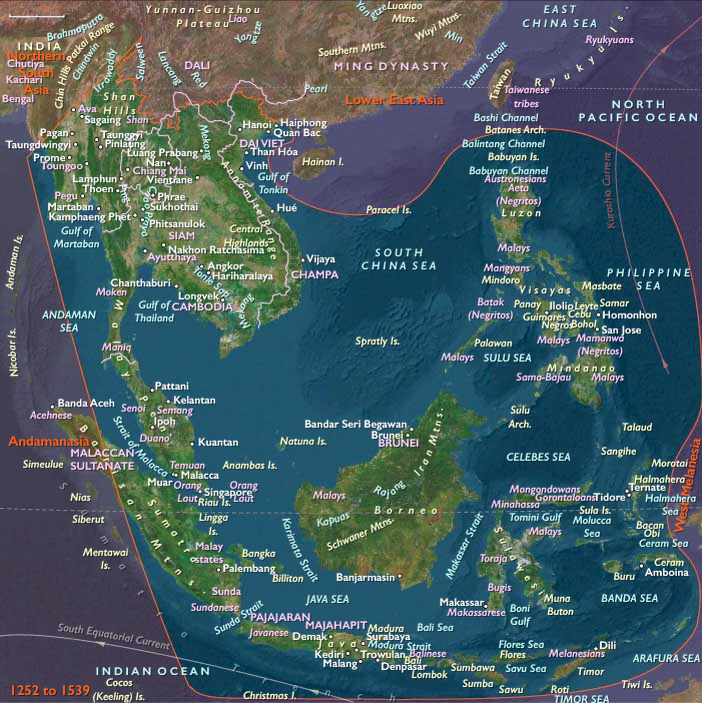
Soalu, the Shan ruler of the semiautonomous Burmese kingdom of Toungoo on the Ava-Pegu border, dies in 1437, and Pegu’s king Binnya Ran installs his son Minsaw as Toungoo’s ruler.
Locations
People
Groups
Topics
Commodoties
Subjects
Regions
Subregions
Related Events
Filter results
Showing 10 events out of 41882 total
A Polish faction opposes the installment of Albert Habsburg as Holy Roman Emperor and king of Bohemia and Hungary, their choice being Wladyslaw III of Poland.
Wladyslaw is only fourteen; most of the major decisions are either made or manipulated by the regent, Zbigniew Olesnicki, who is a powerful Polish noble, bishop of Kraków, and had also been a close adviser to his father.
Sigismund of Luxembourg, finally crowned as Holy Roman Emperor in 1433, has proposed badly needed reforms from 1434-37 but has been unable to persuade the German princes to adopt them.
Before his death at sixty-nine, on December 9, 1437, the childless monarch, his treasury depleted, arranges for the succession of his titles to his forty-year-old son-in-law, Albert Habsburg, thus passing to this powerful family, for the first time, the crown of the Holy Roman Empire.
Constantinople’s Emperor John VIII Palailogos, who has already traveled to Venice and Hungary in search of help, is prepared to reopen negotiations for the union of the churches as a means of stirring the conscience of Western Christendom.
His father Manuel II had been skeptical about the benefits of such a policy, knowing that it would antagonize most of his own people and arouse the suspicion of the Turks.
Economic life in Transylvania had rebounded quickly after the Mongol invasion.
New farming methods have boosted crop yields.
Craftsmen have formed guilds as artisanry flourishes; gold, silver, and salt mining have expanded; and money-based transactions have replaced barter.
Though townspeople are exempt from feudal obligations, feudalism has expanded and the nobles have stiffened the serfs' obligations.
The serfs resent the higher payments; some have fled the country, while others have become outlaws.
In 1437, Romanian and Hungarian peasants rebel against their feudal masters.
The uprising gathers momentum before the Magyar, German, and Szekler nobles in Transylvania unite forces and, with great effort, successfully quell the revolt.
János Hunyadi, a Magyarized Romanian from Transylvania, had become acquainted with the most up-to-date military strategy and implements of war while serving in Italian and Czech mercenary armies as well as that of Emperor Sigismund.
When Hungary falls into a period of turmoil after Sigismund's death in 1437, the Ottoman Turks, advancing into Europe and Hungarian territory, move along the Danube River to the south of heavily-fortified Belgrade and besiege the Semendria (Smederjevo) fortress in 1437.
Hunyadi, now thirty, leads Hungarian forces in a spectacularly successful relief operation, evicting the Turks.
Zurich, an imperial (free) city, expects to acquire Toggenburg as the latest in a line of many such domains recently incorporated in their territory.
The imperial city of Schwyz, however, quickly sets up communes in the Toggenburg and bars the road to Zurich in a preemptive action approved in 1437 by its canton officials.
The feudal domain comprising the Toggenburg district near Lake Constance had been freed by the death of its last count, Frederick VII, in 1436.
Rudolf Stüssi, who had risen from several minor appointments to the position of burgomaster of Zürich in 1430, has forced Zürich into a quarrel with the canton of Schwyz and its chief magistrate, Ital Reding, over the inheritance.
Hans Multscher combines sculpture and painting in masterpieces of the new naturalistic style in a giant altarpiece for a church at Wurzach in 1437.
Executed with a crude, earthy realism, crowds of massive, block-like, and occasionally grotesque figures act out their roles in religious dramas with violence and intensity of expression.
Multscher's work is first documented in Ulm in 1427,.
Cosimo de Medici grants the Jews of Florence the first formal charter for money lending activities in 1437.
The wealthy Humanist Niccolò Niccoli is one of the chief figures in the company of learned men who have gathered around Cosimo de' Medici, and his intellectual quarrels with other noted Humanists have created a sensation in the learned world.
His collections of ancient art objects and library of manuscripts of classical works have helped to shape a taste for the antique.
He has copied and collated ancient manuscripts, correcting the texts, introducing divisions into chapters, and making tables of contents.
Many of the most valuable manuscripts in the Laurentian Library in Florence are by his hand, among them those of Lucretius and of twelve comedies of Plautus.
Niccoli's private library is the largest and best in Florence, and he also possesses a small but significant collection of ancient works of art, coins and medals.
He is also an accomplished calligrapher whose slightly inclined antica corsiva script has influenced the development of italic type.
He dies on February 3 of this year.
Donatello continues to explore the possibilities of the new shallow carving technique known as schiacciato (“flattened out”) in his marble reliefs of the 1420s and early 1430s.
The most highly developed of these are “The Ascension, with Christ Giving the Keys to St. Peter,” which is so delicately carved that its full beauty can be seen only in a strongly raking light; and the “Feast of Herod” (1433–35), with its perspective background.
The large stucco roundels with scenes from the life of St. John the Evangelist (about 1434–37), below the dome of the old sacristy of San Lorenzo, show the same technique but with color added for better legibility at a distance.
Lorenzo Ghiberti has by this time cast the reliefs for the second pair of doors for the Florence Baptistery.
(The work so closely complements Alberti's theories in his pioneering 1435 “Treatise on Painting,” that scholars have proposed him as Ghiberti's inspiration.)
Alberti in this year creates the earliest known peep shows: the perspective views said to have been painted in transparent colors on glass and lighted from behind for various effects, from sunshine to moonlight.
Florentine painter Fra Filippo Lippi, also called Lippo Lippi, an orphan who was raised in a Carmelite monastery, had become a monk at the age of fifteen, but, finding religious life unsuitable, had left the Carmelite order in about 1431 at the age of twenty-five, later marrying Lucrezia Buti.
Like the late Masaccio (who may have been his teacher)—Lippi achieves a sense of grandeur in his earliest datable work, a “Madonna Enthroned” painted in 1437, by using monumental figures, heavy draperies, and lighting designed to heighten the sculptural effect.
The detailed domestic scenery in the background implies the influence of the Flemish masters; he may also have looked to the relief sculptures of Donatello and Ghiberti for inspiration.
Lippi's synthesis of these influences enables him to bring new ideas to painting.

Emperor John travels to Italy in late 1437 to make his proposal for union between the Greek and Latin churches.
Henry and Fernando attack Tangier and meet with disaster; Henry has shown poor generalship and mismanaged the enterprise.
The Portuguese army would have been unable to reembark had not Fernando been left as hostage.
Henry had offered himself as hostage, but as the army had refused to lose its commander, Fernando remains in captivity.