Australia is possibly occupied by at least …
Years: 194445BCE - 173710BCE
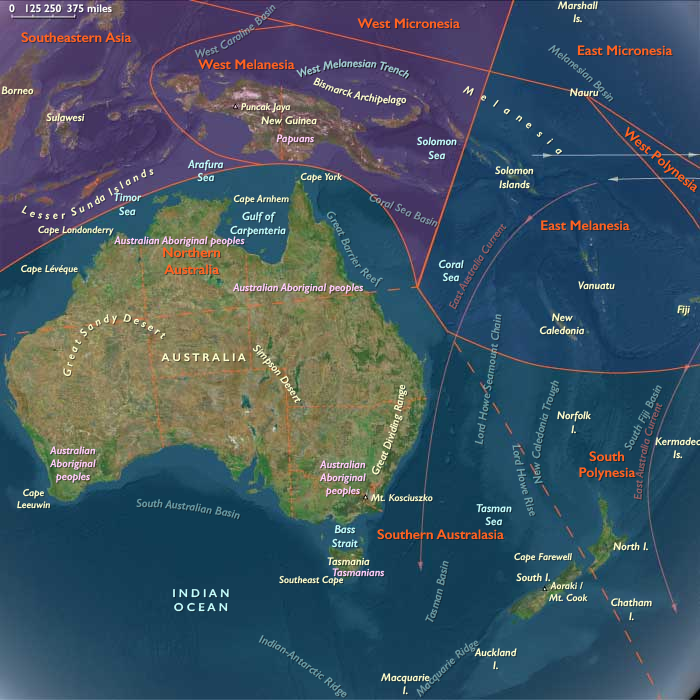
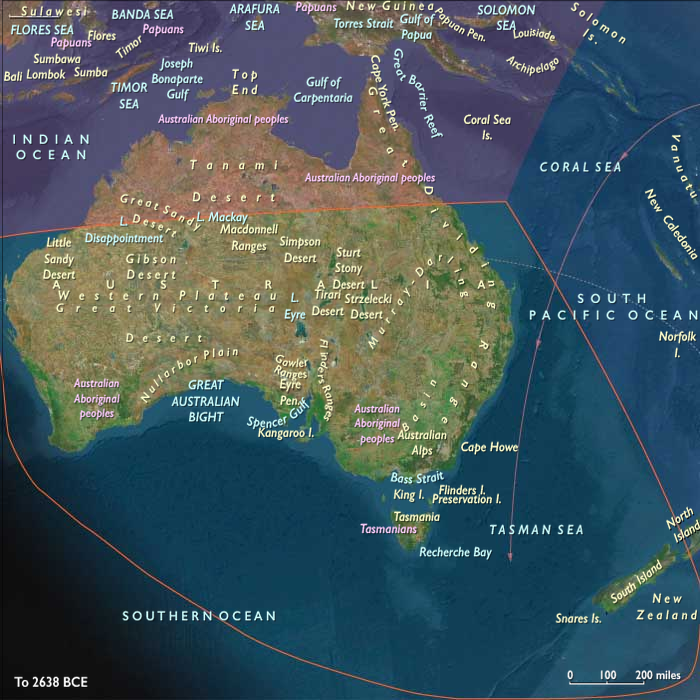
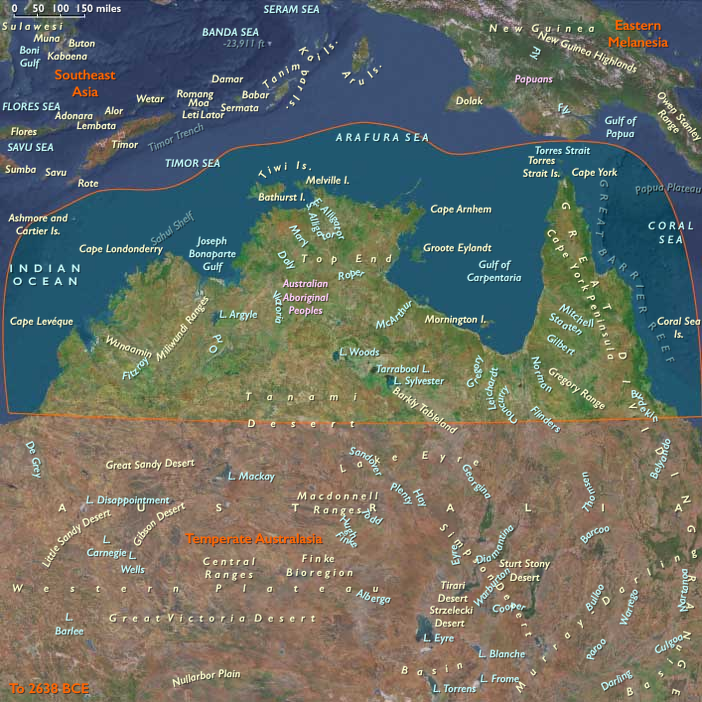
Australia is possibly occupied by at least 174,000 BCE (a date suggested by archaeological fieldwork in Western Australia’s Kimberley district).
Locations
Topics
Subjects
Regions
Subregions
Related Events
Filter results
Showing 10 events out of 69740 total
Homo sapiens begins to evolve from two hundred thousand to one hundred and fifty thousand years ago as more modern-looking Africans use increasingly refined and more specialized toolkits to kill game of all kinds.
They also have more enhanced speaking abilities than their predecessors, displaying a blend of archaic and modern features.
Herto Bouri is a region of Ethiopia under volcanic layers.
By using radioisotope dating, the layers date between one hundred and fifty-four thousand and one hundred and sixty thousand years old.
Idaltu is the Afar word for "elder, first born.”
These fossils differ from those of chronologically later forms of early H. sapiens such as Early European Modern Humans found in Europe and other parts of the world in that their morphology has many archaic features not typical of H. sapiens (although modern human skulls do differ across the globe).
Despite the archaic features, these specimens are postulated to represent the direct ancestors of Homo sapiens sapiens.
"Modern humans" are defined as the Homo sapiens species, of which the only extant subspecies is known as Homo sapiens sapiens.
According to the "Recent African Origin (RAO)" or "Out-Of-Africa" theory, H. sapiens sapiens developed shortly after this period (Khoisan mitochondrial divergence dated not later than 110,000 BP) in Eastern Africa, and as such, to be the oldest representative of the H. sapiens species found so far.
Anatomically modern humans, Homo sapiens sapiens, evidently evolve in tropical Africa between 150,000 and 100,000 BCE.
Archaeological evidence reveals signs of technological change throughout eastern and southern Africa before 130,000 BCE, as the heavier toolkits of earlier times gave way to lighter, more specialized toolkits, which included sharp spearpoints that can be mounted on wooden shafts.
The Neanderthals move into Europe around 150,000 BCE.
The game-hunting occupants of the Grotte du Lazaret (English: Cave of Le Lazaret), now in the eastern suburbs of the French town of Nice and now overlooking the Mediterranean Sea, dating to about this time, make tents, probably of animal hides stretched over a wooden framework, with the tent entrances facing away from the cave opening.
A wolf skull is situated inside the doorway of each tent.
The beginning of the last Ice Age is conventionally dated at about 120,000 BCE.
The Eemian, an interglacial period which begins about one hundred and thirty thousand years ago and ends about one hundred and fourteen thousand years ago, is the second-to-latest interglacial period of the current Ice Age, the most recent being the Holocene which extends to the present day.
The prevailing Eemian climate is believed to have been about as stable as that of the Holocene.
Changes in the earth's orbital parameters from today (greater obliquity and eccentricity, and perihelion), known as the Milankovitch cycle, probably lead to greater seasonal temperature variations in the Northern Hemisphere, although global annual mean temperatures are probably similar to those of the Holocene.
The warmest peak of the Eemian is around one hundred and twenty-five thousand years ago, when forests reach as far north as North Cape (which is now tundra) in northern Norway well above the Arctic Circle.
Hardwood trees like hazel and oak grow as far north as Oulu, Finland.
At the peak of the Eemian, the northern hemisphere winters are generally warmer and wetter than now, though some areas are actually slightly cooler than today.
The hippopotamus is distributed as far north as the rivers Rhine and Thames.
Trees grow as far north as southern Baffin Island in the Canadian Arctic Archipelago instead of only as far north as Kuujjuaq in northern Quebec, and the prairie-forest boundary in the Great Plains of the United States lies further west—near Lubbock, Texas, instead of near Dallas, Texas, where the boundary now exists.
Sea level at peak is probably four to six meters (thirteen to twenty feet) higher than today (references in Overpeck et al., 2006), with much of this extra water coming from Greenland but some likely to have come from Antarctica.
Global mean sea surface temperatures are thought to have been higher than in the Holocene, but not by enough to explain the rise in sea level through thermal expansion alone, and so melting of polar ice caps must also have occurred.
Because of the sea level drop since the Eemian, exposed fossil coral reefs are common in the tropics, especially in the Caribbean and along the Red Sea coastlines.
These reefs often contain internal erosion surfaces showing significant sea level instability during the Eemian.
A 2007 study found evidence that the Greenland ice core site Dye 3 was glaciated during the Eemian, which implies that Greenland could have contributed at most two meters (6.6 feet) to sea level rise.
Scandinavia was an island due to the inundation of vast areas of northern Europe and the West Siberian Plain.
Given that the shorelines of the islands of the present are at this time several feet higher, humans of this epoch must have used boats: the large island of Crete in the Aegean basin is settled as early as 128,000 BCE, during the Middle Paleolithic age.
The period closes as temperatures steadily fall to conditions cooler and drier than the present, with four hundred and sixty-eight-year long aridity pulse in central Europe, and by one hundred and fourteen thousand years before the present, a glacial era has returned.

The fragments of a Neanderthal skull disinterred from a deposit of limestone at the Ehringsdorf quarries along the Ilm River, roughly two point four kilometers from Weimar, Germany, is known as the Ehringsdorf skull.
The deposits in which this skull were found came from the travertines belonging to the second half of the last (Eemian) interglacial period.
The estimated age of the remains are one hundred and fifty thousand to one hundred and twenty thousand years.
German anthropologist Franz Weidenreich will publish a monograph on the subject in 1928, titled Der Schädelfund von Weimar-Ehringsdorf, where he will describes it as the skullcap of an adult female.
His suggestion that the frontal area of the remains showed evidence of being struck leads to the conclusion that the subject was murdered.
In addition, he determined that the lack of a cranial base meant the skull had been opened for the purpose of extracting the brain.
However, the remains are so fragmentary that little attention was paid to this opinion.
Scottish anthropologist Arthur Keith made a study of the skull in 1931, concluding that it belonged to an individual less than twenty years old.
Although classed as an early Neanderthal type, the skull bears some features found in the species Homo sapiens.
In particular, it has a rounded occipital bone.
It is believed that the area was on the route out of Africa that some scholars suggest was used by early humans to colonize the rest of the Old World.
In 1999, the Eritrean Research Project Team, composed of Eritrean, Canadian, American, Dutch and French scientists, will discover a Paleolithic site with stone and obsidian tools dated to over one hundred and twenty-five thousand years old near the Bay of Zula south of Massawa, along the Red Sea littoral.
The tools are believed to have been used by early humans to harvest marine resources like clams and oysters.
The beginning of the last Ice Age is conventionally dated at about one hundred and twenty thousand BCE with the onset of the Abbassia Pluvial, an extended wet and rainy period in the climate history of North Africa.
The Abbassia Pluvial, which lasted approximately thirty thousand years, and ended around ninety thousand ybp, spanned the end of the Lower Paleolithic and the start of the Middle Paleolithic eras—an interval that is also sometimes identified as the Acheulean (two hundred and fifty to ninety kybp).
As with the subsequent Mousterian Pluvial (circa fifty to thirty kybp), the Abbassia was brought about by global climate changes associated with the ice ages and interglacials of the Pleistocene Epoch.
Like the Mousterian Pluvial, the Abbassia Pluvial brought wet and fertile conditions to what is now the Sahara Desert, which bloomed with lush vegetation fed by lakes, swamps, and river systems, many of which later disappeared in the drier climate that followed the pluvial.
During this period, African wildlife now associated with the grasslands and woodlands south of the Sahara penetrated the entire North African.
Human Stone Age cultures—notably the Mousterian and Aterian Industries—flourished in Africa during the Abbassia Pluvial.
The shift to harsher climate conditions that came with the end of the pluvial promoted the emigration of modern Homo sapiens out of Africa and over the rest of the globe.
This was the third wave of the Sahara pump cycle.
There is little evidence of human occupation in Britain during the Ipswichian Stage (Eemian Stage elsewhere) between around one hundred and thirty thousand and one hundred and ten thousand years ago.
Meltwaters from the previous glaciation cut Britain off from the continent during this period, which may explain the lack of activity.
Overall, there appears to be a gradual decline in population between the Hoxnian Stage and this time suggesting that the absence of humans in the archaeological record here was is the result of gradual depopulation.
Lice have been the subjects of significant DNA research that has led to discoveries on human evolution.
For example, recent DNA evidence suggests that pubic lice spread to humans approximately two million years ago from gorillas.
Additionally, the DNA differences between head lice and body lice provide corroborating evidence that humans started losing body hair, also about two million years ago.
Genetic analysis suggests that the human body louse may have originated about one hundred and seven thousand years ago from the head louse after the invention of clothing, with the ancestor of all human lice emerging about seven hundred and seventy thousand years ago.