
…Autophradates of Lydia. Some participation by …
Years: 369BCE - 358BCE
…Autophradates of Lydia.
Some participation by local Greek cities in Anatolia is possible, though perhaps they merely follow the lead of their satrapal overlords; Athens and Sparta seem surreptitiously to have helped.
The aims of the revolt are a matter for speculation, but it looks serious: a second and successful Cunaxa is a possibility.
The satraps, however, are divided by mutual distrust.
Datames, the satrap of Cappadocia and a talented military commander, had after 384 BCE inherited his satrapy from his father Camissares.
He is a respected military commander but later problems with the court led him to revolt in 372 BCE.
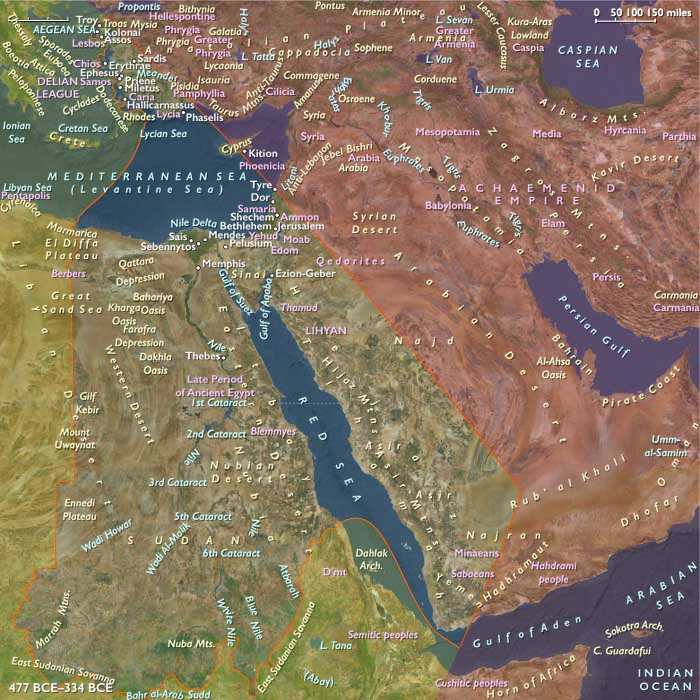
The Persian court commanded the neighboring satraps, Autophradates of Lydia and Artumpara of Lycia, to crush the rebellion but Datames successfully resists their attacks.
Ariobarzanes, satrap of Phrygia and son of the ruler of Pontus, had been made acting satrap of Hellespontine Phrygia until Artabazos, the legitimate heir of the satrapy, could take office, but when Artabazos is ready to take the satrapy, Ariobarzanes refuses to surrender it and in 366 BCE joins Datames' revolt.
Ariobarzanes seeks foreign aid and receives it from King Agesilaus II of Sparta.
Ariobarzanes withstands a siege from Mausolus of Caria and Autophradates of Lydia until Agesilaus negotiates the besiegers’ retreat.
Ariobarzanes is killed in 363, betrayed by his son Mithradates.
Orontes, satrap of Armenia, revolts in 362 after he is ordered by the King to move to Mysia.
His noble birth leads the other satraps to recognize him as leader of the revolt but Orontes later seeks a compromise with the King and betrays the other satraps, after which the rebellion soon collapses.
Orontes receives much of the Aegean coast while Datames is killed after his son-in-law Mitrobarzanes betrays him.
Ariobarzanes is also killed but the other satraps are pardoned, thus ending the rebellion.
The rebellion is finally put down by Persia through a series of treacheries.
The revolt is over at the date of Artaxerxes' death in 359, Achaemenid authority having been restored over most of the empire—more from internal rivalries and discord than from Artaxerxes' efforts.
Locations
People
- Agesilaus II
- Ariobarzanes of Phrygia
- Artabazus II of Phrygia
- Artaxerxes II Mnemon
- Autophradates of Lydia
- Datames
- Mausolus
- Mithridates of Cius
- Orontes I
Groups
- Carians
- Ionians
- Greece, classical
- Persian people
- Sparta, Kingdom of
- Peloponnesian League (Spartan Alliance)
- Achaemenid, or First Persian, Empire
- Athenian Empire or Confederacy, Second
Topics
Commodoties
Subjects
Regions
Subregions
Years: 369BCE - 358BCE
Locations
People
- Agesilaus II
- Ariobarzanes of Phrygia
- Artabazus II of Phrygia
- Artaxerxes II Mnemon
- Autophradates of Lydia
- Datames
- Mausolus
- Mithridates of Cius
- Orontes I
Groups
- Carians
- Ionians
- Greece, classical
- Persian people
- Sparta, Kingdom of
- Peloponnesian League (Spartan Alliance)
- Achaemenid, or First Persian, Empire
- Athenian Empire or Confederacy, Second
Topics
Commodoties
Subjects
Regions
Subregions