Ayutthayan invaders occupy the Khmer capital of …
Years: 1369 - 1369
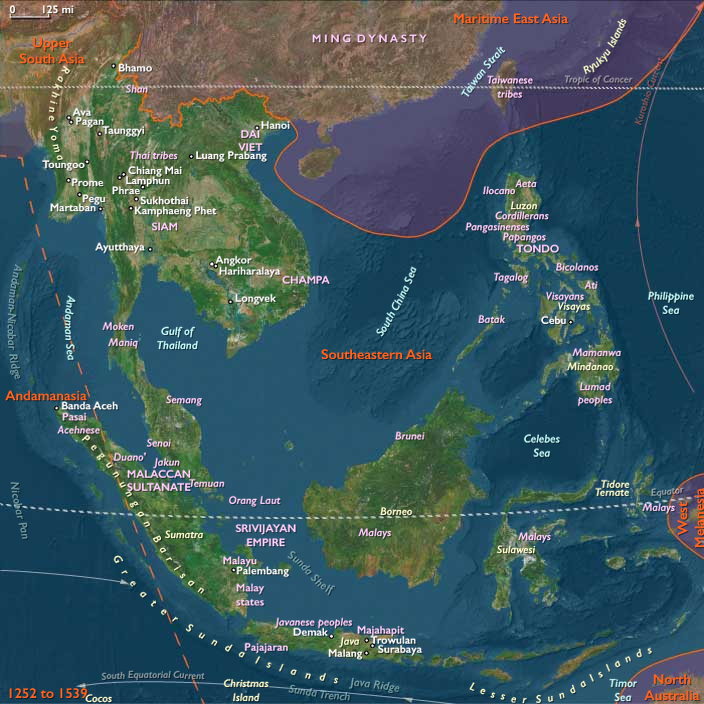
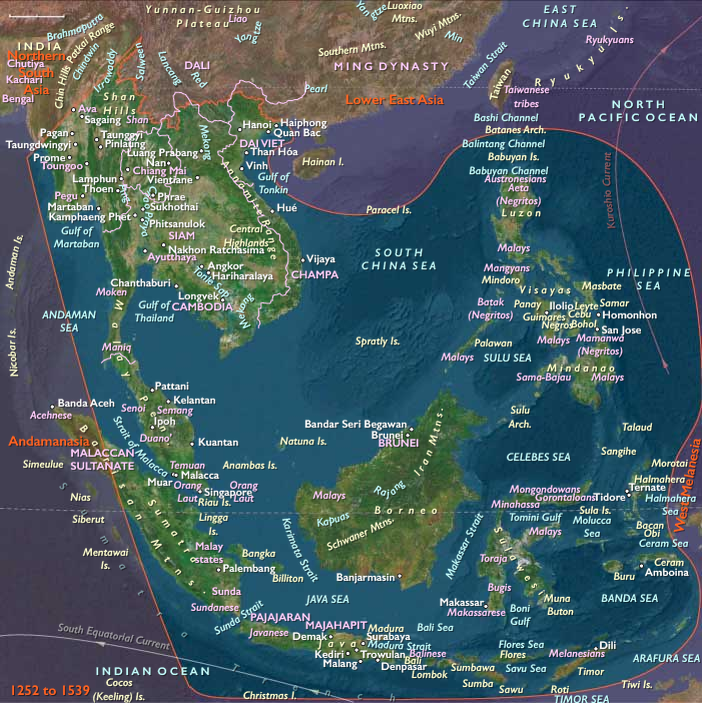
Ayutthayan invaders occupy the Khmer capital of Angkor Wat in 1369.
Locations
Groups
Topics
Commodoties
Subjects
Regions
Subregions
Related Events
Filter results
Showing 5 events out of 5 total
King Richard, following the death of his mother, Joan of Kent, in 1385, and resentful of his regents, had begun to take control of England, appointing his friends to high office.
He has offended much of the English populace with his high-handed style of government, disinterest in the French war, and reliance on these few young friends, especially Michael de la Pole, earl of Suffolk, who Richard names chancellor, and Robert de Vere, earl of Oxford, who Richard makes Duke of Ireland.
Following the departure of Richard’s uncle, John of Gaunt, for Spain, the “Merciless” Parliament of 1386, packed by several barons under the leadership of the the king’s uncle, Thomas of Woodstock, Duke of Gloucester, meets under the threat of rebellion by the king's five leading opponents, known as the Lords Appellant—Gloucester; Gaunt's son, Henry Bolingbroke; the earl of Arundel; the earl of Warwick; and the earl of Nottingham—who bring charges of treason against Oxford.
Suffolk is impeached and a council is imposed on the king, despite Richard's charges of treason.
Roger Mortimer, born April 11, 1374, at Usk in Monmouthshire, is the eldest son of Edmund Mortimer, 3rd Earl of March, by his wife Philippa Plantagenet, who as the daughter of Lionel of Antwerp, 1st Duke of Clarence, and granddaughter of King Edward III, had a claim to the crown which she passed on to her children.
He has a younger brother, Edmund Mortimer, and two sisters, Elizabeth, who has married Henry 'Hotspur' Percy, and Philippa (1375–1401), who will marry firstly John Hastings, 3rd Earl of Pembroke, killed in a tournament at Woodstock Palace in 1389, secondly Richard de Arundel, 11th Earl of Arundel, who will be beheaded in 1397, and thirdly, Sir Thomas Poynings.
Roger Mortimer's mother, Philippa, died on or before January 5, 1382, and was buried at Wigmore Abbey.
His father, said to have caught cold crossing a river in winter, had died at the Dominican friary at Cork in Munster on December 27, 1381, leaving his son to succeed to a title and extensive estates at only six years of age.
Mortimer's estates in England and Wales are on December 16, 1383, granted, for four thousand pounds per annum, to a consortium consisting of Mortimer himself, the Earls of Arundel, Northumberland, and Warwick, and John, Lord Neville.
The guardianship of Mortimer's person had initially been granted to Arundel, but at the behest of King Richard's mother, Joan of Kent, in August 1384 Mortimer's wardship and marriage had been granted, for six thousand marks, to Joan's son, Thomas Holland, 2nd Earl of Kent, who is Richard's half-brother, and on or about October 7, 1388, Mortimer had married Kent's daughter, Eleanor Holland, who is Richard's half-niece.
Mortimer does homage and was on June 18, 1393, granted livery of his lands in Ireland, and on February 25, 1394, of those in England and Wales .
King Richard has no issue, and Mortimer, a lineal descendant of Edward III, is next in line to the throne and married to his half-niece.
George Edward Cokayne, in The Compete Peerage (1932) states that in October 1385 Mortimer was proclaimed by the King as heir presumptive to the crown.
However, according to R.R. Davies in his entry for Mortimer in the Oxford Dictionary of National Biography (1994) the story that Richard publicly proclaimed Mortimer as heir presumptive in Parliament in October 1385 is baseless, although contemporary records indicate that his claim was openly discussed at the time.
He was knighted on April 23, 1390, by the King.
Mortimer after he came of age spent much of his time in Ireland.
King Richard had first made Mortimer his Lord Lieutenant of Ireland on January 24, 1382 when he was a child of seven, with his uncle, Sir Thomas Mortimer, acting as his deputy.
The King had reappointed Roger Mortimer as his lieutenant in Ireland on July 23, 1392, and in September 1394 Mortimer accompanies the King on an Irish expedition in response to interclan strife affecting English administration.
Richard engages in little fighting, but successful negotiations gain him the submission of fifty Irish chiefs and result in his knighting of five Irish kings before he departs the following year.

The Lords Appellant, a group of powerful barons who had come together during the 1380s to seize political control of England from King Richard II, are called so because its members claim simply to be appealing to the King for good government (their major complaint had been Richard's decision to make peace with France).
The Lords are led by Thomas of Woodstock, 1st Duke of Gloucester (youngest son of King Edward III and thus King Richard's uncle), Richard Fitzalan, 11th Earl of Arundel, and Thomas de Beauchamp, Earl of Warwick; the group also involves the Earl of Nottingham, as well as Richard's cousin, the Earl of Derby and Northampton, Henry Bolingbroke.
The Lords Appellant in 1387 had launched an armed rebellion against King Richard and defeated his forces at Radcot Bridge, outside Oxford.
They had maintained Richard as a figurehead with little real power, and impeached, imprisoned, exiled, or executed most of his court.
For example, Richard's Chancellor, the Earl of Suffolk, had been impeached in 1386, and the Duke of Ireland had been stripped of his titles and exiled.
Richard's uncle and supporter, John of Gaunt, the Duke of Lancaster, had returned from Spain in 1389 and Richard has since been able to rebuild his power gradually.
With national stability secured, Richard had begun negotiating a permanent peace with France.
A proposal put forward in 1393 would have greatly expanded the territory of Aquitaine possessed by the English crown.
However, the plan failed because it included a requirement that the English king pay homage to the King of France—a condition that proved unacceptable to the English public.
Instead, in 1396, a truce is agreed to, which is to last twenty eight years.
The truce is hugely unpopular at home in spite of the dividends that peace bring to the kingdom.
As part of the truce, the childless Richard agrees to marry Isabella, daughter of Charles VI of France by Isabella of Bavaria-Ingolstadt, when she comes of age.
There are some misgivings about the betrothal, in particular because the princess is only six years old, and thus will not be able to produce an heir to the throne of England for many years.
Isabella is moved to Wallingford Castle for protection while Richard campaigns in Ireland.
Although the union is political, the twenty-nine-year-old Richard and his child consort will develop a mutually respectful relationship.
The period that historians refer to as the "tyranny" of Richard II began towards the end of the 1390s.
Finally able to exert autocratic authority over the kingdom, he purges all those he sees as not totally committed to him, fulfilling his own idea of becoming God’s chosen prince.
The king now destroys the Lords Appellant, in July 1397 having them arrested.
Arundel is the first of the three to be brought to trial, at the parliament of September 1397.
After a heated quarrel with the king, he is condemned and executed.
Gloucester is being held prisoner by the Earl of Nottingham at Calais while awaiting his trial.
As the time for the trial draws near, Nottingham brings news that Gloucester is dead.
It is thought likely that the king had ordered him to be killed to avoid the disgrace of executing a prince of the blood.
Warwick is also condemned to death, but his life is spared and he is sentenced to life imprisonment instead. (Imprisoned in one of the Tower of London’s thirteen towers, he will give his name to the Beauchamp Tower.)
Arundel's brother Thomas Arundel, the Archbishop of Canterbury, is exiled for life.
Richard now takes his persecution of adversaries to the localities.
While recruiting retainers for himself in various counties, he prosecutes local men who had been loyal to the appellants.
The fines levied on these men bring great revenues to the crown, although contemporary chroniclers raise questions about the legality of the proceedings.
These actions have been made possible primarily through the collusion of John of Gaunt, but also with the support of a number of men lifted to prominence by the king, disparagingly referred to as Richard's "duketti".
John and Thomas Holland, the king's half-brother and nephew, are promoted from earls of Huntingdon and Kent to dukes of Exeter and Surrey, respectively. (Thomas had been sent by Richard to arrest his own uncle, Arundel.)
Among the other loyalists are John Beaufort, Earl of Somerset, Edward, Earl of Rutland, John Montacute, Earl of Salisbury, and Thomas le Despenser.
With the forfeited land of the convicted appellants, the king can now reward these men with lands and incomes suited to their new ranks.
A threat to Richard's authority still exists, however, in the form of the House of Lancaster, represented by John of Gaunt and his son Henry, Earl of Derby (also known as Henry of Bolingbroke).
The house of Lancaster not only possesses greater wealth than any other family in England, they are also of royal descent and, as such, likely candidates to succeed the childless Richard.
Discord breaks out in the inner circles of court in December 1397, when Bolingbroke and Thomas de Mowbray—who have now been made Duke of Hereford and Duke of Norfolk, respectively,—become engaged in a quarrel.
According to Bolingbroke, Mowbray had claimed that the two, as former Lords Appellant, are next in line for royal retribution.
Mowbray vehemently denies these charges, as such a claim would amount to treason.
Arundel’s younger brother Thomas, who had been provided to the Bishopric of Ely in 1373 and fourteen years later transferred to the archbishopric of York, finally moves to Canterbury on September 25, 1397, to replace the late William Courtenay.
He is immediately exiled, however, by King Richard and his tenure assumed in November by Roger Walden, who had served Richard as secretary before becoming treasurer of England, adding the deanery of York to his numerous other benefices.