
Boleslaw II has pursued a policy of …
Years: 1063 - 1063
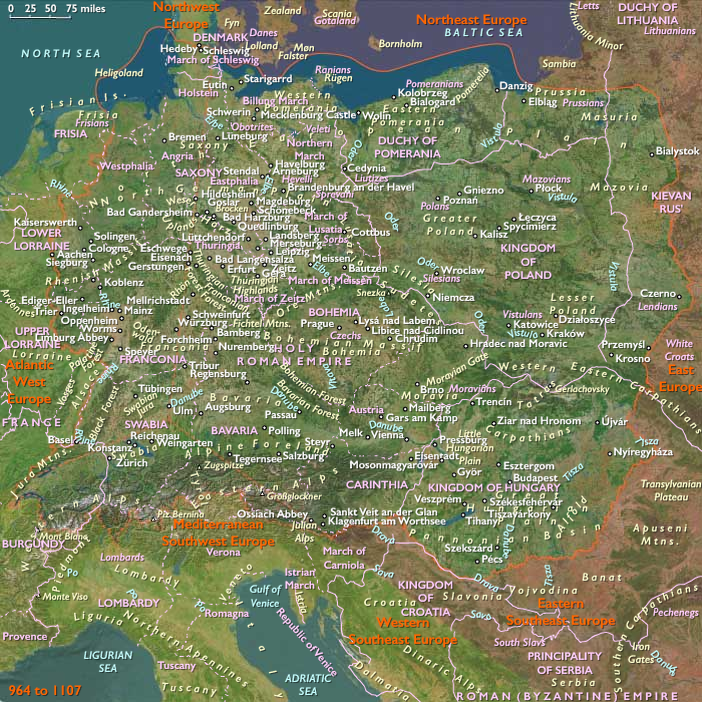
Boleslaw II has pursued a policy of cooperation with the anti-Imperial faction in Hungary, which has allowed him to gain political independence from the Empire but has put him in conflict with an Imperial ally, the Duchy of Bohemia.
Moreover, he had escalated the conflict with the Premyslid duke Vratislaus II by refusing to pay the annual homage for Silesia and spurring the Bohemian nobility to revolt.
IBoleslaw II besieges the (at this time) Moravian town of Hradec nad Moravicí in 1063, but, defeated, he has to retreat.
In the end, the relations with Vratislaus II are settled to a certain extent when the latter marries Princess Swietoslawa, Boleslaw II's sister.
Locations
People
Groups
- Bohemia, Duchy of
- Kievan Rus', or Kiev, Great Principality of
- German, or Ottonian (Roman) Empire
- Hungary, Kingdom of
- Pomerania, Wendish Duchy of
- Poland of the first Piasts, Kingdom of
Commodoties
Subjects
Regions
Subregions
Related Events
Filter results
Showing 10 events out of 50962 total
Emperor Renzong of Song, despite his long reign of over forty years, is not widely known to history.
His reign marks the high point of Song influences and powers but is also the beginning of its slow disintegration that will persist over the next century and a half.
One possible reason behind its weakness is its interpretation of its own foreign policy.
The official policy of the Song Dynasty at this time is one of pacifism and this has caused the weakening of the military.
Western Xia has taken advantage of this deterioration to wage small scale wars against Song China near the borders.
When Renzong came into power, he had issued decrees to strengthen the military and pays massive bribes to the Liao government, an adversary of Western Xia, in the hope that this would ensure the safety of Song China.
However these policies involve a heavy price.
Taxes had been increased severely and the peasants live in a state of perpetual poverty.
This had eventually caused organized rebellions to take place throughout the country and the breakdown of the government.
Emperor Renzong has elevated the forty-sixth generation descendants of Confucius to the current title of Duke Yansheng.
They had previously been of lower noble ranks.
In 1055, the Emperor Renzong had fallen ill, and as he has no surviving sons, there was a threat to the succession.
Under prompting from his Court officials Renzong had agreed to bring two boys, sons of Imperial clansmen, into the palace.
Yingzong is the thirteenth son of Zhao Yunrang (995–1059), known posthumously as Prince Pu Anyi.
Zhao Yunrang had been the first director of the Great Office of [Imperial] Clan Affairs and so the most important clan official at the time.
Moreover Yunrang had been raised in the Palace as a potential heir to Zhenzong before Renzong was born in 1010.
He was a first cousin of Emperor Renzong.
Yingzong's grandfather was Zhao Yuanfen (969–1005), known posthumously as Prince Shang Gongjing, and younger brother of Emperor Zhenzong.
Yingzong's mother, from the Ren family, was the third wife of Prince Pu Anyi, and was titled xianjun of Xianyou (xianjun is a title literally meaning "first lady of the county," which is given to the wives of a certain category of Chinese civil servants).
Renzong, still without a natural heir, dies in 1063 , and Yingzong assumes the imperial throne.
Béla of Hungary has attempted to conclude a peace treaty with the Holy Roman Empire.
For this purpose, shortly after his coronation, he had released all German commanders who had assisted his brother during the civil war.
However, the young German monarch's advisors had refused Béla's proposals.
In the summer of 1063, an assembly of the German princes decides to launch a military expedition against Hungary to restore young Solomon to the throne.
Béla is planning to abdicate in favor of his nephew if the latter restores his former ducatus, but he is seriously injured when "his throne broke beneath him" in his manor at Dömös.
The king—who was "half-dead", according to the Illuminated Chronicle—is taken to the western borders of his kingdom, where he dies at the creek Kinizsa on September 11, 1063.
Béla is buried in the Benedictine Szekszárd Abbey, which he had set up in 1061.
Following Béla's death, his three sons—Géza, Ladislaus and Lampert—seek refuge in Poland.
Accompanied back to Hungary by German troops, Solomon enters Székesfehérvár without resistance.
He is ceremoniously "crowned king with the consent and acclamation of all Hungary" in September 1063, according to the Illuminated Chronicle.
The same source adds that the German monarch "seated" Solomon "upon his father's throne", but did not require him to take an oath of fealty Solomon's marriage with Henry IV's sister, Judith—who is six year older than her future husband—also takes place on this occasion.
Judith, along with the Queen Mother Anastasia, becomes one of her young husband's principal advisors.
Solomon's three cousins—Géza and his brothers—had returned after the German troops had been withdrawn from Hungary.
They had arrived with Polish reinforcements and Solomon sought refuge in the fortress of Moson at the western border of his kingdom.
After the Hungarian prelates began to mediate between them in order to avoid a new civil war, Solomon and his cousins finally reach an agreement, which is signed in Győr on January 20, 1064.
Géza and his brothers acknowledge Solomon as lawful king, and Solomon grants them their father's one-time ducatus.
In token of their reconciliation, Duke Géza puts a crown on Solomon's head in the cathedral of Pécs on Easter Sunday.
However, their relationship still remains tense: when the cathedral burns down during the next night, they initially accuse each other of arson.
Vratislaus, an ally of Henry IV, will support the Emperor in both the Investiture Controversy against the popes and the rebellions in Saxony that are to dominate his long reign.
Pope Gregory VII, having already gained the support of Boleslaw II of Poland, is keen on roping in the duke of Bohemia to surround the emperor with adversaries fighting for the church.
The pope confirms Vratislaus in the privilege of wearing the miter and tunic, which his predecessors had had.
The pope also expresses gratitude for the regular payment of tribute to the Holy See.
Vratislaus is often at odds with his brother Jaromír, the bishop of Prague, and he wears his religious vestments around the bishop to irritate him.
Jaromír, for his part, ignores the creation in 1063 of a new Moravian diocese at Olomouc by Vratislaus, who raises John, a monk of Brevnov, to the see.
Jaromír is resentful of the loss of tithes and fiefs and the brothers enter into a long rivalry.
Jaromír even attacks the new bishop of Olomouc and carries off by force of arms the relics which had been removed from Prague to the new see.
Vratislaus, for his part, spites his brother by wearing his episcopal vestments—an honor conferred by the pope for the price of one hundred marks per annum—in his brother's presence at official functions.
Despite the pope's support for Vratislaus' new see, the Bohemian duke is unswayed in his loyalty to the emperor.
Tughril heads an empire that includes western Iran and Mesopotamia, while his brother Chaghri had gained control over the greater part of Khorasan.
Dying childless in 1063 in the city of Rey, he is succeeded by his nephew Suleiman, but this succession is contested by Alp Arslan, both of them sons of his late brother Chaghri.
His cousin Qutalmish, who had both been a vital part of his campaigns and later a supporter of Yinal's rebellion, also puts forth a claim.
The first attempt by Ramiro I of Aragon to take Graus, the northernmost Muslim outpost in the valley of the Cinca, had taken place in 1055, probably in response to the defeat of García Sánchez III of Navarre at Atapuerca the year before (1054), which had placed Ferdinand I of León and Castile in a commanding position against Ramiro's western border and the Muslim Taifa of Zaragoza to his south.
His first expedition against Graus had failed, and in 1059 Ferdinand had succeeded in extorting parias (tribute) from Zaragoza.
Ramiro marches on Graus again in the spring of 1063, but this time the Zaragozans have with them three hundred Castilian knights under the infante Sancho the Strong and (possibly) his general Rodrigo Díaz de Vivar, better known as El Cid.
The presence of the Cid at the battle is based on a single source, the generally reliable Historia Roderici, which alleges that he was the alférez of Sancho at the time.
Considering the rarity of the Cid's name in the documents of the early 1060s, this is unlikely.
The circumstances of the actual battle are obscure.
Reinhart Dozy argued that Ramiro survived four months after the battle and that neither the Cid nor Sancho took any part in it.
The Fragmentum historicum ex cartulario Alaonis records only that occisus est a mauris in bello apud Gradus (he [Ramiro] was killed by the Moors in war near Graus), with no mention of the Castilians.
The aforementioned Chronica naierensis contains an account generally, though not universally, regarded as a legend: that Sancho Garcés, an illegitimate son of García Sánchez III of Navarre, eloped with the daughter of García's wife, Stephanie (probably by an earlier marriage), who was the fiancée of the Castilian infante Sancho, and that he sought refuge at the court first of Zaragoza, then later of Aragon.
Sancho, to avenge the disruption of his marriage plans, marched against Ramiro and Zaragoza, and Ramiro died in the encounter near "the place called Graus" (loco qui Gradus dicitur) in 1064 or 1070.
According to the Arabic historian al-Turtūshī, Ramiro (misidentified as "Ibn Rudmīr", the son of Ramiro) was assassinated by a Muslim soldier who spoke the Christians' language and infiltrated the Aragonese camp.
Cerami, a hilltop town, is the location of a major battle between Normans and Muslims in 1063, during the Norman conquest of the Island by Roger of Hauteville.
According to Benedictine monk and historian Goffredo Malaterra, after being besieged in the neighboring town of Troina for four months, Roger and one hundred and thirty-six ferocious Norman knights took to the field of Cerami and faced approximately fifty thousand Muslim soldiers.
The apparition of St. George was said to have materialized on a white horse carrying the sign of the cross on his lance and charging into the enemy where their array was the most dense.
Malaterra claims the Normans slaughtered thirty-five thousand of the enemy.
According to English historian Edward Gibbon, even accounting for five or six men at arms accompanying each Norman knight into battle, and even accounting for the Normans' superior martial training, the victory was either miraculous or fabulous.
Nevertheless, the Normans will eventually to capture the island.
Malaterra's work, probably finished his history around 1098, is one of the three surviving contemporaneous histories of the Norman conquest of Italy, the others being those of William of Apulia and Amatus of Montecassino.
Malaterra's is significant because it is the only history to significantly cover the conquest of Sicily.
It seems likely that Goffredo was writing at the behest of Roger, who was an old man by that time and may have been looking to legitimize the claims of his heirs.
Unlike other medieval historians, such as Dudo of Saint-Quentin, Malaterra does not directly identify his sources, and alludes briefly to a number of informants, or relatoribus.
These may have included Roger I of Sicily, himself.
Ferdinand, using the new income from his parias in 1063, organizes a "great raid, or razzia" into the taifas of Seville and ...
…Badajoz.
Seville, and probably Badajoz also, pays ransom for his withdrawal.
This attack is probably also designed to remove Badajoz as a threat during his siege of Coimbra the next year.
Although the sources are unclear, it is possible that Ferdinand attacked the taifa of Badajoz as early as 1055.
Construction begins in 1064 on the Duomo, the medieval cathedral of the Archdiocese of Pisa, entitled to Santa Maria Assunta (St. Mary of the Assumption).
This is to be a five-naved cathedral with a three-naved transept.
Designed by the architect Busketo, it is to set the model for the distinctive Pisan Romanesque style of architecture.
Years: 1063 - 1063
Locations
People
Groups
- Bohemia, Duchy of
- Kievan Rus', or Kiev, Great Principality of
- German, or Ottonian (Roman) Empire
- Hungary, Kingdom of
- Pomerania, Wendish Duchy of
- Poland of the first Piasts, Kingdom of
