
Brahmanism competes in the political and spiritual …
Years: 177BCE - 166BCE
Brahmanism competes in the political and spiritual realm with Buddhism in the Gangetic plain.
Buddhist sources, such as the Asokavadana, mention that Pusyamitra was hostile towards Buddhists and allegedly persecuted the Buddhist faith.
A large number of Buddhist monasteries (viharas) were allegedly converted to Hindu temples, in such places as Nalanda, Bodhgaya, Sarnath or Mathura.
While it is established by secular sources that Hinduism and Buddhism were in competition during this time, with the Sungas preferring the former to the latter, historians such as Etienne Lamotte and Romila Thapar argue that Buddhist accounts of persecution of Buddhists by Sungas are largely exaggerated.
The traditional narratives are dated to two centuries after Pushyamitra’s death in Asokâvadâna and the Divyâvadâna, Buddhist books of legend.
The Asokavadana legend is likely a Buddhist version of Pusyamitra's attack on the Mauryas, reflecting the declining influence of Buddhism in the Sunga Imperial court.
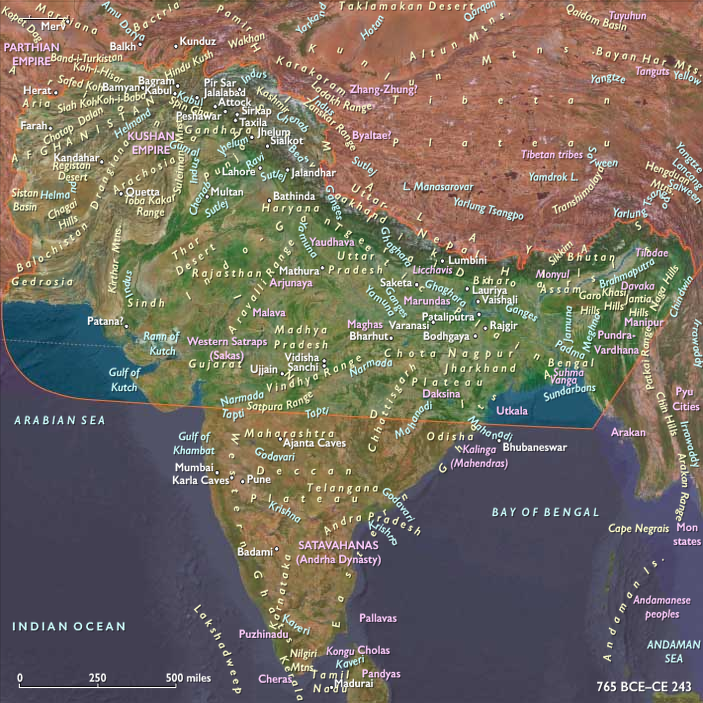
Support of the Buddhist faith by the Sungas at some point is suggested by an epigraph on the gateway of Barhut, which mentions its erection "during the supremacy of the Sungas".
On the other hand, Sir John Marshall noted that the Sanchi stupa was vandalized during the second century BCE before it was rebuilt later on a larger scale, suggesting the possibility that the original brick stupa built by Ashoka was destroyed by Pusyamitra and then restored by his successor Agnimitra.
Similarly, the Deokothar Stupas (geographically located between Sanchi and Barhut) suffered destruction during the same period, also suggesting some kind of involvement of Sunga rule.
Proponents also point to the proclamations and claim that the Manu Smriti was propagated.
Under the Sunga dynasty, stupas—brick-faced, domical mounds containing the relics of the Buddha, whose form symbolically represents the Buddhist universe—will become increasingly elaborate structures.
Locations
People
Groups
Topics
Subjects
Regions

Subregions
Years: 177BCE - 166BCE
Locations
People
Groups
Topics
Subjects
Regions
Subregions