
Breugel, despite the influence of his post-apprenticeship …
Years: 1563 - 1563
Breugel, despite the influence of his post-apprenticeship travels in Italy, continues to paint in a manner that is strongly Northern in both subject and style.
A multiplicity of small elements, an overall composition, and a bird's-eye perspective characterizes his works of this period, exemplified by his Netherlandish Proverbs, painted in 1559, a typically satiric rendering of human folly and sinfulness.
Children's Games, a famous painting executed in 1560 by Bruegel, depicts children playing with a number of toys (most of them still used today in almost identical forms).
A religious painting, the Suicide of Saul, painted by Bruegel in 1562 when he is thirty-eight, exemplifies the change that begins to take place in his style, and shows the Flemish artist’s practice of depicting religious subjects as contemporary events.
His compositions become increasingly concentrated and are often organized along diagonals; the main action is more frequently presented at eye level.
Patronized, by Cardinal Antoine Perrenot de Granville, advisor to Philip II, Breugel moves in about 1563 from Antwerp to …
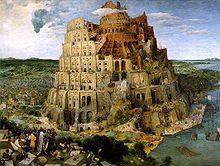
Pieter Brueghel the Elder, The Tower of Babel (1563) oil on board, Kunsthistorisches Museum, Vienna
Locations
People
Groups
Topics
- Renaissance in the Low Countries
- Protestant Reformation
- Counter-Reformation (also Catholic Reformation or Catholic Revival)
- Western Art: 1552 to 1564
Subjects
Regions
Subregions
Years: 1563 - 1563
Pieter Brueghel the Elder, The Tower of Babel (1563) oil on board, Kunsthistorisches Museum, Vienna
Locations
People
Groups
Topics
- Renaissance in the Low Countries
- Protestant Reformation
- Counter-Reformation (also Catholic Reformation or Catholic Revival)
- Western Art: 1552 to 1564
Subjects
Regions
Subregions