
Breugel's The Triumph of Death, strongly …
Years: 1559 - 1559
Breugel's The Triumph of Death, strongly influenced by the style of Hieronymus Bosch, is a panoramic landscape of death: the sky in the distance is blackened by smoke from burning cities and the sea is littered with shipwrecks.
Armies of skeletons advance on the hapless living, who either flee in terror or try vainly to fight back.
Skeletons kill people in a variety of ways: slitting throats, hanging, drowning, and even hunting with skeletal dogs.
In the foreground, skeletons haul a wagon full of skulls, and ring the bell that signifies the death knell of the world.
A fool plays the lute while a skeleton behind him plays along; a starving dog nibbles at the face of a child; a cross sits lonely and impotent in the center of the painting.
People are herded into a trap decorated with crosses, while a skeleton on horseback slaughters people with a scythe.
The painting depicts people of different social backgrounds -- from peasants and soldiers to nobles and even a king and a cardinal -- being taken by death indiscriminately.
The painting shows aspects of everyday European life in the mid-sixteenth century.
Clothes are clearly depicted, as are pastimes such as playing cards.
It shows a common method of execution for sixteenth-century criminals: being lashed to a cartwheel mounted on a vertical pole and objects such as musical instruments and an early mechanical clock, and scenes including a funeral service.
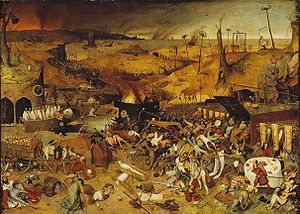
Pieter Brueghel the Elder, The Triumph of Death (c.1562) (oil on panel) 117 x 162 cm (46 x 63.8 in).Museo del Prado, Madrid.
Locations
People
Groups
Topics
- Renaissance in the Low Countries
- Protestant Reformation
- Counter-Reformation (also Catholic Reformation or Catholic Revival)
- Western Art: 1552 to 1564
Commodoties
Subjects
Regions
Subregions

Related Events
Showing 10 events out of 35957 total
Years: 1559 - 1559
Pieter Brueghel the Elder, The Triumph of Death (c.1562) (oil on panel) 117 x 162 cm (46 x 63.8 in).Museo del Prado, Madrid.
Locations
People
Groups
Topics
- Renaissance in the Low Countries
- Protestant Reformation
- Counter-Reformation (also Catholic Reformation or Catholic Revival)
- Western Art: 1552 to 1564
Commodoties
Subjects
Regions
Subregions