
Filters:
Britain has been at war with France's …
Years: 1744 - 1744
January
Britain has been at war with France's ally Spain since 1739, but despite widespread expectations France has not entered the war on Spain's side.
Sporadic fighting in the Americas has broken down into a stalemate.
A separate war has broken out on continental Europe regarding the Austrian Succession in which Britain and Spain are also on opposite sides and in which France remains initially neutral.
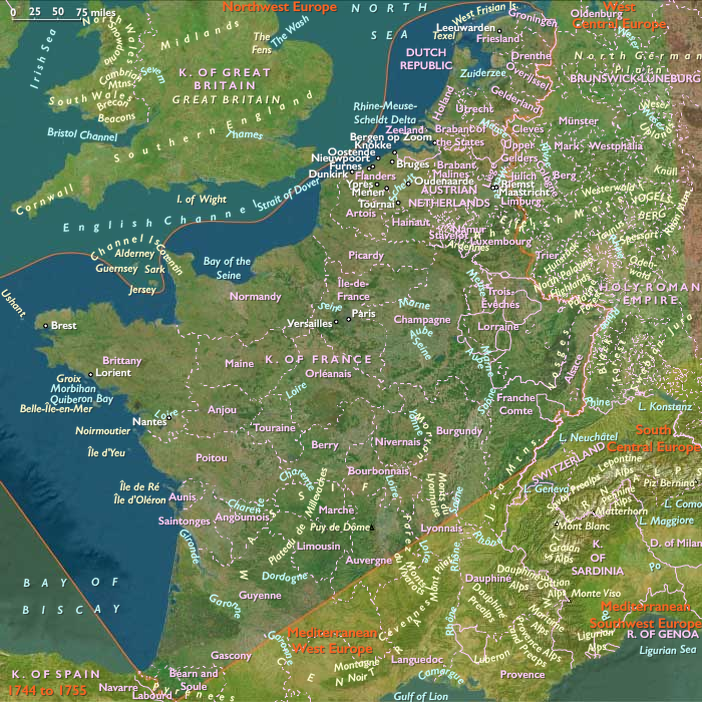
It is clear to many in both countries that war between them cannot be far off, and the British have been particularly alarmed by extensive fortifications in the French port of Dunkirk.
British and French troops have already fought in Europe at battles such as Dettingen and by late 1743 the two countries were in a state of de facto war.
The French King Louis XV in January 1744 formally declares war on Britain.
His ministers, convinced that a strong, immediate strike is needed against Britain, begin advocating an invasion of the British Isles.
British financial subsidies are essential to keeping its continental allies Austria, Hanover and the Dutch Republic afloat.
France believes that by invading Britain and knocking them out of the war, they can pave the way to an easy victory over their enemies to the east.
Preparations for the invasion had been ongoing for some time before the declaration of war and Minister of the Marine Count Maurepas had detailed his trusted and highly competent First Commissioner Joseph Pellerin to prepare for it.
Many flat-bottomed troop ships have been built and provisioned in the northern ports under the Pellerin's direction.
The King had strongly approved this plan.
The experienced Marshal Saxe has been given command of French land forces for the invasion.
The French plan to install the Jacobite James Edward Stuart in London as James III, who will end Britain's involvement in the war and turn Britain into a client state of Louis XV's government.
The Anglo-Austrian Alliance will be terminated, as will Britain's alliance with the Dutch, thereby reversing Britain's past successful policy of forming Grand Alliances against France on the continent through military support and financial subsidies.
James, who is living in exile in a French palace in Paris, has been made aware of these plans.
It is hoped that Jacobite supporters in the British navy and army will assist the French.
In some cases this proves wildly optimistic, as the officers listed as being committed Jacobites are often not or have already dies.
France now gathers a force estimated at somewhere between six thousand to fifteen thousand in size at Dunkirk under the command of Marshal Saxe.
Britain has been expecting a French invasion since as far back as 1740, when there had been an invasion scare, but the country is wary of the concept of standing armies and has limited regular forces to defend Great Britain.
The French plans for a landing at Maldon in Essex.
A squadron under Jacques Aymar, comte de Roquefeuil, will sail from Brest, checking that the Channel between Dunkirk and the English coast is clear of the British fleet.
A message will then be sent to Saxe's invasion force at Dunkirk, informing them that the crossing is feasible.
Sporadic fighting in the Americas has broken down into a stalemate.
A separate war has broken out on continental Europe regarding the Austrian Succession in which Britain and Spain are also on opposite sides and in which France remains initially neutral.
It is clear to many in both countries that war between them cannot be far off, and the British have been particularly alarmed by extensive fortifications in the French port of Dunkirk.
British and French troops have already fought in Europe at battles such as Dettingen and by late 1743 the two countries were in a state of de facto war.
The French King Louis XV in January 1744 formally declares war on Britain.
His ministers, convinced that a strong, immediate strike is needed against Britain, begin advocating an invasion of the British Isles.
British financial subsidies are essential to keeping its continental allies Austria, Hanover and the Dutch Republic afloat.
France believes that by invading Britain and knocking them out of the war, they can pave the way to an easy victory over their enemies to the east.
Preparations for the invasion had been ongoing for some time before the declaration of war and Minister of the Marine Count Maurepas had detailed his trusted and highly competent First Commissioner Joseph Pellerin to prepare for it.
Many flat-bottomed troop ships have been built and provisioned in the northern ports under the Pellerin's direction.
The King had strongly approved this plan.
The experienced Marshal Saxe has been given command of French land forces for the invasion.
The French plan to install the Jacobite James Edward Stuart in London as James III, who will end Britain's involvement in the war and turn Britain into a client state of Louis XV's government.
The Anglo-Austrian Alliance will be terminated, as will Britain's alliance with the Dutch, thereby reversing Britain's past successful policy of forming Grand Alliances against France on the continent through military support and financial subsidies.
James, who is living in exile in a French palace in Paris, has been made aware of these plans.
It is hoped that Jacobite supporters in the British navy and army will assist the French.
In some cases this proves wildly optimistic, as the officers listed as being committed Jacobites are often not or have already dies.
France now gathers a force estimated at somewhere between six thousand to fifteen thousand in size at Dunkirk under the command of Marshal Saxe.
Britain has been expecting a French invasion since as far back as 1740, when there had been an invasion scare, but the country is wary of the concept of standing armies and has limited regular forces to defend Great Britain.
The French plans for a landing at Maldon in Essex.
A squadron under Jacques Aymar, comte de Roquefeuil, will sail from Brest, checking that the Channel between Dunkirk and the English coast is clear of the British fleet.
A message will then be sent to Saxe's invasion force at Dunkirk, informing them that the crossing is feasible.
Locations
People
- Charles Emmanuel III
- George Wade
- James Francis Edward Stuart
- Jean-Frédéric Phélypeaux
- Joseph Pellerin
- Louis XV of France
- Maria Theresa
- Maurice de Saxe
- Philip V of Spain
- Thomas Mathews
Groups
- Austria, Archduchy of
- Swiss Confederacy, Old (Swiss Confederation)
- France, (Bourbon) Kingdom of
- Spain, Bourbon Kingdom of
- Britain, Kingdom of Great
- Sardinia, Kingdom of (Savoy)
Topics
Commodoties
Subjects
Regions

Subregions
Years: 1744 - 1744
January
Locations
People
- Charles Emmanuel III
- George Wade
- James Francis Edward Stuart
- Jean-Frédéric Phélypeaux
- Joseph Pellerin
- Louis XV of France
- Maria Theresa
- Maurice de Saxe
- Philip V of Spain
- Thomas Mathews
Groups
- Austria, Archduchy of
- Swiss Confederacy, Old (Swiss Confederation)
- France, (Bourbon) Kingdom of
- Spain, Bourbon Kingdom of
- Britain, Kingdom of Great
- Sardinia, Kingdom of (Savoy)
Topics
Commodoties
Subjects
Regions
Subregions