
The Matale Rebellion against British rule in …
Years: 1848 - 1848
July
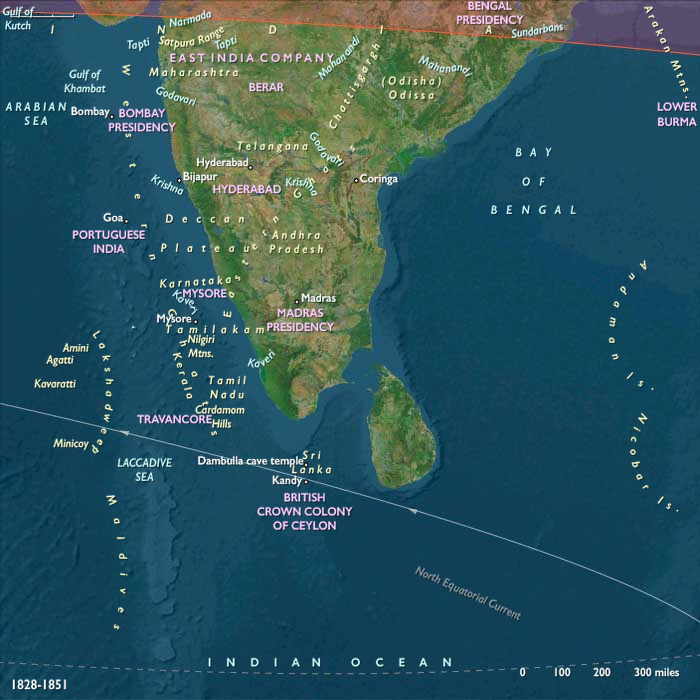
The Matale Rebellion against British rule in Sri Lanka breaks out in Ju1y 1848.
Following the suppression of the Uva Rebellion the Kandyan peasantry had been stripped of their lands by the Wastelands Ordinance, a modern enclosure movement, and reduced to penury.
The British have found that the uplands of Sri Lanka are very suitable for coffee, tea and rubber cultivation.
By the mid-nineteenth century, Ceylon tea has become a staple of the British market bringing great wealth to a small number of white tea planters.
Coffee is grown on the land taken from the peasants.
The principal impetus to this development had been the decline in coffee production in the West Indies, following the abolition of slavery there.
However, the dispossessed peasantry were not employed on the plantations: the Kandyan villagers refuse to abandon their traditional subsistence holdings and become wage-workers on these new estates.
The British therefore have to draw on its reserve pool of labor in India.
A system of contract labor is established that transports hundreds of thousands of Tamil 'coolies' from southern India into Sri Lanka for the coffee estates.
An economic depression in the United Kingdom has severely affected the local coffee and cinnamon industry, and planters and merchants are calling for a reduction of export duties.
Sir James Emerson Tennent, the Colonial Secretary in Colombo, had recommended to Earl Grey, Secretary of State for the Colonies in London, that taxation should be radically shifted from indirect taxation to direct taxation, which proposal was accepted.
It had been decided to abolish the export duty on coffee and reduce the export duty on cinnamon leaving a deficit of forty thousand pounds, which is to be met by direct taxes on the people.
A new Governor, thirty-five-year-old Lord Torrington, a cousin of Prime Minister Lord Russell, had been dispatched to Colombo by Queen Victoria to carry out these reforms.
On July 1, 1848, license fees are imposed on guns, dogs, carts, and shops, and labor is made compulsory on plantation roads unless a special tax is paid.
These taxes weigh heavily not only on the purse but also on the traditions of the Kandyan peasant.
A mass movement against the oppressive taxes begins to develop.
The masses are without the leadership of their native King (who had been deposed in 1815) or their chiefs (who had been either crushed after the Uva Rebellion or are collaborating with the colonial power).
The leadership passes for the first time in the Kandyan provinces into the hands of ordinary people.
Following the suppression of the Uva Rebellion the Kandyan peasantry had been stripped of their lands by the Wastelands Ordinance, a modern enclosure movement, and reduced to penury.
The British have found that the uplands of Sri Lanka are very suitable for coffee, tea and rubber cultivation.
By the mid-nineteenth century, Ceylon tea has become a staple of the British market bringing great wealth to a small number of white tea planters.
Coffee is grown on the land taken from the peasants.
The principal impetus to this development had been the decline in coffee production in the West Indies, following the abolition of slavery there.
However, the dispossessed peasantry were not employed on the plantations: the Kandyan villagers refuse to abandon their traditional subsistence holdings and become wage-workers on these new estates.
The British therefore have to draw on its reserve pool of labor in India.
A system of contract labor is established that transports hundreds of thousands of Tamil 'coolies' from southern India into Sri Lanka for the coffee estates.
An economic depression in the United Kingdom has severely affected the local coffee and cinnamon industry, and planters and merchants are calling for a reduction of export duties.
Sir James Emerson Tennent, the Colonial Secretary in Colombo, had recommended to Earl Grey, Secretary of State for the Colonies in London, that taxation should be radically shifted from indirect taxation to direct taxation, which proposal was accepted.
It had been decided to abolish the export duty on coffee and reduce the export duty on cinnamon leaving a deficit of forty thousand pounds, which is to be met by direct taxes on the people.
A new Governor, thirty-five-year-old Lord Torrington, a cousin of Prime Minister Lord Russell, had been dispatched to Colombo by Queen Victoria to carry out these reforms.
On July 1, 1848, license fees are imposed on guns, dogs, carts, and shops, and labor is made compulsory on plantation roads unless a special tax is paid.
These taxes weigh heavily not only on the purse but also on the traditions of the Kandyan peasant.
A mass movement against the oppressive taxes begins to develop.
The masses are without the leadership of their native King (who had been deposed in 1815) or their chiefs (who had been either crushed after the Uva Rebellion or are collaborating with the colonial power).
The leadership passes for the first time in the Kandyan provinces into the hands of ordinary people.
Locations
People
Groups
- Tamil people
- Sinhalese people
- Buddhists, Theravada
- East India Company, British (United Company of Merchants of England Trading to the East Indies)
- Britain (United Kingdom of Great Britain and Ireland)
- Ceylon, British Crown Colony of
Topics
Commodoties
Subjects
Regions

Subregions
Related Events
Showing 10 events out of 16793 total
Years: 1848 - 1848
July
Locations
People
Groups
- Tamil people
- Sinhalese people
- Buddhists, Theravada
- East India Company, British (United Company of Merchants of England Trading to the East Indies)
- Britain (United Kingdom of Great Britain and Ireland)
- Ceylon, British Crown Colony of
Topics
Commodoties
Subjects
Regions
Subregions