
This high point of Goryeo culture coincides …
Years: 1252 - 1395
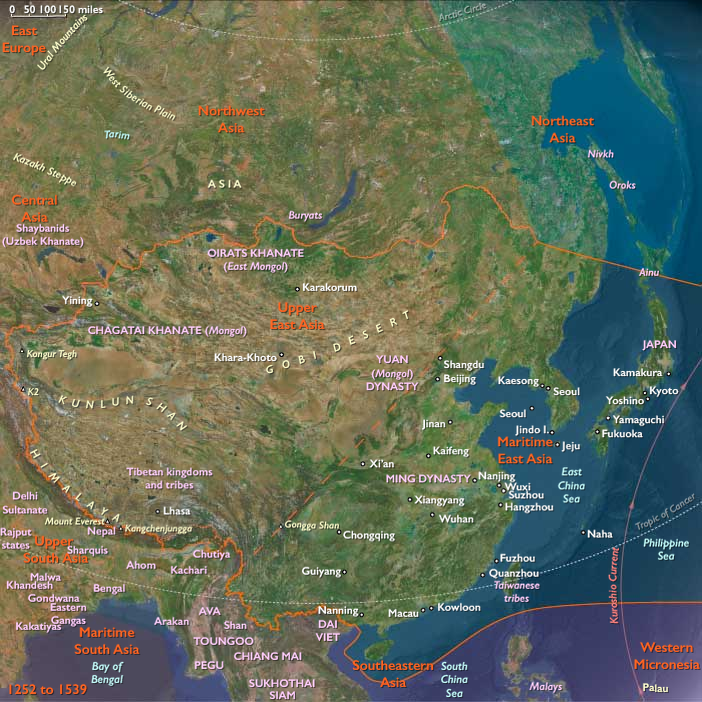
This high point of Goryeo culture coincides with internal disorder and the rise of the Mongols, whose power sweeps most of the known world during the thirteenth century.
Goryeo was no exception, as Kublai Khan's forces had invaded and demolished Goryeo's army in 1231, forcing the Goryeo government to retreat to Ganghwa Island (off modern-day Inch'on), a ploy that had exploited the Mongol horsemen's fear of water, but after a more devastating invasion in 1254, in which countless people die and some two hundred thousand people are made captives, Koryo succumbs to Mongol domination, and its kings marry Mongol princesses.
The Mongols now enlist thousands of Koreans in ill-fated invasions of Japan in 1274 and 1281, using Korean-made ships.
The Kamakura shogunate (1185-1333) turns back both invasions with aid, as legend has it, from opportune typhoons known as the "divine wind" or kamikaze.
The last period of Mongol influence is marked by the appearance of a strong bureaucratic stratum of scholar-officials or literati (sadaebu in Korean).
Many of them live in exile outside the capital, and they use their superior knowledge of the Confucian classics to condemn the excesses of the ruling families, who are backed by Mongol power.
Locations
People
Groups
Topics
- Mongol Conquests
- Mongol Invasions of Korea
- Mongol Invasion of Japan, First
- Mongol Invasion of Japan, Second
Subjects
Regions
Subregions

Years: 1252 - 1395
Locations
People
Groups
Topics
- Mongol Conquests
- Mongol Invasions of Korea
- Mongol Invasion of Japan, First
- Mongol Invasion of Japan, Second
Subjects
Regions
Subregions