Burebista, whose Geto-Dacian union now stretches from …
Years: 49BCE - 49BCE
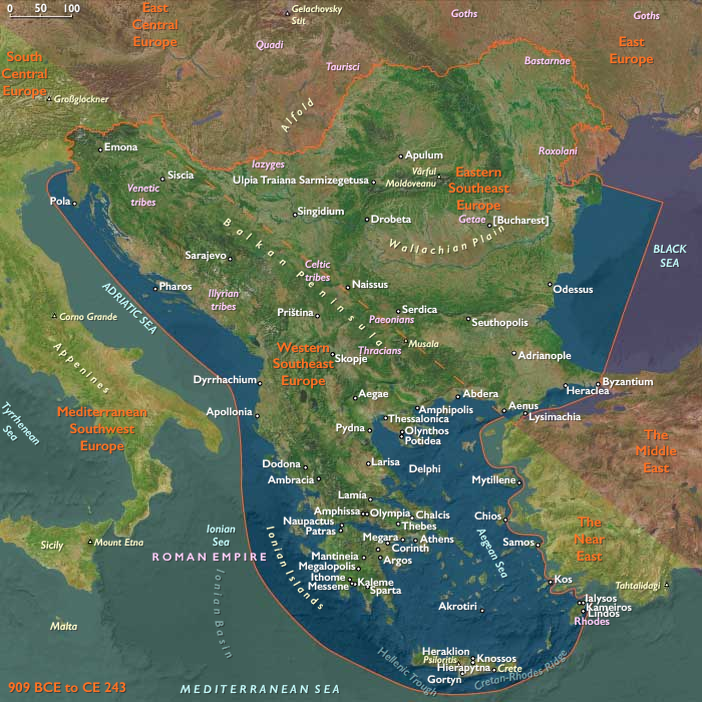
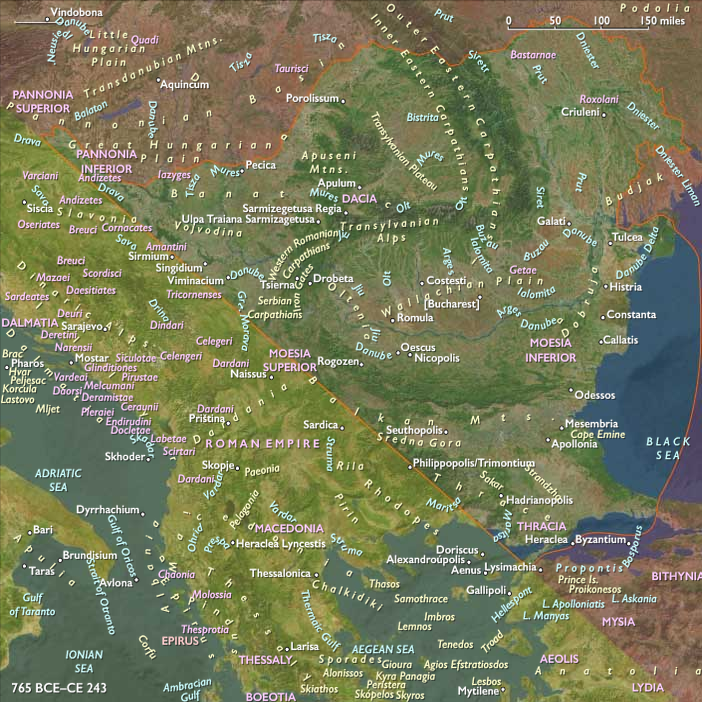
Burebista, whose Geto-Dacian union now stretches from the Black Sea to the Adriatic and from the Balkan Mountains to Bohemia, offers his support to Pompey in his struggle against Caesar.
Locations
People
Groups
Topics
- Classical antiquity
- Roman Age Optimum
- Roman Republic, Crisis of the
- Roman Civil War, Great, or Caesar's Civil War
Commodoties
Subjects
Regions
Subregions
Related Events
Filter results
Showing 10 events out of 62498 total
Contemporary historians are silent on the early reign of Pharnaces II, but eventually, on viewing the increasing power struggles between the Romans, and with an eye to recreating the kingdom of his father, he had attacked and subjugated the free Greek city of Phanagoria, violating one of his agreements with Pompey.
Ptolemy XIII, seeking to retain his father's allies in 49 BCE, supplies Pompey with ships and troops.
A court clique, headed by Theodotus, the eunuch Pothinus, and the general Achillas, subsequently gains influence over the King, fanning the growing rivalry between him and his strong-willed sister, who is seven years his senior.
Cicero, as he was in defense of the senate and Republican tradition, had in 50 BCE chosen to favor Pompey when the struggle between Pompey and Julius Caesar grew more intense, but at the same time he had prudently avoided openly alienating Caesar.
Cicero flees Rome in 49 BCE when Caesar invades Italy.
Caesar, seeking the legitimacy an endorsement by a senior senator would provide, has courted Cicero's favor, but even so Cicero slips out of Italy and travels to Dyrrachium (Epidamnos), Illyria, where Pompey's staff is situated.
Cassius Longinus, returning in 50 to Rome from Syria after a two-year stint as proquaestor, had been elected tribune of the Plebs for 49 BCE, and has thrown in his lot with the Optimates, although his brother Lucius Cassius supports Caesar.
Cassius had left Italy shortly after Caesar crossed the Rubicon.
Meeting Pompey in Greece, Cassius has been appointed to command part of his fleet.
Lucius Domitius Ahenobarbus, who had become proconsul of Gaul, is sent in April 49 to gain control of Massalia (modern Marseille) in order to oppose Caesar.
As Caesar marches to Spain (en route to the Battle of Ilerda), the Massiliots close their gates to him, having allied with Ahenobarbus and the Optimates.
Roused by their hostile actions, he commences a siege against Massallia, leaving the newly raised XVII, XVIII, and XIX legions to conduct the siege.
These are the same legions that will be wiped out at Teutoburg Forest fifty-eight years later.
He also places Decimus Junius Brutus Albinus in charge of his fleet here.
After the siege has begun, Ahenobarbus arrives in Massallia to defend it against the Caesarian forces.
In late June, Caesar's ships, although they are less skillfully built than those of the Massiliots and outnumbered, are victorious in the ensuing naval battle, after which the fleet is confiscated by the Roman authorities.
Gaius Trebonius, Caesar's legatus, conducts the siege using a variety of siege machines including siege towers, a siege-ramp, and a "testudo-ram".
Gaius Scribonius Curio, careless in adequately guarding the Sicilian Straits, allows Lucius Nasidius to bring more ships to the aid of Ahenobarbus.
He fights a second naval battle with Decimus Brutus in early September, but withdraws defeated and sails for Spain.
The Massiliots valiantly defend against the siege machines and works.
They throw down burning pitch and pine-shavings as the Caesarians undermine the foundations of their city walls.
At one point they seem likely to surrender and declare a truce, but at night they cunningly destroy the siege works in a gross violation of the treaty.
They are now near surrender.
At the final surrender of Massallia, Caesar shows his usual leniency and Lucius Ahenobarbus escapes to Thessaly in the only vessel that is able to escape from the Populares.
Afterwards, Massallia loses its independence and is absorbed into the Roman Republic.
During Roman times the city is called Massilia.
Gaius Sallustius Crispus (Anglicized as Salllust), had, after an ill-spent youth, entered public life and may have won election as quaestor in 55 BCE.
He became a Tribune of the Plebs in 52 BCE, the year in which the followers of Milo killed Clodius in a street brawl.
Sallust then supported the prosecution of Milo.
He also had hostilities with the famous orator Cicero.
From the beginning of his public career, Sallust has operated as a decided partisan of Julius Caesar, to whom he owes such political advancement as he attains.
In 50 BCE, the censor Appius Claudius Pulcher had removed him from the Senate on the grounds of gross immorality (probably really because of his opposition to Milo and Cicero); in the following year, perhaps through Caesar's influence, he is reinstated.
On January 1, 49, the Senate receives from Caesar a proposal that he and Pompey should lay down their commands simultaneously.
Caesar's message is peremptory, and on January 7, the Senate resolves that Caesar shall be treated as a public enemy if he does not lay down his command “by a date to be fixed.” On January 10-11, 49, Caesar leads a single legion across the little river Rubicon, the boundary between his province of Cisalpine Gaul and Italy proper.
He thus commits the first act of war.
This is not, however, the important aspect.
The actual question of substance is whether the misgovernment of the Greco-Roman world by the Roman nobility shall be allowed to continue or whether it shall be replaced by an autocratic regime.
Either alternative will result in a disastrous civil war.
(The subsequent partial recuperation of the Greco-Roman world under the principate suggests, however, that Caesarism was the lesser evil.)
The civil war is a tragedy, for war is not wanted either by Caesar or by Pompey or even by a considerable part of the nobility, while the bulk of the Roman citizen body ardently hopes for the preservation of peace.
By this time, however, the three parties that count politically are all entrapped.
Caesar's success in building up his political power has made the champions of the old regime so implacably hostile to him that he is now faced with a choice between putting himself at his enemies' mercy or seizing the monopoly of power at which he is accused of aiming.
He finds that he cannot extricate himself from this dilemma by reducing his demands (as he eventually will) to the absolute minimum required for his security.
As for Pompey, his growing jealousy of Caesar has led him so far toward the nobility that he cannot come to terms with Caesar again without loss of face.
Gnaeus Pompeius is the elder son of Pompey by his third wife, Mucia Tertia.
Both he and his younger brother Sextus Pompey have grown up in the shadow of their father, one of Rome's best generals and not originally a conservative politician who had drifted to the more traditional faction when Julius Caesar became a threat.
When Caesar crosses the Rubicon and ignites a civil war, Gnaeus follows his father in their escape to the south, as do most of the conservative senators.
Pompey, despite greatly outnumbering Caesar, who has with him only his Thirteenth Legion, does not intend to fight, having little confidence in his newly raised troops.
Caesar pursues Pompey, hoping to capture him before his legions can escape, but Pompey manages to elude him.

Caesar decides to head for Spain.
Leaving Italy under the control of Mark Antony, Caesar makes an astonishing twenty-seven-day route-march to Spain, where he defeats Pompey's lieutenants.
He then returns east, to challenge Pompey in Greece.
Caesar's lieutenants have fared less well, however, in Africa and around the Adriatic Sea.
Deciding to attack Pompey directly, Caesar brings fifteen thousand of his troops from Spain to Brundisium in Italy in late 49, intending to bring the war to Pompey.
Sampsiceramus I builds a castle during his reign (64-48 BCE) at Shmemis, on top of an extinct volcano, and ...
…rebuilds the city of Salamiyah, which the Romans incorporate in the ruling territory.
In time, Sampsiceramus I establishes and forms a powerful ruling dynasty and a leading kingdom in the Roman East.
His priest-king dynasty is to rule from 64 BCE until at least 254.
Caesar, with Spain secure, crosses the Adriatic to Epirus, landing here on January 4 and occupying Oricum and …
Years: 49BCE - 49BCE
Locations
People
Groups
Topics
- Classical antiquity
- Roman Age Optimum
- Roman Republic, Crisis of the
- Roman Civil War, Great, or Caesar's Civil War