Byblos and other Phoenician cities fall to …
Years: 549BCE - 538BCE
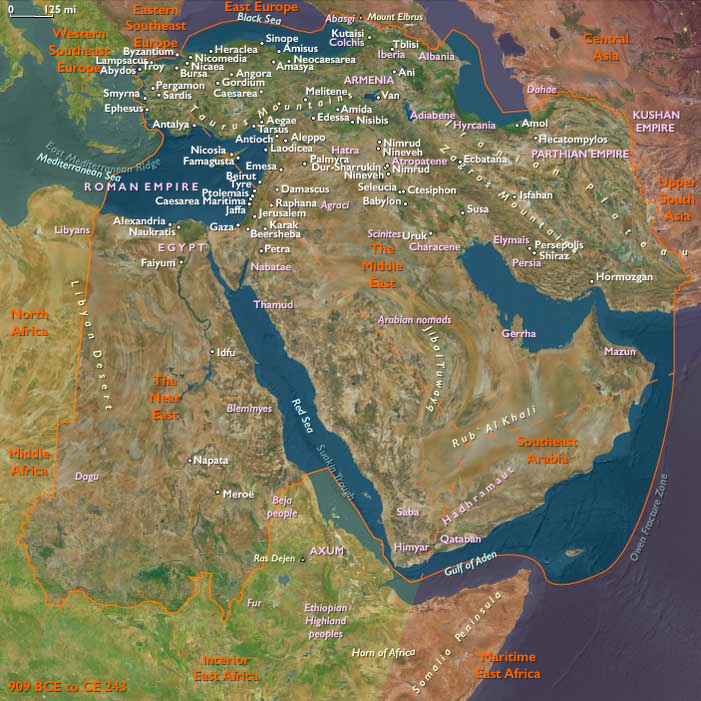
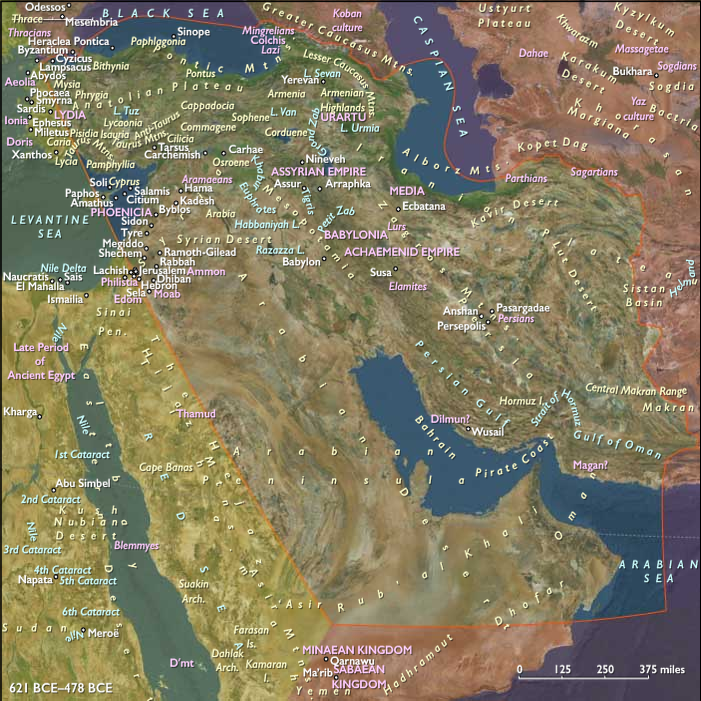
Byblos and other Phoenician cities fall to Persian control.
Locations
People
Groups
Topics
- Younger Subboreal Period
- Iron Age, Near and Middle East
- Iron Age Cold Epoch
- Classical antiquity
- Persian Conquests of 559-509 BCE
- Persian Revolt
- Persian-Lydian War of 547-546 BCE
Commodoties
Subjects
Regions
Subregions
Related Events
Filter results
Showing 10 events out of 26 total
Several new German universities are founded, some soon considered among Europe's best.
An increasingly literate public makes possible a jump in the number of journals and newspapers.
At the end of the seventeenth century, most books printed in Germany were in Latin; by the end of the next century, all but five percent are in German.
The eighteenth century also sees a refinement of the German language and a flowering of German literature with the appearance of such figures as Gotthold Lessing, Johann Wolfgang von Goethe, and Friedrich Schiller.
German music also reaches great heights with the Bach family, George Frederick Handel, Joseph Haydn, and Wolfgang Amadeus Mozart.
Johann Wolfgang von Goethe anonymously releases Annette, his first collection of poems, 1in 1770.
His uncritical admiration for many contemporary poets had vanished as he became interested in Gotthold Ephraim Lessing and Christoph Martin Wieland.
Already at this time, Goethe writes a good deal, but he throws away nearly all of these works, except for the comedy Die Mitschuldigen.
The restaurant Auerbachs Keller and its legend of Faust's 1525 barrel ride impressed him so much that Auerbachs Keller will become the only real place in his closet drama Faust Part One.
Goetheleaves Frankfurt in order to finish his studies at the University of Strasbourg in April 1770.
Goethe's father, Johann Caspar Goethe, lived with his family in a large house in Frankfurt, at this time an Imperial Free City of the Holy Roman Empire.
Though he had studied law in Leipzig and had been appointed Imperial Councillor, he was not involved in the city's official affairs.
Johann Caspar had married Goethe's mother, Catharina Elizabeth Textor at Frankfurt on August 20, 1748, when he was thirty-eight and she was seventeen.
All their children, with the exception of Johann Wolfgang and his sister, Cornelia Friederica Christiana, who was born in 1750, had died at early ages.
His father and private tutors had given Goethe lessons in all the common subjects of their time, especially languages (Latin, Greek, French, Italian, English and Hebrew).
Goethe had also received lessons in dancing, riding and fencing.
Johann Caspar, feeling frustrated in his own ambitions, had been determined that his children should have all those advantages that he had not.
Although Goethe's great passion was drawing, he had quickly became interested in literature; Friedrich Gottlieb Klopstock and Homer were among his early favorites.
He had a lively devotion to theater as well and was greatly fascinated by puppet shows that were annually arranged in his home; this is a recurrent theme in his literary work Wilhelm Meister's Apprenticeship.
He also took great pleasure in reading works on history and religion.
Goethe had become also acquainted with Frankfurt actors.
Among early literary attempts, he was infatuated with Gretchen, who would later reappear in his Faust and the adventures with whom he would concisely describe in Dichtung und Wahrheit.
He adores Caritas Meixner (July 27, 1750 – December 31, 1773), a wealthy Worms trader's daughter and friend of his sister, who will later marry the merchant G. F. Schuler.
Goethe had studied law at Leipzig University from 1765 to 1768. He detested learning age-old judicial rules by heart, preferring instead to attend the poetry lessons of Christian Fürchtegott Gellert.
In Leipzig, Goethe had fallen in love with Anna Katharina Schönkopf and had written cheerful verses about her in the Rococo genre.
As his studies did not progress, Goethe had been forced to return to Frankfurt at the close of August 1768.
Goethe had become severely ill in Frankfurt.
During the following year and a half that followed, because of several relapses, the relationship with his father has worsened.
Goethe is nursed during convalescence by his mother and sister.

No other landscape does he describe as affectionately as the warm, wide Rhine area.
In Strasbourg, Goethe has met Johann Gottfried Herder.
The two have become close friends, and crucially to Goethe's intellectual development, Herder has kindlesd his interest in Shakespeare, Ossian and in the notion of Volkspoesie (folk poetry).
On October 14, 1772 Goethe had held a gathering in his parental home in honor of the first German "Shakespeare Day".
His first acquaintance with Shakespeare's works is described as his personal awakening in literature.
On a trip to the village Sessenheim, Goethe had fallen in love with Friederike Brion, in October 1770, but, after ten months, terminated the relationship in August 1771.
Several of his poems, like "Willkommen und Abschied", "Sesenheimer Lieder" and "Heidenröslein", originate from this time.
At the end of August 1771, Goethe had acquired the academic degree of the Lizenziat (Licentia docendi) in Frankfurt and established a small legal practice.
Although in his academic work he had expressed the ambition to make jurisprudence progressively more humane, his inexperience led him to proceed too vigorously in his first cases, and he was reprimanded and lost further ones.
This had prematurely terminated his career as a lawyer after only a few months.
At this time, Goethe is acquainted with the court of Darmstadt, where his inventiveness is praised.
From this milieu comese Johann Georg Schlosser (who is later to become his brother-in-law) and Johann Heinrich Merck.
Goethe also pursues literary plans again; this time, his father does not have anything against it, and even helps.
Goethe obtains a copy of the biography of a noble highwayman from the German Peasants' War.
In a couple of weeks the biography is reworked into a colourful drama.
Entitled Götz von Berlichingen, the work goes directly to the heart of Goethe's contemporaries.
Goethe cannot subsist on being one of the editors of a literary periodical (published by Schlosser and Merck).
In May 1772 he once more begins the practice of law at Wetzlar.
The outer shape of the work's plot is widely taken over from what Goethe experienced during his Wetzlar time with Charlotte Buff (1753–1828) and her fiancé, Johann Christian Kestner (1741–1800),
as well as from the suicide of the author's friend Karl Wilhelm Jerusalem (1747–1772); in it, Goethe makes a desperate passion of what is in reality a hearty and relaxed friendship.
Despite the immense success of Werther, it does not bring Goethe much financial gain because copyright laws at the time ware essentially nonexistent. (Goethe will bypass this problem in later years by periodically authorizing "new, revised" editions of his Complete Works.)
Johann Wolfgang von Goethe's loosely autobiographical epistolary novel The Sorrows of Young Werther (Die Leiden des jungen Werthers), written intensively in six weeks between January and March, 1774, is published anonymously in Leipzig, Germany.
It instantly puts him among the foremost international literary celebrities, and remains the best known of his works to the general public.
It will become influential in the Sturm und Drang movement and will later influence the Romantic movement in literature.
Many influential intellectuals and progressive politicians count themselves as members of the Illuminati during the period in which it is legally allowed to operate, including Ferdinand of Brunswick and the diplomat Xavier von Zwack, who is number two in the operation and is found with much of the group's documentation when his home is searched.
The Illuminati's members pledge obedience to their superiors, and are divided into three main classes, each with several degrees.
The order has branches in most countries of the European continent; it reportedly gains around two thousand members during the ten-year span from 1776 to 1786.
The organization has its attraction for such literary men as Johann Wolfgang von Goethe and Johann Gottfried Herder, and even for the reigning dukes of Gotha and Weimar.
Weishaupt has modeled his group to some extent on Freemasonry, and many Illuminati chapters draw membership from existing Masonic lodges.
Internal rupture and panic over succession precedes its downfall, which is effected by the Secular Edict made by the Bavarian government in 1785.
Goethe visits Cagliostro's family in Palermo in 1787.
Goethe's journey to the Italian peninsula and Sicily from 1786 to 1788 is of great significance in his aesthetic and philosophical development.
His father had made a similar journey during his own youth, and his example was a major motivating factor for Goethe to make the trip.
More importantly, however, the work of Johann Joachim Winckelmann has provoked a general renewed interest in the classical art of ancient Greece and Rome.
Thus Goethe's journey has something of the nature of a pilgrimage to it.
During the course of his trip Goethe meets and befriended the artists Angelica Kauffman and Johann Heinrich Wilhelm Tischbein, as well as encountering such notable characters as Lady Hamilton and Alessandro Cagliostro.
He also journeys to Sicily during this time, and writes intriguingly that "To have seen Italy without having seen Sicily is to not have seen Italy at all, for Sicily is the clue to everything."
While in Southern Italy and Sicily, Goethe encounters, for the first time, genuine Greek (as opposed to Roman) architecture, and is quite startled by its relative simplicity.
Winckelmann had not recognized the distinctness of the two styles.
Goethe's diaries of this period form the basis of the non-fiction Italian Journey.
Italian Journey only covers the first year of Goethe's visit.
The remaining year is largely undocumented, aside from the fact that he spent much of it in Venice. This "gap in the record" has been the source of much speculation over the years.
In the decades which immediately follow its publication in 1816, Italian Journey will inspire countless German youths to follow Goethe's example.
This is pictured, somewhat satirically, in George Eliot's Middlemarch.
Goethe, having just turned thirty-seven at the beginning of September 1786, had "slipped away", in his words, from his duties as Privy Councillor in the Duchy of Weimar, from a long platonic affair with a court lady, and from his immense fame as the author of the novel Werther and the stormy play Götz von Berlichingen, and took what became a licensed leave of absence.
By May 1788 he has traveled to Italy via Innsbruck and the Brenner Pass and visited Lake Garda, Verona, Vicenza, Venice, Bologna, Rome and Alban Hills, Naples and Sicily.
He has written many letters to a number of friends in Germany, which he will later use as the basis for Italian Journey.
The French have meanwhile been successful on several other fronts, occupying Savoy and Nice in Italy, while General Custine invades Germany, several German towns along the Rhine, and reaching as far as Frankfurt.
Custine, following his service to France as a captain in the Seven years war, had next served with distinction against the British as a colonel in expeditionary force of the comte de Rochambeau in the War of American Independence.
On his return to France, he had been named maréchal de camp (brigadier general) and appointed governor of Toulon.
He had been elected in 1789 to the states-general by the bailliage of Metz.
He had again joined the army in 1789 with the rank of lieutenant-general and become popular with the soldiers, among whom he is known as général moustache.
General-in-chief of the army of the Vosges, he takes Speyer, ...
Years: 549BCE - 538BCE
Locations
People
Groups
Topics
- Younger Subboreal Period
- Iron Age, Near and Middle East
- Iron Age Cold Epoch
- Classical antiquity
- Persian Conquests of 559-509 BCE
- Persian Revolt
- Persian-Lydian War of 547-546 BCE