Caesar, with Spain secure, crosses the Adriatic …
Years: 48BCE - 48BCE
January
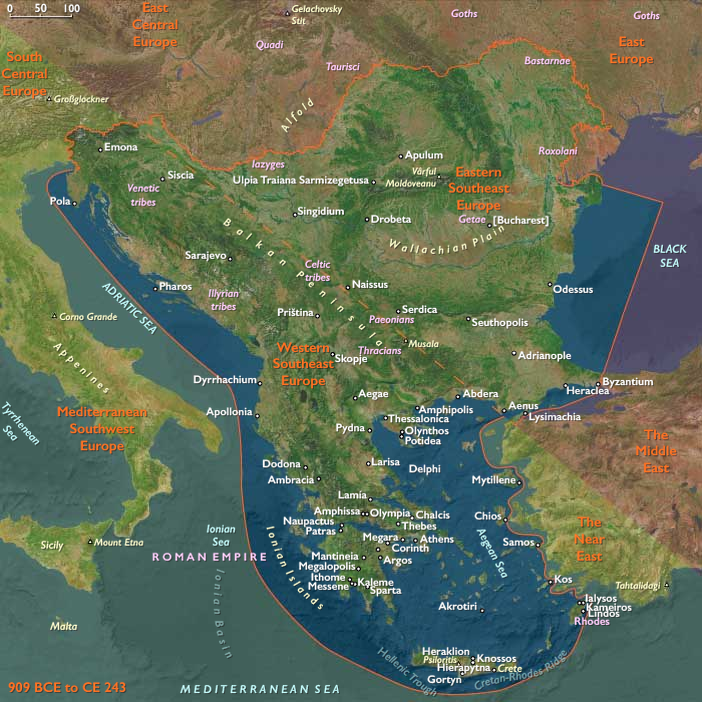
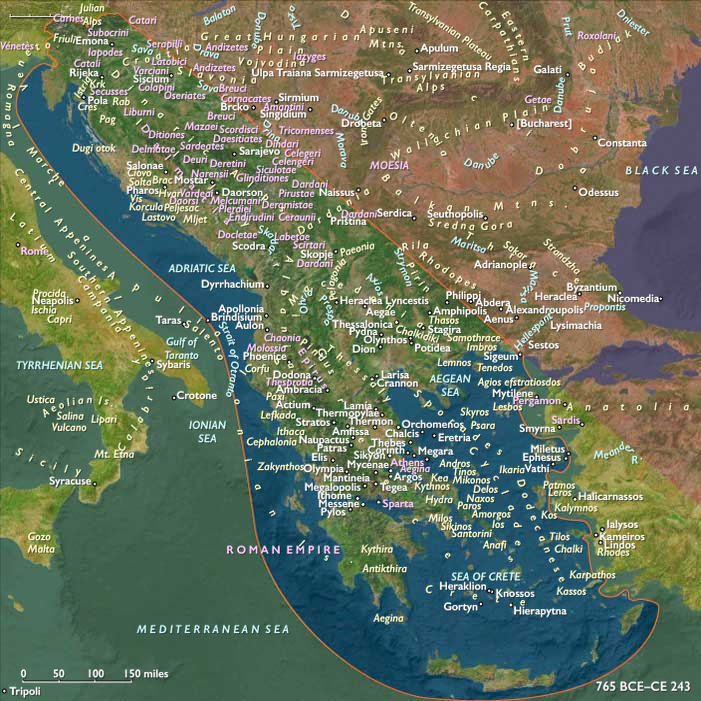
Caesar, with Spain secure, crosses the Adriatic to Epirus, landing here on January 4 and occupying Oricum and …
Locations
People
Groups
Topics
- Classical antiquity
- Roman Age Optimum
- Roman Republic, Crisis of the
- Roman Civil War, Great, or Caesar's Civil War
Commodoties
Subjects
Regions
Subregions
Related Events
Filter results
Showing 10 events out of 19 total
Enea Silvio de'Piccolomini, after studying at the universities of Siena and Florence, had settled in the former city as a teacher, but in 1431 had accepted the post of secretary to Domenico Capranica, bishop of Fermo, then on his way to the Council of Basel (1431–39).
Capranica had been protesting against the new Pope Eugene IV's refusal of a cardinalate for him, which had been designated by Pope Martin V. Arriving at Basel after enduring a stormy voyage to Genoa and then a trip across the Alps, Enea had successively served Capranica, who ran short of money, and then other masters.
He had been sent by Cardinal Albergati, Eugenius IV's legate at the council, on a secret mission to Scotland in 1435, the object of which is variously related, even by himself.
He had visited England as well as Scotland, had undergone many perils and vicissitudes in both countries, and has left a valuable account of each.
The journey to Scotland had proved so tempestuous that Piccolomini swore that he would walk barefoot to the nearest shrine of Our Lady from their landing port.
This proved to be Dunbar; the nearest shrine was ten miles distant at Whitekirk.
The journey through the ice and snow had left Aeneas afflicted with pain in his legs for the rest of his life.
It is only once he arrived in Newcastle that he had felt he had returned to a civilized part of the world and the inhabitable face of the Earth, Scotland and the far north of England being "wild, bare and never visited by the sun in winter".
In Scotland, he had fathered his second natural child, the other one having been born in Strasbourg.
Upon his return to Basel, Enea had sided actively with the council in its conflict with the Pope, and, although still a layman, had eventually obtained a share in the direction of its affairs.
He had supported the creation of the Antipope Felix V (Amadeus, Duke of Savoy) and had participated in his coronation.
Enea then withdrew to the court of Holy Roman Emperor Emperor Frederick III court in Vienna.
Crowned imperial poet laureate in 1442, he has obtained the patronage of the emperor's chancellor, Kaspar Schlick.
Some identify the love adventure at Siena that Enea related in his romance The Tale of the Two Lovers with an escapade of the chancellor.
Enea’s character had hitherto been that of an easy and democratic-minded man of the world with no pretense to strictness in morals or consistency in politics.
He now begins to be more regular in the former respect, and in the latter had adopted a decided line by making his peace between the Empire and Rome.
Being sent on a mission to Rome in 1445, with the ostensible object of inducing Pope Eugene to convoke a new council, he had been absolved from ecclesiastical censures and returned to Germany under an engagement to assist the Pope.
This he did most effectually by the diplomatic dexterity with which he had smoothed away differences between the papal court of Rome and the German imperial electors.
He plays a leading role in concluding a compromise in 1447 by which the dying Pope Eugene accepts the reconciliation tendered by the German princes.
As a result, the council and the antipope are left without support.
He had already taken orders, and one of the first acts of Pope Eugene's successor, Pope Nicholas V (1447–1455), is to make him Bishop of Trieste.

Tommaso Parentucelli was born at Sarzana, Liguria, where his father, a physician, died while he Tommaso was young.
Parentucelli later became a tutor, in Florence, to the families of the Strozzi and Albizzi, where he had met the leading humanist scholars.
He had studied at Bologna and Florence, gaining a degree in theology in 1422.
Bishop Niccolò Albergati was so awestruck with Parentucelli’s capabilities that he had taken him into his service and given him the chance to pursue his studies further by sending him on a tour through Germany, France and England.
He has been able to collect books, for which he had an intellectual's passion, wherever he went.
Some of them survive with his marginal annotations.
He had attended the Council of Florence, and in 1444, when his patron died, he had been appointed Bishop of Bologna in his place.
Civic disorders at Bologna were prolonged, so Pope Eugene IV soon named him as one of the legates sent to Frankfurt, where he was to assist in negotiating an understanding between the Papal States and the Holy Roman Empire, regarding undercutting or at least containing the reforming decrees of the Council of Basel (1431–1439).
His successful diplomacy had gained him the reward, on his return to Rome, of the title Cardinal-Priest of Santa Susanna in December 1446.
At the papal conclave of 1447, he is elected Pope in succession to Eugene IV on March 6.
He takes the name Nicholas V in honor of his early benefactor, Niccolò Albergati.
Frederick III, in reaching the Concordat of Vienna, or Aschaffenburg, with the newly installed Pope Nicholas V on February 17, 1448, regulates control of church offices and helps force the dissolution of the Council of Basel, which is asserting conciliar supremacy over the popes.
The decrees of the Council of Basel against papal annates and reservations are abrogated so far as Germany is concerned.
He hires as a secretary the distinguished diplomat and humanist scholar Enea Silvio Piccolomini, who first brings Renaissance influences to Germany.
A Portuguese expedition may have attempted to colonize the Canary Islands as early as 1336, but there is not enough hard evidence to support this.
The Castilian conquest of the islands had begun in 1402, with the expedition of French explorers Jean de Béthencourt and Gadifer de la Salle, nobles and vassals of Henry III of Castile, to Lanzarote.
From there, they had conquered Fuerteventura (1405) and El Hierro.
Béthencourt had received the title King of the Canary Islands, but still recognized King Henry III as his overlord.
Béthencourt had also established a base on the island of La Gomera, but it will be many years before the island is truly conquered.
The natives of La Gomera, and of Gran Canaria, Tenerife, and La Palma will resist the Castilian invaders for almost a century.
Maciot de Béthencourt in 1448 sells the lordship of Lanzarote to Portugal's Prince Henry the Navigator, an action that is not accepted by the natives nor by the Castilians.
Despite Pope Nicholas V ruling that the Canary Islands are under Portuguese control, a crisis swells to a revolt that will last until 1459 with the final expulsion of the Portuguese.
Basel has eight thousand residents in the mid-fifteenth century.
The rump Council of Basel, in accepting Pope Nicholas V’s 1448 Concordat of Vienna, expires ingloriously in 1449.
The abdication of the antipope Felix V ends the schism within the Roman Catholic church.
Skanderbeg's Albanian resistance forces rout Sultan Murad II himself in 1449-50, defeating a siege of the fortress of Krujë in 1450.
Now a hero to the West, Skanderbeg receives aid from Venice, Naples, Hungary, and the papacy.
The pontificate of Nicholas V is important in the political, scientific, and literary history of the world.
Politically, he had on February 17, 1448, concluded the Concordat of Vienna, or Aschaffenburg, with the German King, Frederick III, by which the decrees of the Council of Basel against papal annates and reservations were abrogated so far as Germany was concerned.
In the following year, he had secured a still greater tactical triumph with the resignation of the Antipope Felix V on April 7 and his own recognition by the rump of the Council of Basel that assembled at Lausanne.
Nicholas V holds a Jubilee at Rome in 1450, and the offerings of the numerous pilgrims who throng to Rome give him the means of furthering the cause of culture in Italy, which he has so much at heart.
Nicholas of Cusa or Kues (Latinized as "Cusa"), the second of four children of Katherina Roemer and Johan Krebs (or Cryfftz), "a prosperous boat owner and ferryman." (Donald F. Duclow, "Life and Works", in Christopher M. Bellitto, Thomas M. Izbicki, Gerald Christianson (Eds.), Introducing Nicholas of Cusa, A Guide to a Renaissance Man, Paulist Press, 2004, p 25), had entered the University of Heidelberg in 1416 as "a cleric of the diocese of Trier" studying the liberal arts, then received his doctorate in Canon law from the University of Padua in 1423.
Afterwards, he had entered the University of Cologne in 1425 as "a doctor of canon law", which it appears he both taught and practiced there.
Following this brief period in Cologne, he had become secretary to Otto of Ziegenhain, the Archbishop of Trier, and had represented him in Rome in 1427.
After the death of Otto, during the period when the archbishopric of Trier was contested by opposing parties, he had attended the Council of Basel (1431–49), representing Ulrich von Manderscheid, one of the claimants.
While present at the council, Nicholas had written De concordantia catholica, a synthesis of ideas on church and empire balancing hierarchy with consent.
This work remained useful to critics of the papacy long after Nicholas left Basel.
Nicholas had been close to the late Cardinal Giuliano Cesarini, who had tried to reconcile pope and council, combining reform and hierarchic order.
Nicholas had supported transfer of the council to Italy to meet with the Greeks, who needed aid against the Ottoman Turks, and had supported Pope Eugenius IV in his effort to bring the Eastern churches into union with the Western at such a "council of union."
While returning from a mission to Constantinople to persuade the Greeks to attend the Council of Florence, Nicholas had a shipboard experience that led to his writing thereafter on metaphysical topics.
Nicholas then represented the pope in Germany, becoming known as the Hercules of the Eugenian cause.
After a successful career as a papal envoy, he had been made a theologian by Pope Nicholas V in 1448 or 1449, and is named Bishop of Brixen in 1450.
His role as papal legate to the German lands includes wide travels.
His local councils enacts reforms, many of which are not successful.
Pope Nicholas cancels some of Nicholas' decrees, and the effort to discourage pilgrimages to venerate the allegedly miraculous bleeding hosts of Wilsnack (the so-called Holy Blood of Wilsnack) is unsuccessful.
John of Capistrano is the principal force in the founding of the Franciscan Observants, a severely ascetic group of friars who separated from the more liberal Conventuals.
Pope Nicholas V sends him in 1451 as a legate to Germany, Bohemia, Moravia, and Silesia, with the special mission to preach against the Hussites and other heretical teachings and to subdue “the disbelieving Jews”, in accordance with the resolutions adopted at the council of Basel held from 1431 to 1443.
John repeats the old charges of ritual murder and host desecration.
His admirers call him “the scourge of the Judeans”.
Henry XVI, Duke of Bavaria, had died in July 1450, and his son, Louis IX (called the Rich) had succeeded.
About this time Bavaria begins to recover some of its former importance.
Influenced by Capistrano, Louis IX expels the Jews from his duchy, increases the security of traders, and improved both the administration of justice and the condition of the finances.
The University of Glasgow is established in 1451, on the model of the University of Bologna,by a charter or papal bull from Pope Nicholas V, at the suggestion of King James II, giving Bishop William Turnbull permission to add the university to the city's cathedral.
It is the second-oldest university in Scotland, and the fourth-oldest in the English-speaking world.
Years: 48BCE - 48BCE
January
Locations
People
Groups
Topics
- Classical antiquity
- Roman Age Optimum
- Roman Republic, Crisis of the
- Roman Civil War, Great, or Caesar's Civil War