
Joseph Haydn composes his two great oratorios, …
Years: 1792 - 1803
Joseph Haydn composes his two great oratorios, The Creation (1798) and The Seasons (1801), in collaboration with his librettist and mentor Gottfried van Swieten, and with funding from van Swieten's Gesellschaft der Associierten.
Both are enthusiastically received.
Haydn frequently appears before the public, often leading performances of The Creation and The Seasons for charity benefits, including Tonkünstler-Societät programs with massed musical forces.
He also composes instrumental music: the popular Trumpet Concerto, and the last nine in his long series of string quartets, including the Fifths, Emperor, and Sunrise.
A brief work, "Gott erhalte Franz den Kaiser" (the "Emperor's Hymn"; 1797), achieves great success and becomes "the enduring emblem of Austrian identity right up to the First World War" (Jones); in modern times it will become (with different words) the national anthem of Germany.
During the later years of this successful period, Haydn faces incipient old age and fluctuating health, and he has to struggle to complete his final works.
His last major work, from 1802, is the sixth mass for the Esterházys, the Harmoniemesse.
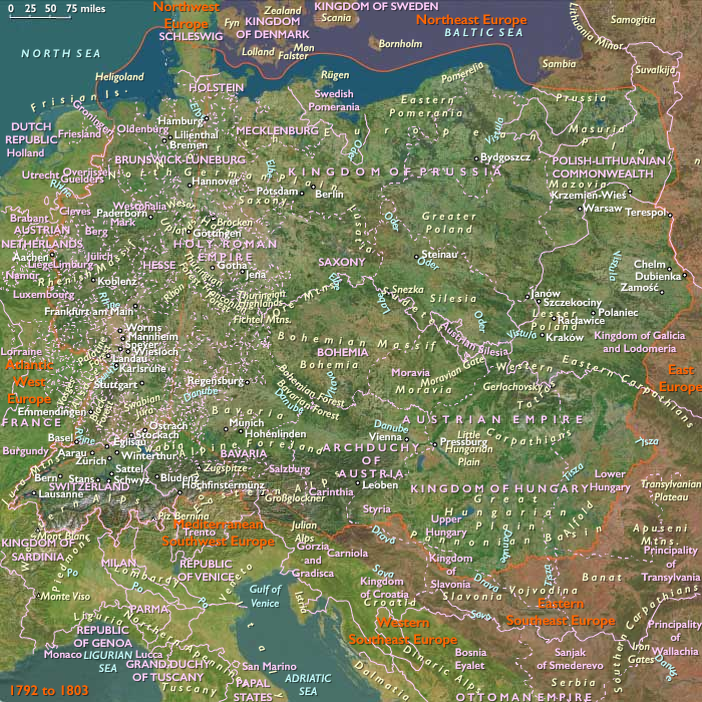
Haydn had returned to Vienna in 1795.
Prince Anton had died, and his successor Nikolaus II had proposed that the Esterházy musical establishment be revived with Haydn serving again as Kapellmeister.
Haydn had taken up the position on a part-time basis.
He spends his summers with the Esterházys in Eisenstadt, and over the course of several years writes six masses for them.
By this time Haydn has become a public figure in Vienna.
He spends most of his time in his home, a large house in the suburb of Windmühle, and writes works for public performance.
Locations
People
Groups
Topics
Subjects
Regions
Subregions
Related Events
Showing 10 events out of 23942 total
Years: 1792 - 1803
Locations
People
Groups
Topics
Subjects
Regions
Subregions