The Fall of …
Years: 885 - 885
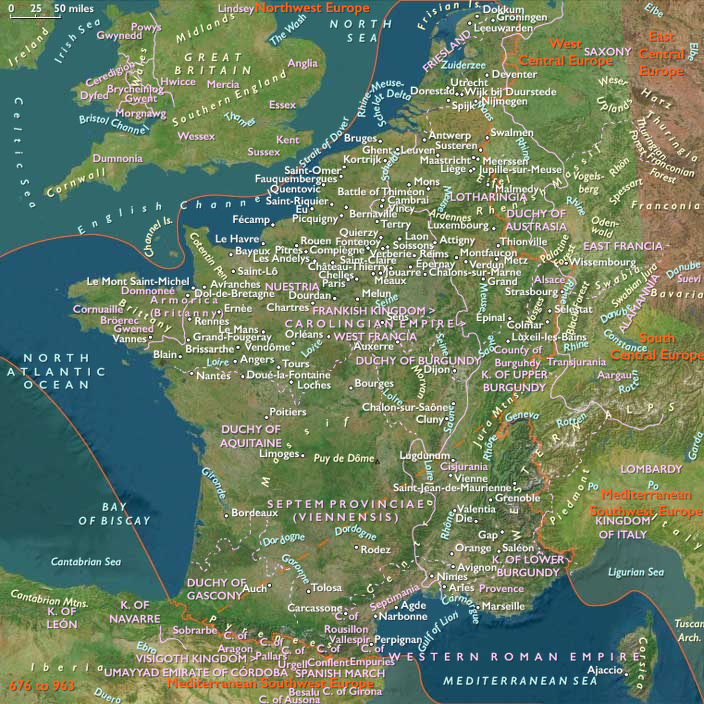
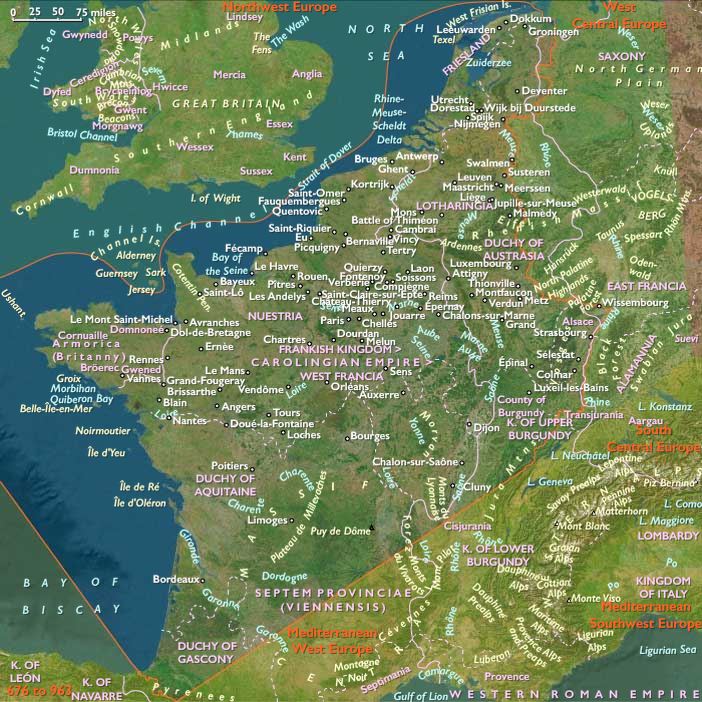
The Fall of Godfrid and Hugh of Alsace: The Conference at Spijk (885)
By 885, Emperor Charles the Fat finds himself increasingly threatened by Viking incursions and the ambitions of his own nobles. Among those he fears most are:
- Godfrid, the Viking ruler of Frisia, who had previously sworn allegiance to Charles but remained a dangerous and unpredictable figure.
- Hugh, Duke of Alsace, Lothair II’s illegitimate son, who posed a potential rival for power in Lotharingia.
To neutralize both threats, Charles arranges a conference at Spijk, near Lobith (modern-day Netherlands), where he lures Godfrid into a trap.
The Conference at Spijk (885) and the Fall of Godfrid
- Charles summons Godfrid under the pretense of negotiations, likely promising him new lands or recognition of his rule in Frisia.
- When Godfrid arrives at Spijk, he falls into the emperor’s ambush.
- The Viking leader is captured and executed, eliminating one of the most formidable Norse warlords in the region.
The Fate of Hugh of Alsace
- Hugh, who had allied himself with Godfrid, is also betrayed and captured at Spijk.
- As punishment, he is blinded and sent to the monastery of Prüm, removing him as a political threat in Lotharingia.
Impact of the 885 Betrayal
- Charles the Fat temporarily secures Frisia, weakening Viking influence in the region.
- The blinding of Hugh removes a powerful Carolingian rival, consolidating Charles’ control over Lotharingia.
- However, Charles’ tactics of deception and treachery further alienate the Frankish nobility, many of whom are already disillusioned with his rule.
- The Viking threat is not eradicated—even as Godfrid is killed, other Norse warbands continue their raids into Francia, culminating in the Siege of Paris later that year.
A Short-Lived Victory
Though Charles successfully eliminates two dangerous rivals, his failure to strengthen his empire means that his rule remains fragile. His passive handling of Viking invasions, particularly the Siege of Paris (885–886), will soon lead to his deposition in 887, marking the final collapse of a united Carolingian Empire.
Locations
People
Groups
- Franks
- Frisians
- Vikings
- Frankish, or Carolingian (Roman) Empire
- Saxony, Duchy of
- Francia Occidentalis (West Francia, or France), Kingdom of
- Francia Orientalis (East Francia), Kingdom of
Topics
Commodoties
Subjects
Regions
Subregions
Related Events
Filter results
Showing 10 events out of 19 total
Raising the stakes in the conflict, Henry seizes Flambard's lands and, with the support of Anselm, removes Flambard from his position as bishop.
Henry holds court in April and June, where the nobility renew their oaths of allegiance to him, but their support still appears partial and shaky.
Robert by July has formed an army and a fleet, ready to move against Henry in England.
With the invasion imminent, Henry mobilizes his forces and fleet outside Pevensey, close to Robert's anticipated landing site, training some of them personally in how to counter cavalry charges.
Despite English levies and knights owing military service to the Church arriving in considerable numbers, many of his barons do not appear.
Anselm intervenes with some of the doubters, emphasizing the religious importance of their loyalty to Henry.
Robert unexpectedly lands further up the coast at Portsmouth on July 20 with a modest force of a few hundred men, but these are quickly joined by many of the barons in England.
However, instead of marching into nearby Winchester and seizing Henry's treasury, Robert pauses, giving Henry time to march west and intercept the invasion force.
King Richard I, returned from captivity in Austria, had set about summoning a fleet and an army to Portsmouth, Hampshire, which Richard had taken over from John of Gisors.
The King on May 2, 1194, had given Portsmouth, strategically located on the English Channel, its first Royal Charter granting permission for the borough to hold a fifteen day annual "Free Market Fair", weekly markets, to set up a local court to deal with minor matters, and exemption from paying the annual tax, with the money instead used for local matters.
King Richard later had gone on to build a number of houses and a hall in Portsmouth.
The hall is thought to have been at the current location of the Clarence Barracks (the area was previously known as Kingshall Green).
Some believe that the crescent and eight-point star found on the thirteenth century common seal of the borough was derived from the arms of William de Longchamp, Lord Chancellor to Richard I at the time of the granting of the charter but it is actually the granting by Richard of the arms of the defeated Isaac Komnenos of Cyprus, who had held Richard's fiancee and sister captive; he had conquered Cyprus as a result, in the Third Crusade.
His awarding of the arms could possibly reflect a significant involvement of Portsmouth soldiers, sailors or vessels in that operation.
The crescent and star, in gold on a blue shield, were subsequently recorded by the College of Arms as the coat of arms of the borough.
King John had in 1200 reaffirmed the rights and privileges awarded by Richard.
John's desire to invade Normandy results in the establishment of Portsmouth as a permanent naval base, and soon afterward construction begins on the first docks, and the Hospital of St. Nicholas, which performs its duties as an almshouse and hospice.
King John, needing to supply a war across the English Channel, had in 1203 ordered all shipyards (including inland ports such as Gloucester) in England to provide at least one ship, with places such as the newly built Portsmouth being responsible for several.
He makes Portsmouth the new home of the navy. (The Anglo-Saxon kings, such as Edward the Confessor, had royal harbors constructed on the south coast at Sandwich, and most importantly, Hastings.)
He has forty-five large galleys available to him by the end of 1204, and from this point on an average of four new ones every year.
He also creates an Admiralty of four admirals, responsible for various parts of the new navy.
Major improvements will be made during John's reign in ship design, including the addition of sails and removable forecastles.
He also creates the first big transport ships, called buisses.
John is sometimes credited with the founding of the modern Royal Navy.
What is known about this navy comes from the Pipe Rolls, since these achievements are ignored by the chroniclers and early historians.
England’s King John I had in 1200 reaffirmed the rights and privileges awarded by Richard II to the city of Portsmouth, which had rapidly eclipsed the older settlement of Portchester, with its Roman and medieval castle, as the sea receded from that site.
King John's desire to invade Normandy resulted in the establishment of Portsmouth as a permanent naval base.
Shortly afterwards, construction had begun on the first docks, and the Hospital of St Nicholas, which performed its duties as an almshouse and hospice.
During the thirteenth century Portsmouth, was commonly used by Henry III and Edward I as a base for attacks against France.
By the fourteenth century, commercial interests had grown considerably.
Common imports include wool, grain, wheat, woad, wax and iron; however the port's largest trade is in wine from Bayonne and Bordeaux.
A French fleet led by Nicholas Béhuchet had raided Portsmouth in 1338, destroying much of the town, with only the local church and hospital surviving.
Edward III had given the town exemption from national taxes to aid reconstruction.
Only ten years later, the town had been struck by the Black Death.
To prevent the regrowth of Portsmouth as a threat, the French had again sacked the town in 1369, 1377 and 1380.
Henry V, who built the first permanent fortifications of Portsmouth, had in 1418 ordered a wooden Round Tower be built at the mouth of the harbor, which was completed in 1426.
Henry VII has rebuilt the fortifications with stone, raised a square tower, and assisted Robert Brygandine and Sir Reginald Bray in the construction of the world's first dry dock.
Although King Alfred may have used Portsmouth to build ships as early as the ninth century, the first warship recorded as constructed in the town is the Sweepstake, built in 1497 in the dry dock.

England following the defeat of Buckingham in October 1627 attempts to send two fleets to relieve La Rochelle.
The first one, led by William Feilding, Earl of Denbigh, a veteran of the Expedition to Cadiz three years earlier, leaves on April 1628, but returns without a fight to Portsmouth, as Denbigh "said that he had no commission to hazard the king's ship in a fight and returned shamefully to Portsmouth".
Buckingham's failure to protect the Huguenots—indeed, his attempt to capture Saint-Martin-de-Ré spurs Louis XIII's attack on the Huguenot fortress of La Rochelle—furthers Parliament's detestation of the Duke—“the grievance of grievances,”—and the king's close proximity to this eminence grise.
Buckingham, trying meanwhile to organize a second campaign to relieve the Siege of La Rochelle, is stabbed and killed at Portsmouth on August 23, 1628 by John Felton, a disaffected army officer who had been wounded in the earlier military adventure and believes he had been passed over for promotion by Buckingham.
Felton will be hanged in November; Buckingham is buried in Westminster Abbey, his tomb bearing a Latin inscription translated as: "The Enigma of the World."
Buckingham’s infant son, also named George Villiers, becomes the 2nd duke of Buckingham.
On December 6, 1785, Orders in Council are issued in London for the establishment of a penal colony in New South Wales, on land claimed for Britain by explorer James Cook in his first voyage to the Pacific in 1770.
The Fleet consists of two Royal Navy vessels, three store ships and six convict transports, carrying between one thousand and fifteen hundred convicts, marines, seamen, civil officers and free people (accounts differ on the numbers), and a vast quantity of stores.
Here they are transferred to the guardship HMS Hector to await trial.
The prisoners include the three detained loyalists—Coleman, McIntosh and Norman—to whom Bligh had promised justice, the blind fiddler Michael Byrne (or "Byrn"), Heywood, Morrison, and four active mutineers: Thomas Burkett, John Millward, Thomas Ellison and William Muspratt.
Bligh, who has been given command of HMS Providence for a second breadfruit expedition, had left England in August 1791, and thus will be absent from the pending court martial proceedings.
Years: 885 - 885
Locations
People
Groups
- Franks
- Frisians
- Vikings
- Frankish, or Carolingian (Roman) Empire
- Saxony, Duchy of
- Francia Occidentalis (West Francia, or France), Kingdom of
- Francia Orientalis (East Francia), Kingdom of