
Conrad and his eldest legitimate son, Henry …
Years: 1152 - 1152
March
Conrad and his eldest legitimate son, Henry Berengar, had in 1150 defeated Welf VI, Duke of Spoleto and Margrave of Tuscany, and his son Welf VII at the Battle of Flochberg.
Henry Berengar had died later that year and the succession had been thrown open.
Frederick III, Hohenstaufen Duke of Swabia, from 1147, had accompanied his uncle, the German king Conrad III, on the disastrous Second Crusade, but had distinguished himself and won the complete confidence of the king.
When Conrad died on February 15, 1152, only Frederick and the prince-bishop of Bamberg had been at his deathbed.
Both assert afterwards that Conrad had, in full possession of his mental powers, handed the royal insignia to Frederick and indicated that Frederick, rather than Conrad's own six-year-old son, the future Frederick IV, Duke of Swabia, should succeed him as king.
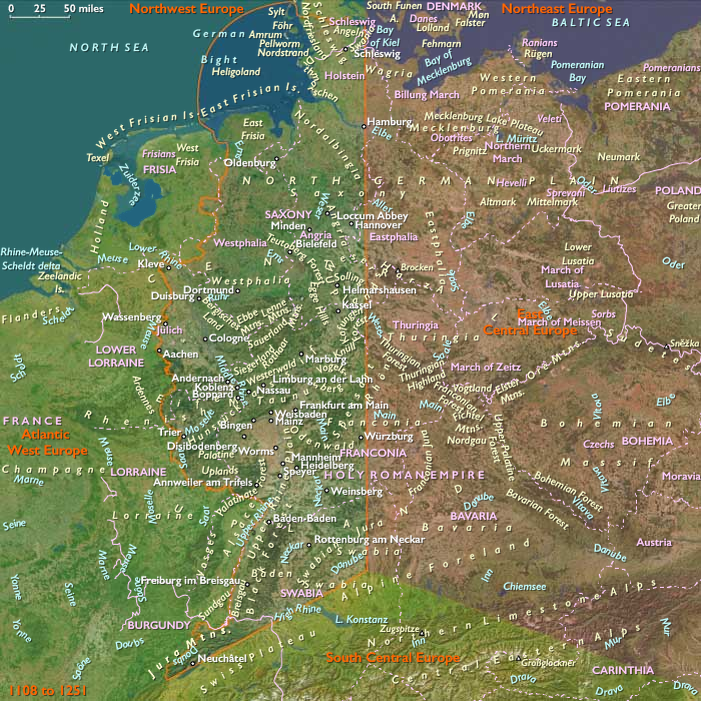
Frederick energetically pursues the crown and at Frankfurt on arch 4 the kingdom's princely electors designate him as the next German king.
He is crowned at Aachen five days later.
The young son of the late king is given the Duchy of Swabia.
The son of Duke Frederick II of the Hohenstaufen dynasty, his mother is Judith, daughter of Henry IX, Duke of Bavaria, from the rival House of Welf, and Frederick therefore descends from Germany's two leading families, making him an acceptable choice for the Empire's prince-electors.
He rules as king Frederick I; the Italians call him Barbarossa (“Red-Beard”).
Anxious to restore the Empire to the position it had occupied under Charlemagne and Otto I the Great, the new king sees clearly that the restoration of order in Germany is a necessary preliminary to the enforcement of the imperial rights in Italy.
Issuing a general order for peace, he makes lavish concessions to the nobles.
Abroad, Frederick intervenes in the Danish civil war between Syewn III and Valdemar I of Denmark and begins negotiations with the East Roman emperor, Manuel I Komnenos.
It is probably about this time that the king obtains papal assent for the annulment of his childless marriage with Adelheid of Vohburg, on the grounds of consanguinity (his great-great-grandfather was a brother of Adela's great-great-great-grandmother).
He now makes a vain effort to obtain a bride from the court of Constantinople.
Locations
People
- Conrad III of Germany
- Frederick I, Holy Roman Emperor
- Manuel I Komnenos
- Sweyn III of Denmark
- Valdemar I of Denmark
Groups
- Denmark, Kingdom of
- Papal States (Republic of St. Peter)
- German, or Ottonian (Roman) Empire
- Bamberg, Prince-Bishopric of
- Welf, House of
- Roman Empire, Eastern: Komnenos dynasty, restored
- Pirates of the Korea Strait
Topics
Commodoties
Subjects
Regions

Subregions
Years: 1152 - 1152
March
Locations
People
- Conrad III of Germany
- Frederick I, Holy Roman Emperor
- Manuel I Komnenos
- Sweyn III of Denmark
- Valdemar I of Denmark
Groups
- Denmark, Kingdom of
- Papal States (Republic of St. Peter)
- German, or Ottonian (Roman) Empire
- Bamberg, Prince-Bishopric of
- Welf, House of
- Roman Empire, Eastern: Komnenos dynasty, restored
- Pirates of the Korea Strait
Topics
Commodoties
Subjects
Regions
Subregions