Constantius returns east to fight Shapur, who …
Years: 359 - 359
Constantius returns east to fight Shapur, who has renewed his attacks on the eastern frontier.
Locations
People
Groups
- Persian people
- Thracia (Roman province)
- Persian Empire, Sassanid, or Sasanid
- Xionites
- Thrace, Diocese of
- Roman Empire: Constantinian dynasty (Constantinople)
- East, or Oriens, Praetorian prefecture of
Topics
Commodoties
Subjects
Regions
Subregions
Related Events
Filter results
Showing 10 events out of 59733 total
Amid(a), also known by various names throughout its long history, had been established as an Assyrian settlement, circa the third millennium BCE.
The oldest artifact from Amida (modern Diyarbakir, Turkey) is the famous stele of king Naram-Sin, also believed to be from third millennia BCE.
The name Amida first appears in the writings of Assyrian King Adad Nirari who ruled the city from about 1310 to 1281 BCE as a part of the Assyrian homeland, of which Amida had remained an important region throughout the reign of king Tiglath-Pileser-I (1114–1076 BCE).
The name Amida appeared in the annals of Assyrian rulers until 705 BCE, and also appears in the archives of Armenian king Tiridates II in 305, and the Roman historian Ammianus Marcellinus (325–391).
Constantius II has enlarged and strengthened this city on the upper Tigris.
Marcellinus narrates vividly the episode of Shapur’s capture of Amida with the aid of Xionite auxiliaries.
Arianism, despite its condemnation by the first council of Nicaea, becomes the Roman Empire’s official faith in 359, when the Eastern bishops meet in council at Seleucia (now Silifke, Turkey).
Concurrent with the Council of Seleucia, four hundred bishops of the Western Roman Empire attend a church council called by the emperor and held at Ariminum (modern Rimini, Italy).
Most of the bishops in attendance are orthodox and accept the faith of Nicaea, but the Arian minority includes skilled diplomats who successfully undo the orthodox decision of the majority when it reaches the emperor.
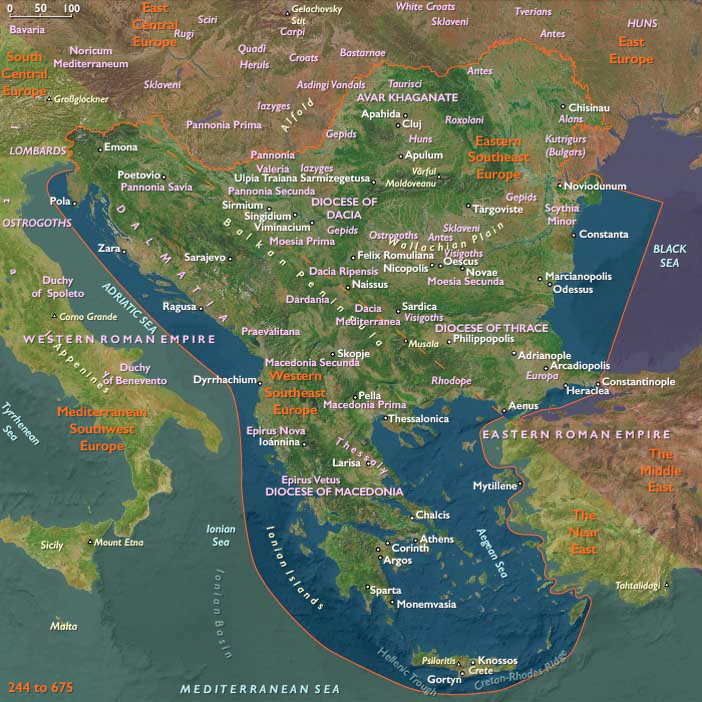
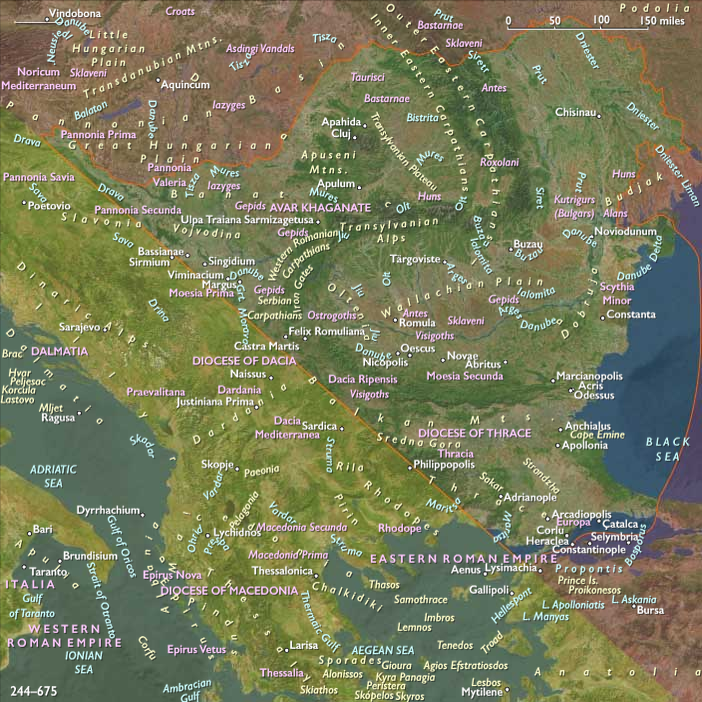
The orthodox bishops remaining at Ariminum are then forced to recant and subscribe to an Arian creed drawn up at Nice in Thracia.
Pope Liberius, soon repudiating this creed, declares the Council of Ariminum without authority.
The so-called anomoeans had succeeded in having their views endorsed at Sirmium in 357, but their extremism has stimulated the moderates, who assert that the Son was “of similar substance” (homoiousios) with the Father.
Constantius had at first supported these homoiousians but soon transferred his support to the homoeans, led by Acacius, who affirm that the Son was “like” (homoios) the Father.
Their views are approved in 360 at the Council of Constantinople (attended by Ulfilas), where all previous creeds are rejected, the term ousia (“substance,” or “stuff”) is repudiated as too risky, and a statement of faith is issued stating that the Son was “like the Father who begot him.”
Books begin to replace scrolls around 360.
he Renaming of Lutetia to Paris (360 CE)
In 360 CE, Lutetia, the Roman city on the Île de la Cité, was officially renamed Paris, adopting the name of the Gallic Parisii tribe that had once inhabited the region.
1. The Origins of the Name "Paris"
- The Parisii were a Gallic tribe that had settled along the Seine River before the Roman conquest of Gaul in the 1st century BCE.
- While the Romans named their city Lutetia, the local population continued to use "Parisii" as an ethnic and regional identifier.
- The term "Parisiacus" had already been used for centuries as an adjective, referring to things related to the Parisii or Lutetia.
2. Julian and the Renaming of the City
- The renaming of Lutetia to Paris occurred during the reign of Julian, who was serving as Caesar in Gaul at the time.
- Julian had used Lutetia as his winter quarters in 357 CE, after securing a major victory over the Alamanni at the Battle of Strasbourg.
- By 360 CE, he had been proclaimed Augustus by his troops while in Lutetia, further elevating the city’s status.
3. The Significance of the Name Change
- The name change from Lutetia to Paris reflected the enduring influence of Gallic heritage in the region.
- It marked a shift from the older Roman designation to one more closely tied to local identity.
- This renaming foreshadowed the later importance of Paris as a medieval and modern capital, becoming the heart of the Frankish and later French kingdoms.
4. Conclusion: The Birth of Paris as a Lasting Identity
- The transition from Lutetia to Paris in 360 CE signaled the city's growing regional prominence.
- Although still a Roman city, Paris retained its Gallic roots, a blend of Roman and indigenous traditions that would shape its future identity.
- Over time, Paris would rise to become one of the most significant cities in European history, a transformation that began with its renaming in the late Roman period.
Wang Xizhi, a member of an eminent family and a master of all types of calligraphic scripts, gains particular renown for his running script, or "hsing-shu," and his cursive script, or "ts'ao-shu."
Born in Linyi, Shandong, Wang spent most of his life in present-day Shaoxing, Zhejiang.
He had learned the art of calligraphy from Lady Wei Shuo.
He excels in every script but particularly in semi-cursive script.
Unfortunately, none of his original works remains today.
An outstanding example of his work in “hsing-shu” is his Preface to the Poems Composed at the Orchid Pavilion, the introduction to a collection of poems written by a number of poets during a gathering at Lanting near the town of Shaoxing for the Spring Purification Festival.
The original is lost, but the work is survived in a number of finely traced copies in existence, with the earliest and most well regarded copy being the one made between about 627 to 650 by Feng Chengsu; it is located in the Palace Museum in Beijing.
Experts consider his On the Seventeenth to be the best work in “ts'ao-shu.”
Traditionally referred to as the "Sage of Calligraphy", he leaves government service in 355 in his early fifties.
Wang Xizhi is particularly remembered for one of his hobbies, that of rearing geese.
Legend has it that he learned that the key to how to turn his wrist while writing was to observe how geese moved their necks.
There is a small porcelain cup depicting Wang Xizhi "walking geese" in the China Gallery of the Asian Civilizations Museum in Singapore.
The other side of the cup depicts a scholar "taking a zither to a friend".
Wang Xizhi has seven children, all of whom are notable calligraphers.
The most distinguished is his youngest son, Wang Xianzhi.
A Tang reproduction of one of Wang's calligraphy scrolls on silk with four lines, will be sold in China at an auction in 2010 for an amount equivalent to forty-six million dollars.

The Huns, a confederation of Central Asian equestrian nomads or semi-nomads who are perhaps Turkic or possibly Mongol in origin, now include substantial numbers of Germanic and Indo-Iranian groups, their culture and organization a mélange of many different customs.
Heavily reliant on animal herding, the horde is sustained by the plundering of sedentary peoples.
The Huns move west, appearing in South Russia around 358 to conquer the region’s various inhabitants or, in the case of many of the Germanic tribes, such as the Greuthings, causing them to flee into the Roman Empire.
The Romans invite the Huns east of the Ukraine to settle Pannonia in 361.
Eunomius, who had studied theology at Alexandria under Aëtius, and afterwards come under the influence of Eudoxius of Antioch, who ordained him deacon, had in 360 been appointed bishop of Cyzicus, in Mysia, on the recommendation of Eudoxius.
Propounding an extreme form of Arianism that refutes the divinity of Christ and constructing his argument on a Platonist philosophical structure, Eunomius teaches that Christ was not equal to God the Father but only resembled him.
Here his free utterance of extreme Arian views have led to popular complaints, and Eudoxius is compelled, by command of Constantius, to depose him from the bishopric within a year of his elevation to it.
The orthodox Christian majority in the West consolidates its position after the death of Constantius, driving Arianist bishops from their sees.
Liberius had acceded to the papacy in 352.
However, when Liberius was banished in 353 by the Arianist emperor Constantius II for refusing to subscribe the sentence of condemnation against Athanasius of Alexandria, Felix II had been installed as antipope.
At the end of an exile of more than two years, the emperor had recalled Liberius; but, as Felix was the official occupant of the Roman See, a year had passed before Liberius was sent to Rome.
It was the emperor's intention that Liberius should govern the Church jointly with Felix, but on the arrival of Liberius, the Roman people had expelled Felix.
Neither Liberius nor Felix had taken part in the Council of Rimini in 359.
Following the death of Constantius in 361, Liberius annuls the decrees of that assembly, but, with the concurrence of bishops Athanasius and Hilary, retains the bishops who had signed and then withdrawn their adherence.
Years: 359 - 359
Locations
People
Groups
- Persian people
- Thracia (Roman province)
- Persian Empire, Sassanid, or Sasanid
- Xionites
- Thrace, Diocese of
- Roman Empire: Constantinian dynasty (Constantinople)
- East, or Oriens, Praetorian prefecture of