
Filters:
The Revival of the Ducal Title in …
Years: 927 - 927
The Revival of the Ducal Title in Aquitaine (890s–927)
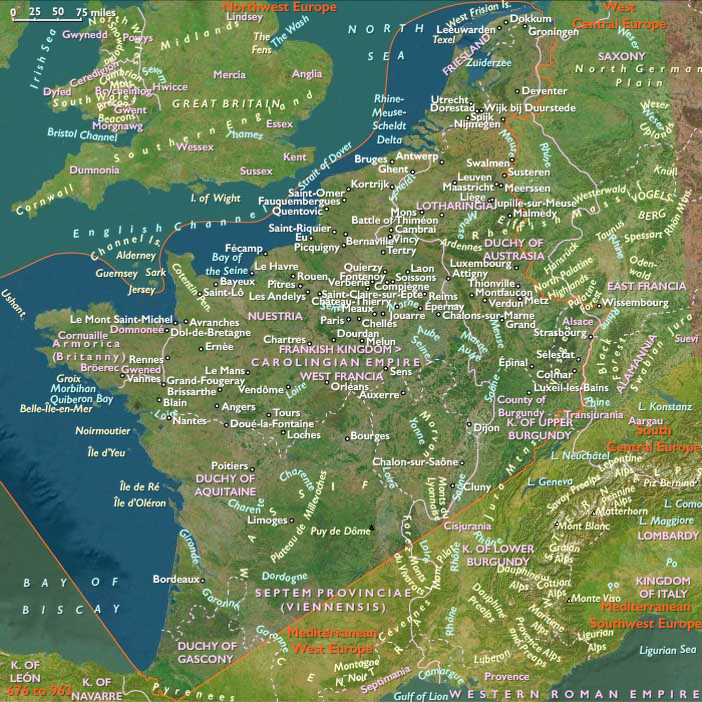
During the late 9th and early 10th centuries, the once-unified Duchy of Aquitaine, which had been fragmented following the decline of Carolingian power, is revived as a political entity by Count William the Pious of Auvergne.
William the Pious and the Reestablishment of the Duchy of Aquitaine (890s)
- William the Pious (d. 918), Count of Auvergne, is the first to assume the title of Duke of Aquitaine, effectively recreating the duchy in the 890s.
- His control over large parts of central and southern Francia, including Auvergne, Limousin, and Poitou, gives him the power base needed to assert dominance over Aquitaine.
- Though still nominally under the West Frankish king, William governs independently, a sign of the weakening of royal authority.
- His most enduring legacy is the founding of Cluny Abbey in 910, a landmark moment in medieval monastic reform.
The Transfer of the Ducal Title to the Counts of Poitiers (927)
- After William’s death in 918, his successor, William II (the Younger), Duke of Aquitaine, continues his rule but dies in 927 without a direct heir.
- With William II’s death, the title passes to the Count of Poitiers, who now inherits the Duchy of Aquitaine, further consolidating power under the House of Poitiers.
Significance of the Ducal Transition
-
The House of Poitiers Gains Dominance
- The transfer of the ducal title to the Poitevin counts establishes their long-term rule over Aquitaine, lasting for centuries.
-
Aquitaine as a Semi-Independent Duchy
- Under Poitevin leadership, Aquitaine continues to function as a de facto independent entity, though still technically part of West Francia.
-
The Weakening of Royal Power in Southern France
- The revival of the duchy outside royal control demonstrates the continued decentralization of West Francia, as local rulers gain autonomy at the expense of the monarchy.
Conclusion: The Foundations of Poitevin Rule in Aquitaine
The title of Duke of Aquitaine, first assumed by William the Pious, passes to the Poitevin counts in 927, marking the formal beginning of their long rule over the region. This transition reinforces Aquitaine’s autonomy, setting the stage for its later power struggles with the Capetian monarchy, culminating in its pivotal role in medieval France and England.
Locations
People
Groups
- Toulouse, County of
- Aquitaine, (Carolingian) Kingdom of
- Francia Occidentalis (West Francia, or France), Kingdom of
Subjects
Regions

Subregions
Years: 927 - 927
Locations
People
Groups
- Toulouse, County of
- Aquitaine, (Carolingian) Kingdom of
- Francia Occidentalis (West Francia, or France), Kingdom of
Subjects
Regions
Subregions