
Cyrus, after incorporating Lydia and such Ionian …
Years: 549BCE - 538BCE
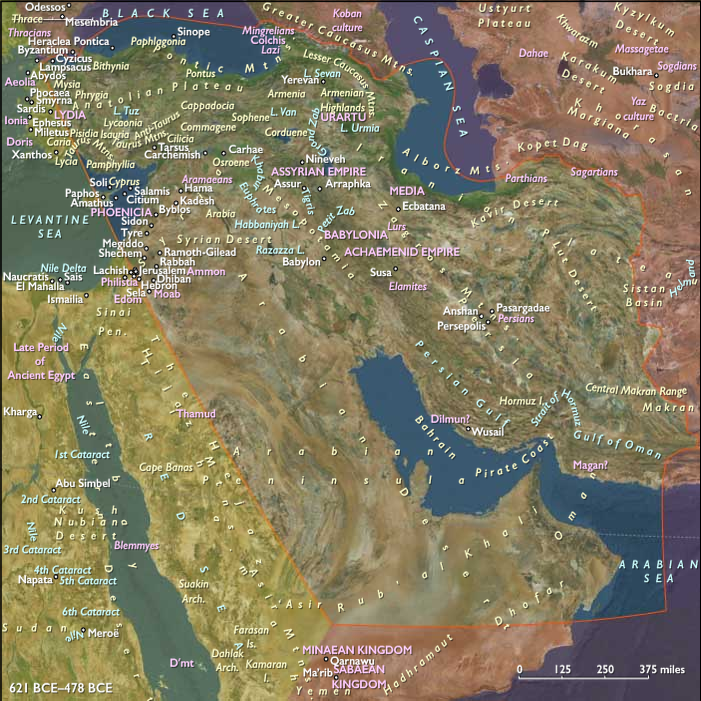
Cyrus, after incorporating Lydia and such Ionian dependencies as Ephesos to his Persian kingdom in 546, consolidates his rule over Ionian Greek cities on the coast of the Aegean Sea, then turns to Babylonia, where the people’s dissatisfaction with the rule of Nabonidus and his son provide Cyrus with a pretext for invasion.
Persia is the leading power in the Near East at the time of the Battle of Opis.
Its power has grown enormously under its king, who has conquered a huge swath of territory to create an empire that covers an area corresponding to the modern countries of Turkey, Armenia, Azerbaijan, Iran, Kyrgyzstan and Afghanistan.
The only remaining significant unconquered power in the Near East is the Neo-Babylonian Empire, which controls Mesopotamia and subject kingdoms such as Syria, Judea, Phoenicia and parts of Arabia.
It had been closely linked with Cyrus's enemies elsewhere.
The empire was previously an ally of Croesus of Lydia, whose kingdom had been overrun by the Persians a few years earlier.
During a great banquet, Belshazzar, according to Biblical sources (Daniel 5), sees the “handwriting on the wall” that only the prophet Daniel can interpret: a message spelling the end of the Chaldean dynasty.
The dynasty indeed ends when Babylon, Sippar, Ur and other Neo-Babylonian centers surrender to Cyrus in 539 BCE.
Both Belshazzar and his father Nabonidus will die soon after.
The site of the final battle is at the city of Opis on the river Tigris, located about fifty miles (eighty kilometers) north of modern Baghdad.
The city is thought to have been a preferred point to cross the river; Xenophon describes a bridge there.
The timing of the invasion may have been determined by the ebb of the Mesopotamian rivers, which are at their lowest levels—and therefore are easiest to cross—in the early autumn.
Opis is a place of considerable strategic importance; apart from the river crossing, it is at one end of the Median Wall, a fortified defensive barrier north of Babylon that had been built several decades earlier by Nebuchadnezzar II.
Control of Opis will enable Cyrus to break through the Median Wall and open the road to the capital.
The main contemporary source of information on Cyrus's Mesopotamian campaign of 539 BCE is the Nabonidus Chronicle, one of a series of clay tablets collectively known as the Babylonian Chronicles that record the history of ancient Babylonia.
Some additional detail is provided by one of the few documents to have survived from Cyrus's lifetime, the Cyrus Cylinder.
Further information on Cyrus's campaign is provided by the later ancient Greek writers Herodotus and Xenophon, though neither mention the battle at Opis and their accounts of the campaign differ considerably from the Persian and Babylonian sources.
Most scholars prefer to use the Nabonidus Chronicle as the main source on the battle, as it is a contemporaneous source.
Although much of the Nabonidus Chronicle is fragmentary, the section relating to the last year of Nabonidus's reign—539 BCE—is mostly intact.
It provides very little information about Cyrus's activities in the years immediately preceding the battle.
The chronicler focuses on events of immediate relevance to Babylonia and its rulers, only occasionally records events outside Babylonia and does not provide much detail other than a bare outline of key incidents.
There is almost no information for the period 547-539.
Most of the chronicle's text for this period is illegible, making it impossible to assess the significance of the few words that can be read.
By the time of the battle, Babylonia is in an unpromising geopolitical situation; the Persian empire borders it to the north, east and west.
It has also been suffering severe economic problems exacerbated by plague and famine, and its king Nabonidus was said to be unpopular among many of his subjects for his unconventional religious policies.
Cyrus was said to have persuaded a Babylonian provincial governor named Gobryas (and a supposed Gadates) to defect to his side.
Gutium, the territory governed by Gobryas, is a frontier region of considerable size and strategic importance, which Cyrus was said to have used as the starting point for his invasion.
The Nabonidus Chronicle records that prior to the battle, Nabonidus had ordered cult statues from outlying Babylonian cities to be brought into the capital, suggesting that the conflict had begun possibly in the winter of 540 BCE.
In a fragmentary section of the chronicle which is presumed to cover 540/39 BCE, there is a possible reference to fighting, a mention of Ishtar and Uruk, and a possible reference to Persia The Battle of Opis is thus probably only the final stage in an ongoing series of clashes between the two empires.
After taking Babylon, Cyrus proclaims himself "king of Babylon, king of Sumer and Akkad, king of the four corners of the world" in the famous Cyrus cylinder, an inscription deposited in the foundations of the Esagila temple dedicated to the chief Babylonian god, Marduk.
The text of the cylinder denounces Nabonidus as impious and portrays the victorious Cyrus pleasing the god Marduk.
It describes how Cyrus had improved the lives of the citizens of Babylonia, repatriated displaced peoples and restored temples and cult sanctuaries.
Although some have asserted that the cylinder represents a form of human rights charter, historians generally portray it in the context of a long-standing Mesopotamian tradition of new rulers beginning their reigns with declarations of reforms.
Locations
People
Groups
- Mesopotamia
- Polytheism (“paganism”)
- Ionians
- Greece, classical
- Neo-Babylonian, or Chaldean, Empire
- Achaemenid Empire
Topics
- Younger Subboreal Period
- Iron Age, Near and Middle East
- Iron Age Cold Epoch
- Classical antiquity
- Babylonian Captivity
- Persian Conquests of 559-509 BCE
- Persian Revolt
- Persian-Lydian War of 547-546 BCE
- Opis, Battle of
Commodoties
Subjects
- Commerce
- Writing
- Environment
- Labor and Service
- Conflict
- Mayhem
- Faith
- Government
- Custom and Law
- Technology
- Prophecy
- Movements
- Economics
Regions
Subregions
Years: 549BCE - 538BCE
Locations
People
Groups
- Mesopotamia
- Polytheism (“paganism”)
- Ionians
- Greece, classical
- Neo-Babylonian, or Chaldean, Empire
- Achaemenid Empire
Topics
- Younger Subboreal Period
- Iron Age, Near and Middle East
- Iron Age Cold Epoch
- Classical antiquity
- Babylonian Captivity
- Persian Conquests of 559-509 BCE
- Persian Revolt
- Persian-Lydian War of 547-546 BCE
- Opis, Battle of
Commodoties
Subjects
- Commerce
- Writing
- Environment
- Labor and Service
- Conflict
- Mayhem
- Faith
- Government
- Custom and Law
- Technology
- Prophecy
- Movements
- Economics
Regions
Subregions