
Dabiša will spend the rest of his …
Years: 1394 - 1394
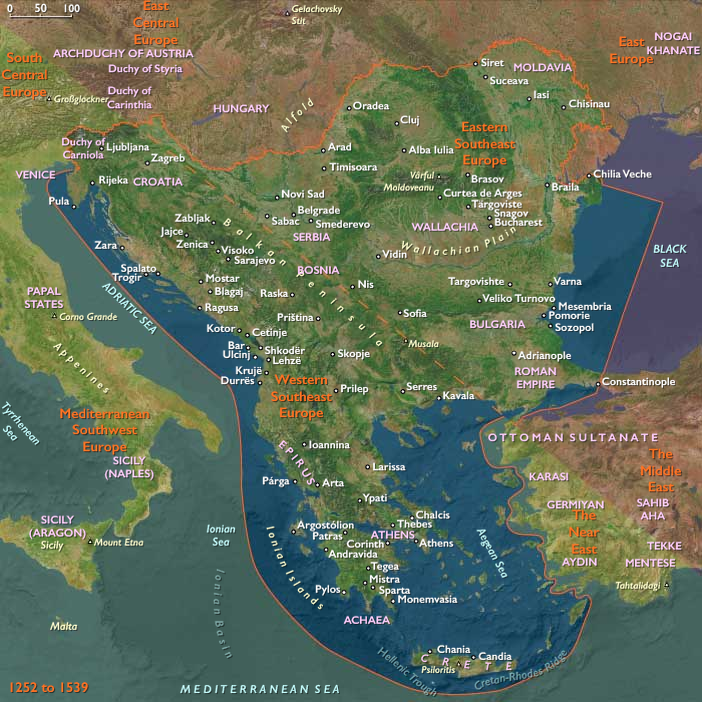
Dabiša will spend the rest of his reign quarreling with the Hungarian King Sigismund and the King of Naples Ladislaus for control over Croatia and Dalmatia.
King Ladislaus manages to win the Vukčić family to his side.
Vuk Vukčić, Dabiša's Ban, takes Ostrovica and Vrana from Ivaniš Paližna.
Dabiša desires to put Zadar under his supreme rule, but Vuk works for Ladislaus.
Hrvoje Vukčić recognizes Dabiša's supreme rule, stating that he will serve him as long as he breathes, after which he will serve the Hungarian King Sigismund.
At the beginning of 1394, the nobility under Ivaniš Horvat, a subject of Ladislaus, refuses to serve King Dabiša.
Dabiša dispatches Prince Ivan Radivojević to take Omiš from Horvat as a punishment.
The Hungarian King Sigismund moves to destroy both Horvat and Dabiša.
The Hungarian Army besieges and burns to the ground Dobor in the lower stream of Bosna.
Dabiša arrives here, recognizes King Sigismund's suzerainty and gives up Dalmatia and Croatia in his name.
In turn, the Hungarian King nominates him Prince of the Szomod Principality.
King Stephen Dabiša dies of an illness on September 8, 1395 and King Sigismund takes control over most of Bosnia, but the Bosnian Rusag elects Dabiša’s wife and consort, Jelena Gruba, to ascend the throne as queen regnant.
Locations
People
Groups
- Dalmatia region
- Croatia, Kingdom of
- Hungary, Kingdom of
- Naples, Angevin Kingdom of
- Bosnia, Kingdom of
Commodoties
Subjects
Regions
Subregions

Related Events
Filter results
Showing 10 events out of 38 total
Denmark thus adopts liberalizing reforms in line with those of the French Revolution, with no direct contact.
Danes are aware of French ideas and agree with them, as it moves from Danish absolutism to a liberal constitutional system between 1750 and 1850.
The change of government in 1784 is caused by a power vacuum created when King Christian VII takes ill, and influence shifts to the crown prince (who later becomes King Frederick VI) and reform-oriented landowners.
Between 1784 and 1815, the abolition of serfdom makes the majority of the peasants into landowners.
The government also introduced free trade and universal education.
In contrast to France under the ancien regime, agricultural reform is intensified in Denmark, civil rights are extended to the peasants, the finances of the Danish state are healthy, and there are no external or internal crises.
That is, reform is gradual and the regime itself carries out agrarian reforms that have the effect of weakening absolutism by creating a class of independent peasant freeholders.
Much of the initiative comes from well-organized liberals who direct political change in the first half of the nineteenth century.
Christian VII, the son of Frederick V, King of Denmark, and his first consort Louisa, daughter of George II of Great Britain, had become King of Denmark and Norway, and Duke of Schleswig and Holstein, on his father’s death on January 14, 1766.
Although possessed of a winning personality and considerable talent, he has been badly educated, systematically terrorized by a brutal governor, Detlev Greve zu Reventlow, and hopelessly debauched by corrupt pages, and is apparently intelligent and certainly has periods of clarity, Christian suffers from severe mental problems, possibly schizophrenia.
After his marriage at Christiansborg on November 8, 1766, to his cousin Princess Caroline Matilda (known in Denmark as Queen Caroline Mathilde), a sister of King George III of Great Britain, he has abandoned himself to the worst excesses, especially debauchery.
He had in 1767 entered in to a relationship with the courtesan Støvlet-Cathrine, publicly declaring that he cannot love Caroline Mathilde, because it is "unfashionable to love one's wife".
He ultimately sinks into a condition of mental stupor.
Symptoms during this time include paranoia, self-mutilation and hallucinations.
He becomes submissive to upstart Johann Friedrich Struensee, who has risen steadily in power in the late 1760s.
The neglected and lonely Caroline Mathilde has drifted into an affair with Struensee.
The king’s marriage with Caroline Mathilde is in 1772 dissolved by divorce.
Struensee is arrested and executed in this same year.
Christian had signed Struensee's arrest warrant with indifference, and under pressure from his stepmother, Juliana Maria of Brunswick-Wolfenbüttel, who had led the movement to have the marriage dissolved.
Caroline Mathilde, retaining her title but not her children, will eventually leave Denmark in exile and pass her remaining days in neighboring Celle, where on May 11, 1775, she will die of scarlet fever.
The marriage had produced two children, the future Frederick VI and Princess Louise Auguste.
However, it is widely believed that Louise was the daughter of Struensee—portrait comparisons have supported this.
Christian is only nominally king from 1772 onward.
Denmark is now ruled by Christian's stepmother, his physically disabled half-brother Frederick, and the Danish politician Ove Høegh-Guldberg.
Northwest Europe (1780–1791): Imperial Shifts, Industrial Revolution, and Revolutionary Ideas
Britain’s Defeat and American Independence
From 1780 to 1783, Britain faced the costly final phases of the American Revolutionary War. Although the British Empire was engaged in a worldwide struggle against a coalition that included Russia, France, Holland, French Canadians, Spain, Sweden, Denmark, and Prussia—collectively known as the League of Armed Neutrality—it offered only seemingly token resistance to the American colonists’ revolt. Britain’s defeat culminated in General Charles Cornwallis’s surrender at Yorktown (1781) and the Treaty of Paris (1783), officially recognizing American independence. While the loss fundamentally reshaped British imperial strategy, Britain managed to retain critical territories in Canada and the Caribbean.
The Advent and Impact of the Industrial Revolution
Despite this imperial setback, Britain surged decisively ahead of its European rivals through the dramatic unfolding of the Industrial Revolution. The foundations of this transformation were facilitated partly by the century-long influx of Brazilian gold, providing vital capital to stimulate early industrial enterprises. Britain's burgeoning industries rapidly expanded, substantially increasing national prosperity and living standards. This spiraling cycle of rising demand, production, and prosperity reshaped domestic markets and significantly boosted overseas trade. The East India Company, benefiting enormously from heightened British demand for raw materials, particularly commodities from India, became the single largest player in Britain's increasingly globalized economy. This expansion was further amplified by wartime necessity, as Indian commodities were essential to sustain British troops and industries.
James Watt and the Steam Engine Revolution
Crucial to Britain’s industrial ascendancy were the advances made by James Watt, whose enhanced steam engine transformed manufacturing, mining, and industry. Watt’s earliest commercial steam engines, installed beginning in 1776, initially powered pumps to remove water from mines, notably in Cornwall. These massive early engines featured large cylinders—typically fifty inches in diameter, standing around twenty-four feet tall—necessitating dedicated engine houses for their operation. Initially, Watt did not manufacture these engines himself; rather, he acted as a consulting engineer, overseeing installations according to his designs, while others undertook their construction. Watt’s firm, Boulton & Watt, charged clients an annual royalty calculated at one-third of the coal savings compared to older Newcomen engines.
Encouraged by Matthew Boulton, Watt broadened the applications of steam power beyond pumping by converting the reciprocating piston motion into rotational motion suitable for driving industrial machinery, including grinding mills, weaving looms, and milling devices. Although a crank seemed the natural choice for this conversion, Watt and Boulton were impeded by an existing patent held by James Pickard. Instead of accepting a restrictive cross-license arrangement, Watt ingeniously devised the sun and planet gear mechanism in 1781 to circumvent Pickard’s patent.
From 1781 to 1788, Watt introduced a series of major improvements: a double-acting engine (steam acting alternately on both sides of the piston), the application of "expansive" steam operation at pressures above atmospheric, and the development of compound engines, wherein two or more engines were linked for greater efficiency. In 1784, Watt patented his celebrated parallel motion mechanism, enabling a piston rod to move in a straight line—essential for the double-acting engine—despite being attached to a rocking beam with a circular arc. Watt also developed crucial control devices, such as the throttle valve and, in 1788, the centrifugal governor to prevent engines from dangerously accelerating ("running away"). Together, these innovations produced an engine five times more fuel-efficient than its predecessors. Despite these advances, Watt cautiously restricted steam pressures to near atmospheric levels, wary of boiler explosions caused by primitive boiler designs prone to leaks and structural failures.
Adam Smith’s Influence and Economic Liberalism
Amidst industrial and imperial transformations, Enlightenment economic ideas, epitomized by Adam Smith’s influential Wealth of Nations (1776), guided Britain’s policy debates. Smith’s advocacy of free trade, competitive markets, and limited governmental intervention—his system of “natural liberty”—resonated profoundly. His work supported liberalized trade policies and provided intellectual justification for Britain’s expanding industrial capitalism. Concurrently, Smith’s earlier moral philosophy in The Theory of Moral Sentiments (1759) continued informing social reformers and policymakers addressing humanitarian concerns, including public health and penal reform.
The Gordon Riots and Penal Reforms
Internally, Britain faced severe unrest during the violent Gordon Riots of 1780, sparked by anti-Catholic sentiment and opposition to the Catholic Relief Act (1778). The ensuing destruction highlighted deep social tensions and the need for stronger governance. Meanwhile, prison conditions, spotlighted by recurring epidemics of gaol fever (typhus), became targets of growing public condemnation. Reformers like John Howard, whose influential work The State of the Prisons gained prominence throughout the 1780s, began reshaping public attitudes toward sanitation, dietary improvements, and more humane prison practices.
Innovations in Life Insurance and Financial Practices
Britain’s financial services sector also advanced significantly, driven by the actuarial innovations introduced earlier by figures like Edward Rowe Mores and institutions such as the Society for Equitable Assurances on Lives and Survivorship. Throughout the 1780s, life insurance practices evolved dramatically, employing sophisticated mortality tables and actuarial calculations to secure public confidence. These methods supported the burgeoning middle class’s investment culture, bolstering economic stability.
Cultural Developments: Leisure, Culinary, and Artistic Flourishing
Cultural innovation was evident in daily life as well. The popularization of the sandwich, associated famously with the busy Earl of Sandwich, became emblematic of changing eating habits driven by convenience and modernity. Leisure culture at coastal resorts flourished, aided by increasing use of bathing machines, reflecting new social conventions around recreation and modesty.
Simultaneously, artistic life thrived through Rococo-inspired portraiture by leading artists such as Joshua Reynolds, Thomas Gainsborough, Angelica Kauffman, and George Romney, who captured the elegance and sophistication of British elites during this period.
Exploration: James Cook’s Final Voyages
Britain’s global scientific explorations continued, notably through the voyages of Captain James Cook. Cook’s third and final voyage (1776–1780), although ending tragically with his death in Hawaii (1779), vastly expanded European geographic knowledge of the Pacific Northwest, the Hawaiian Islands, and the Australian continent, reinforcing Britain’s global maritime dominance.
Denmark-Norway and Irish Reforms
Under Crown Prince Frederick’s regency from 1784, Denmark-Norway embraced Enlightenment reforms in agriculture, trade liberalization, and education, stabilizing governance and promoting prosperity. Ireland, meanwhile, secured legislative autonomy in 1782 after vigorous nationalist advocacy led by figures like Henry Grattan, despite continued economic distress under restrictive British trade and penal laws.
Between 1780 and 1791, Northwest Europe navigated profound shifts in global power and industrial capacity. Britain’s burgeoning industrial economy, propelled by revolutionary steam-engine technologies developed by James Watt and energized by global commerce through the East India Company, set it decisively ahead of its European rivals. Concurrently, Enlightenment philosophies influenced economics, humanitarian reforms reshaped social conditions, and cultural transformations enriched everyday life. Collectively, these pivotal developments defined the trajectory toward Britain’s global dominance, intensified industrialization, and the revolutionary upheavals approaching the nineteenth century.
Northeast Europe (1792–1803 CE): Political Turmoil, Defensive Realignments, and Socioeconomic Challenges
Between 1792 and 1803 CE, Northeast Europe faced significant political upheaval, shifting diplomatic alliances, and intensified socioeconomic pressures resulting from broader European instability caused by the French Revolutionary Wars. Sweden experienced internal turmoil following the assassination of King Gustav III, with Finland enduring particular economic strain under Sweden’s mercantilist policies. Denmark–Norway maintained careful neutrality amidst growing European conflict, while Prussia navigated internal reforms and diplomatic caution. The Baltic territories—Estonia, Latvia, and Lithuania—experienced cautious stability and incremental economic advancement, despite rising regional tensions.
Sweden: Assassination and Internal Instability
The assassination of King Gustav III in 1792 plunged Sweden into political uncertainty. His young successor, Gustav IV Adolf (r. 1792–1809), assumed full control in 1796, following a regency period marked by noble intrigue and governance inefficiencies. Internally, the Swedish nobility regained significant influence, reversing many earlier absolutist reforms, exacerbating governance challenges, and increasing social tensions.
Sweden’s frequent involvement in costly wars resulted in heavy taxation and governmental attempts to augment state revenues through strict economic controls, rooted in mercantilist policies. This economic strategy not only constrained Sweden’s domestic growth but had particularly severe implications for Finland, its eastern province.
Finnish Economic Exploitation and Social Strains under Swedish Rule
Finland, under Swedish governance, endured notable economic exploitation and socioeconomic stress during this period. Sweden’s mercantilist policies systematically directed Finnish economic output—particularly the profitable trade in naval stores such as timber, tar, pitch, and resin—primarily toward the benefit of Sweden itself. Consequently, Finland's economic development was severely hindered, perpetuating dependence and limiting the emergence of a robust indigenous middle class.
Finnish society remained predominantly agrarian, with the peasantry forming its backbone. However, peasants faced heavy taxation and compulsory labor obligations imposed by the Swedish state, despite the absence of formal serfdom. These burdens, coupled with warfare-induced economic hardships, intensified social pressures throughout rural Finland.
Moreover, Sweden’s military engagements facilitated significant land grants to Swedish aristocrats and military officers within Finland, further entrenching the dominance of the Swedish-speaking minority over Finnish political, economic, and social life. While provincial assemblies allowed Finnish peasants to retain a small measure of local political representation, real political and economic power remained concentrated among the Swedish-speaking nobility and elite.
Despite such socioeconomic challenges, agricultural productivity in Finland saw incremental improvement, notably due to the earlier introduction and expanded cultivation of potatoes from the 1730s onward, which provided a stable food supply and helped alleviate some of the hardships associated with warfare and economic exploitation. The agricultural frontier gradually extended northward, settling new stretches of inland wilderness.
Danish–Norwegian Neutrality and Economic Stability
Denmark–Norway, effectively governed since 1784 by Crown Prince Frederick (later Frederick VI) due to King Christian VII’s mental illness, steadfastly adhered to neutrality amidst Europe’s escalating conflicts. This neutrality significantly benefited maritime trade, particularly in Copenhagen, leading to sustained economic prosperity. Internal stability and economic resilience were reinforced by improved agricultural methods, infrastructure investments, and efficient governance, although Denmark–Norway faced growing pressures concerning maritime neutrality.
Prussian Diplomatic Caution and Internal Consolidation
Prussia, under Frederick William II (r. 1786–1797) and subsequently Frederick William III (r. 1797–1840), navigated cautiously, seeking diplomatic neutrality amid Europe’s Revolutionary conflicts. Internally, Prussia continued to prioritize administrative efficiency, economic consolidation, and military readiness, notably around strategically significant Königsberg (Kaliningrad). Prussia’s cautious diplomacy avoided immediate conflict, although external diplomatic pressures gradually intensified.
Stability and Incremental Development in the Baltic Territories
The Baltic territories—Estonia, Latvia, and Lithuania—experienced relative internal stability and modest economic growth, continuing under Baltic-German nobility governance. Major urban centers, especially Riga and Reval (Tallinn), maintained gradual economic development through sustained commerce and prudent administration, despite broader regional uncertainties.
Economic Prosperity and Urban Stability
Throughout Northeast Europe, major urban centers such as Stockholm, Copenhagen, Königsberg, Riga, and Reval sustained relative economic prosperity. Maritime commerce flourished under stable governance and effective merchant networks, enabling these cities to maintain economic resilience despite regional tensions and geopolitical uncertainty.
Cultural Continuity Amidst Political Instability
Despite political upheavals, cultural and intellectual institutions maintained continuity. Sweden’s established cultural institutions, notably the Swedish Academy, continued fostering scholarly and cultural activities. Danish–Norwegian institutions similarly thrived, particularly within Copenhagen’s academic circles. Prussia continued supporting educational and cultural advancement, contributing to sustained intellectual engagement and regional prestige.
Diplomatic Realignments and Pragmatic Neutrality
Diplomatic interactions remained cautiously pragmatic. Sweden’s diplomatic isolation deepened amid internal instability, costly warfare, and strained finances. Denmark–Norway preserved neutrality, though increasingly challenged by maritime disputes. Prussia’s careful neutrality and internal consolidation mitigated immediate conflicts but faced growing external pressures amid shifting European alliances.
Legacy of the Era
The era from 1792 to 1803 CE profoundly influenced Northeast Europe through intensified socioeconomic strains, particularly evident in Finland’s economic exploitation under Swedish mercantilist policies. While agricultural innovations alleviated some hardships, Finnish society faced ongoing burdens due to heavy taxation, compulsory labor, and persistent Swedish dominance. Denmark–Norway’s careful neutrality fostered economic resilience, whereas Prussia maintained cautious diplomatic strategies. Collectively, these developments significantly shaped the region’s geopolitical alignments, internal stability, and socioeconomic trajectories, laying critical groundwork for future historical transformations.
Northwest Europe (1792–1803): Revolutionary Wars, Industrial Innovations, and Advances in Navigation
Revolutionary Wars and Britain’s Maritime Dominance
Between 1792 and 1803, Northwest Europe was reshaped by turmoil from the French Revolution and ensuing Revolutionary Wars. The execution of Louis XVI in 1793 intensified conflict, bringing Britain into prolonged warfare against revolutionary France. Britain's naval strength, exemplified by Admiral Horatio Nelson’s decisive victory at the Battle of the Nile (1798), secured its maritime supremacy, allowing it to dominate European rivals and control critical global trade routes. Despite continental instability, Britain strengthened its position as the leading maritime and colonial power.
Accelerating Industrial Revolution and Economic Leadership
Britain’s global ascendancy was substantially reinforced by rapid industrial expansion, initially spurred by earlier influxes of Brazilian gold, which provided capital for industrial investment. Wartime demands for commodities, especially from India through the powerful East India Company, drove unprecedented industrial productivity, setting off cycles of prosperity and rising living standards. The mechanization of British industry—facilitated by steam power innovations pioneered by James Watt—further propelled economic growth, solidifying Britain’s position as the undisputed home of the Industrial Revolution.
James Watt and the Steam Power Revolution
The steam engine developments of James Watt and Matthew Boulton reached maturity during this period. Watt’s inventions—including the double-acting engine, the parallel motion mechanism (1784), throttle valve, and centrifugal governor (1788)—proved crucial for efficient manufacturing and mining operations. Boulton & Watt’s steam engines, five times more efficient than the earlier Newcomen designs, became industry standards, significantly enhancing British manufacturing capabilities and driving industrial productivity.
Edmund Cartwright and the Power Loom
A parallel transformative innovation emerged in textile manufacturing through the power loom, devised by English inventor Edmund Cartwright. Cartwright, educated at Queen Elizabeth Grammar School and University College, Oxford, was a Church of England clergyman who sought to mechanize weaving after observing the efficiencies of mechanical spinning. Although his initial loom (patented 1785) was unsuccessful, by 1789 he developed an improved version that inspired further innovations.
Cartwright continuously refined his loom by adding critical mechanical features—positive let-off motion, warp and weft stop motions, crank and eccentric wheels for differential actuation, automatic shuttle-box mechanisms, and automatic stretching temples. Despite these efforts, fundamental challenges, especially the need to size warps while the loom was stationary, limited commercial viability. An attempt by Robert Grimshaw to deploy 500 power looms at Knott Mill near Manchester in 1790 ended disastrously when arson, likely motivated by fears among handloom weavers, destroyed the factory after only thirty looms had been installed.
Cartwright’s remaining technical problems were resolved in 1803 by William Radcliffe and Thomas Johnson, whose beam warper and dressing sizing machine allowed warps to be sized efficiently outside the loom. Although Cartwright’s immediate commercial success was modest, his foundational innovations paved the way for fully mechanized weaving, profoundly impacting textile production and the industrial landscape. Cartwright eventually received parliamentary recognition in 1809 with a grant of £10,000, and later gained election as a Fellow of the Royal Society (1821).
Marine Chronometers and Navigation Improvements
Advances in maritime navigation accelerated dramatically as marine chronometers—initially prohibitively expensive (about 30% of a ship’s cost)—became progressively more accessible. Initially, adoption of chronometers was slow due to their high precision-manufacturing costs and relatively low production volumes. However, after John Arnold introduced simplified marine chronometers around 1783, and following the expiration of Arnold’s patents in the late 1790s, makers like Thomas Earnshaw began producing reliable and significantly less expensive chronometers.
By the early nineteenth century, chronometer prices had fallen dramatically—from initial prohibitive costs to approximately £25 to £100—representing roughly half to two years' wages for a skilled worker. Lower-cost deck chronometers, though somewhat less accurate than their boxed counterparts, provided many merchant vessels with sufficient navigational accuracy. Despite historians noting limited production volumes, as highlighted by David Landes, the chronometers’ long-lasting reliability meant they seldom required replacement. Consequently, even modest production easily met growing merchant marine demands.
Though initially competing against the Lunar Distances method, marine chronometers increasingly overtook alternative navigation techniques. By the early nineteenth century, navigating without a chronometer became "unwise to unthinkable," transforming maritime trade by greatly enhancing safety, reliability, and economic efficiency. Insurance incentives, practical necessity, and growing maritime commerce accelerated their universal adoption, cementing the marine chronometer as an essential instrument for global navigation and trade.
Adam Smith’s Influence and Economic Liberalism
Economic liberalism, epitomized by Adam Smith’s Wealth of Nations (1776), continued shaping British policy even during revolutionary upheavals. Smith’s advocacy of free markets, limited state interference, and trade liberalization became deeply embedded in British economic thought, underpinning Britain’s thriving industrial and commercial networks amid global conflict.
Cultural Flourishing: Art, Literature, and Leisure
British culture flourished through elegant Rococo portraiture by masters like Joshua Reynolds and Thomas Gainsborough, while literature transitioned toward Romanticism, marked notably by Wordsworth and Coleridge’s Lyrical Ballads (1798). Public leisure evolved at seaside resorts equipped with bathing machines, and culinary convenience was epitomized by the widespread adoption of the sandwich, popularized by the Earl of Sandwich.
Ireland’s Union and Danish-Norwegian Stability
Ireland experienced political upheaval culminating in the 1798 rebellion, which led to the Acts of Union (1800), formally integrating Ireland into Great Britain in 1801. Concurrently, Denmark-Norway maintained cautious neutrality under Frederick VI, fostering domestic stability through agricultural modernization, education reforms, and measured trade liberalization.
Maritime Exploration: Vancouver’s Pacific Voyages
British exploration continued with Captain George Vancouver’s Pacific expeditions (1791–1795), significantly enhancing geographical knowledge and British strategic interests in the Pacific Northwest, vital for subsequent colonial and commercial expansion.
Financial Innovations and Life Insurance Maturity
Financial institutions matured further, driven by actuarial innovations pioneered by institutions like the Society for Equitable Assurances. Life insurance practices increasingly relied on rigorous mortality calculations, underpinning Britain’s expanding middle-class investment and reinforcing economic stability amid wartime uncertainties.
Between 1792 and 1803, Northwest Europe was profoundly reshaped by revolutionary wars, accelerated industrial innovation—particularly in textiles and steam power—and critical advances in maritime navigation driven by more affordable and widespread adoption of marine chronometers. Edmund Cartwright’s power loom, James Watt’s steam engines, and Arnold’s and Earnshaw’s marine chronometers collectively catalyzed Britain's dominance in global commerce, manufacturing, and maritime trade, solidifying its position as an industrial powerhouse at the dawn of the nineteenth century.
Northeast Europe (1804–1815 CE): Geopolitical Transformations, Territorial Reconfigurations, and the End of Old Alliances
Between 1804 and 1815 CE, Northeast Europe experienced dramatic geopolitical upheaval, territorial realignments, and profound socioeconomic adjustments due to the far-reaching consequences of the Napoleonic Wars. Central to this era was the dissolution of the centuries-old union between Sweden and Finland, Finland’s transition into a Russian Grand Duchy with substantial autonomy, Denmark–Norway’s forced alliance shifts and territorial losses, Prussia’s military setbacks and subsequent reform-driven resurgence, and incremental social progress within the Baltic territories, particularly Estonia’s initial steps towards peasant reform.
Sweden’s Loss of Finland and Internal Political Reorganization
Under King Gustav IV Adolf (r. 1792–1809), Sweden adopted an anti-Napoleonic stance, leading to diplomatic isolation. Following France and Russia’s alliance at the Treaty of Tilsit (1807), Napoleon urged Tsar Alexander I to compel Sweden into joining their alliance against Britain. Complying with this directive, Russia invaded Finland in 1808, quickly overwhelming Sweden’s poorly organized defenses in the ensuing Finnish War (1808–1809). The war culminated with the decisive Treaty of Hamina (Fredrikshamn) on September 17, 1809, through which Sweden formally ceded Finland to Russia, thereby dissolving their historic union.
This significant territorial loss triggered domestic political upheaval, forcing the abdication of Gustav IV Adolf. His uncle succeeded him as Charles XIII (r. 1809–1818), under whom Sweden adopted a new constitutional monarchy in 1809, effectively ending absolutism. Subsequently, Sweden sought diplomatic realignment, electing Jean-Baptiste Bernadotte (later King Karl XIV Johan) as crown prince in 1810, marking Sweden’s entry into the anti-Napoleonic coalition and initiating a dramatic geopolitical shift.
Finland: Autonomy and Conciliation Under Russian Sovereignty
Initially, Russia planned to annex Finland directly as an ordinary province, but recognizing potential Finnish resistance, Tsar Alexander I offered an alternative arrangement. Under his proposal, Finland was not annexed outright but joined to Russia through the person of the tsar himself, creating the autonomous Grand Duchy of Finland. This arrangement preserved Finland’s existing laws, constitution, and administrative traditions from the era of Swedish absolutism, including the comprehensive Law Code of 1734, which safeguarded individual rights.
In 1809, the Finnish Diet convened at Porvoo (Swedish, Borgå) to formally endorse this agreement, and as a further act of goodwill, in 1812 the tsar returned to Finland territories previously annexed by Russia in the eighteenth century. This careful conciliatory approach proved effective, securing Finnish loyalty for decades. The governance structure stipulated that the tsar directly controlled Finland’s government through an appointed Governor-General—the first being the Swedish-Finn Göran Sprengtporten, assisted notably by prominent Swedish-Finn statesman Gustaf Mauritz Armfelt.
During this transitional period, Finnish society and economy remained predominantly agrarian, with approximately ninety percent of its roughly 900,000 inhabitants engaged in farming by 1810. The combined effects of warfare, heavy taxation, and previous famines had suppressed population growth, keeping urbanization minimal and society largely static, despite shifting political affiliations.
Danish–Norwegian Conflict and Union Dissolution
Denmark–Norway, governed by Crown Prince (later King) Frederick VI (r. 1808–1839), was reluctantly drawn into the Napoleonic conflict after Britain attacked and captured the Danish fleet at Copenhagen in 1807. Forced into an alliance with Napoleonic France, Denmark–Norway’s maritime commerce was severely restricted, causing considerable economic distress. Following Napoleon’s defeat, the Treaty of Kiel (1814) compelled Denmark to cede Norway to Sweden, ending the centuries-old Danish-Norwegian union. Despite Norway’s brief bid for independence in 1814, the subsequent Convention of Moss secured a personal union under the Swedish crown, dramatically reordering the political landscape of Scandinavia.
Prussian Struggles and Reformative Resurgence
Prussia, initially neutral under King Frederick William III (r. 1797–1840), suffered catastrophic defeat by Napoleonic forces at Jena–Auerstedt in 1806, losing vast territories and prestige at the Treaty of Tilsit (1807). This defeat spurred extensive internal reforms focused on military modernization, educational improvements, and administrative restructuring, especially crucial in the strategic exclave around Königsberg (Kaliningrad). These reforms enabled Prussia’s resurgence, pivotal participation in Napoleon’s defeat at Leipzig (1813), and ultimate territorial and diplomatic rehabilitation at the Congress of Vienna (1815).
Estonia’s First Steps Towards Serfdom Reform
Within the Baltic territories, significant socioeconomic progress emerged when Estonia initiated its first real reforms of serfdom in 1804, granting peasants limited rights and protections. While modest, these reforms marked the beginning of gradual social transformations in Estonian rural life, setting a precedent for broader changes in subsequent decades.
Economic Resilience in Urban Centers
Major Northeast European cities—Stockholm, Copenhagen, Königsberg, Riga, and Reval (Tallinn)—managed relative economic resilience despite wartime disruptions. Danish maritime commerce faced severe British restrictions but later stabilized. Sweden’s internal reorganization and alliance shifts fostered eventual economic stabilization, while Prussian urban recovery was supported by post-war reforms and infrastructure investments.
Cultural and Intellectual Continuity
Throughout Northeast Europe, cultural and intellectual life maintained resilience. Finland, despite its territorial transfer to Russia, preserved its distinct cultural institutions, education systems, and traditions. In Sweden and Denmark, scholarly and cultural institutions continued to thrive, benefiting from Enlightenment ideals and intellectual continuity. Prussia’s educational reforms notably enhanced regional intellectual vigor, helping underpin societal recovery after military setbacks.
Diplomatic Reorientation and Legacy of the Era
Diplomatic interactions in this period were marked by strategic realignments and pragmatic flexibility. Sweden’s dramatic shift from diplomatic isolation toward an anti-Napoleonic coalition significantly redefined its international relationships. The transformation of Finland into a Russian Grand Duchy altered the regional balance, while Denmark–Norway’s forced alliance and union dissolution reshaped Scandinavia’s political configuration. Prussia’s internal reforms and diplomatic repositioning laid critical foundations for its later prominence.
The era from 1804 to 1815 CE thus profoundly reshaped Northeast Europe. Sweden’s loss of Finland fundamentally altered both states’ trajectories, while Finland’s autonomy under Russia established a unique governance model. Denmark–Norway’s dissolution and Prussia’s transformative recovery underscored the complexity of geopolitical realignments. Collectively, these developments defined regional identities, diplomatic alliances, and socioeconomic structures, leaving an enduring legacy on Northeast Europe’s subsequent historical evolu
Denmark declares war on Sweden the following day.
Colonel Johan Bergenstråhle lands eleven hundred Swedes just a few kilometers north east of Vasa and manages to quickly advance to the town.
The Russians, however, manage to gather together a force of three thousand men, which manages to force the ill-trained Swedes to withdraw.
Vegesack chooses to land his force at Lemu manor house just a few kilometers south of Åbo.
The landing had begun on June 19 and was initially successful.
The surprised Russians garrisoned at Åbo had reacted quickly, however, and deployed over three thousand men to stop the landing force.
By the morning of June 20, the Swedish forces are forced to withdraw.
Due to bad weather and bad visibility, the fleet under Admiral Cedeström had chosen to stay relatively far from the coast.
After approaching the coast on June 21 Cedeström learns that the Russians had already passed the cape some time earlier.
Attempts to stop the Russians deeper in the archipelago do not succeed either.
Failure to stop the Russians leads the king to relieve Cederström from his duties and replace him with Admiral Nauckhoff.
Years: 1394 - 1394
Locations
People
Groups
- Dalmatia region
- Croatia, Kingdom of
- Hungary, Kingdom of
- Naples, Angevin Kingdom of
- Bosnia, Kingdom of
Commodoties
Subjects
Regions
Subregions