
Kimberley is the second largest town in …
Years: 1873 - 1873
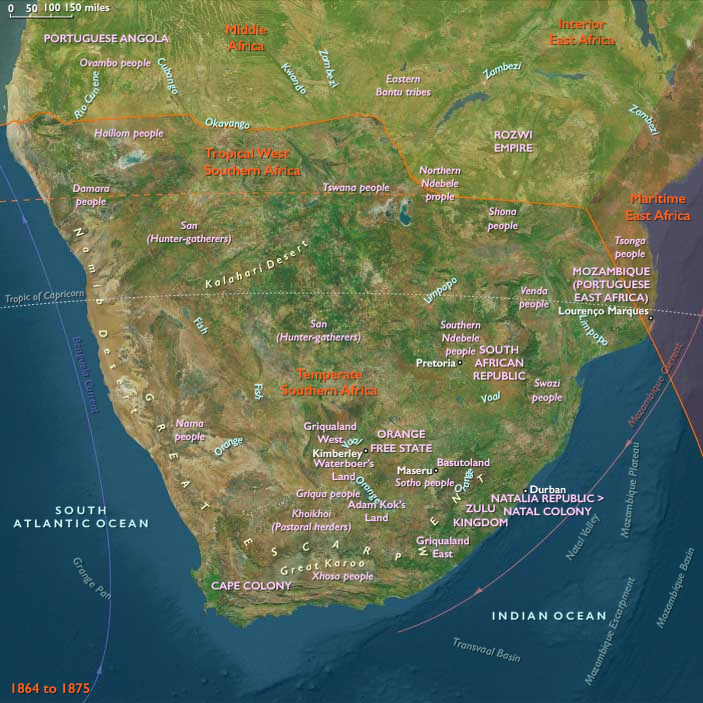
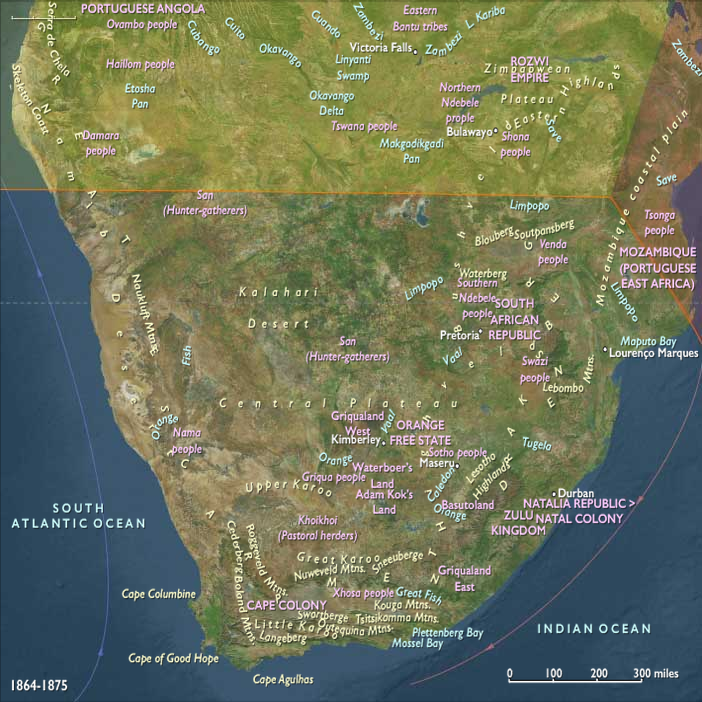
Kimberley is the second largest town in South Africa by 1873, with an approximate population of forty thousand.
Digger objections and minor riots had led to Governor Barkly's visit to New Rush in September 1872, when he revealed a plan instead to have Griqualand West proclaimed a Crown Colony.
Richard Southey had arrived as Lieutenant-Governor of the intended Crown Colony in January 1873.
Months had passed, however, without any sign of the proclamation or of the promised new constitution and provision for representative government.
The delay was in London, where Secretary of State for the Colonies, Lord Kimberley, insistsed that before electoral divisions could be defined, the places had to receive "decent and intelligible names. His Lordship has declined to be in any way connected with such a vulgarism as New Rush and as for the Dutch name, Vooruitzigt … he could neither spell nor pronounce it." (Kimberley, turbulent city by Brian Roberts, p. 115 (1976, published by David Phillip & Historical Society of Kimberley and the Northern Cape))]
The matter had been passed to Southey who had given it to his Colonial Secretary J.B. Currey.
Roberts writes that "when it came to renaming New Rush, [Currey] proved himself a worthy diplomat. He made quite sure that Lord Kimberley would be able both to spell and pronounce the name of the main electoral division by, as he says, calling it 'after His Lordship'."
New Rush becomes Kimberley, by Proclamation dated 5 July 1873.
Digger sentiment is expressed in an editorial in the Diamond Field newspaper when it states, "we went to sleep in New Rush and waked up in Kimberley, and so our dream was gone." (Roberts, Brian. 1976. Kimberley, turbulent city. Cape Town: David Philip, p 115)
Locations
Groups
- Griqua people
- Britain (United Kingdom of Great Britain and Ireland)
- Cape Colony, British
- Orange Free State, Republic of the (Boer Republic)
- Transvaal, Republic of the
- Griqualand West
Commodoties
Subjects
Regions
Subregions
Years: 1873 - 1873
Locations
Groups
- Griqua people
- Britain (United Kingdom of Great Britain and Ireland)
- Cape Colony, British
- Orange Free State, Republic of the (Boer Republic)
- Transvaal, Republic of the
- Griqualand West
Commodoties
Subjects
Regions
Subregions