
Filters:
The question of whether Leopold Mozart was …
Years: 1756 - 1756
December
The question of whether Leopold Mozart was successful as a composer (either in terms of artistic success or fame) is debated: the Grove Dictionary says that as of 1756, "Mozart was already well-known. His works circulated widely in German-speaking Europe."
In 1755, he wrote his Versuch einer gründlichen Violinschule, a comprehensive treatise on violin playing.
This work is published in 1756 (the year of Wolfgang's birth).
Today, the work is consulted by musicians interested in eighteenth century-performance practice.
This work will make a reputation in Europe for Leopold, and his name will begin to appear in music dictionaries and other works of musical pedagogy.
Leopold was born in Augsburg, son of Johann Georg Mozart (1679–1736), a bookbinder, and his second wife Anna Maria Sulzer (1696–1766).
From an early age he sang as a choirboy, and attended a local Jesuit school, the St. Salvator Gymnasium, where he studied logic, science, theology, graduating magna cum laude in 1735.
He then moved on to a more advanced school, the St. Salvator Lyceum.
While a student in Augsburg, he appeared in student theatrical productions as an actor and singer, and became a skilled violinist and organist.
He also developed an interest, which he has retained, in microscopes and telescopes.
Although his parents had planned a career for Leopold as a Catholic priest, this apparently was not Leopold's own wish.
He withdrew from the St. Salvator Lyceum after less than a year and, following a year's delay, moved to Salzburg to resume his education, enrolling in November 1737 at the Benedictine University (now University of Salzburg) to study philosophy and jurisprudence.
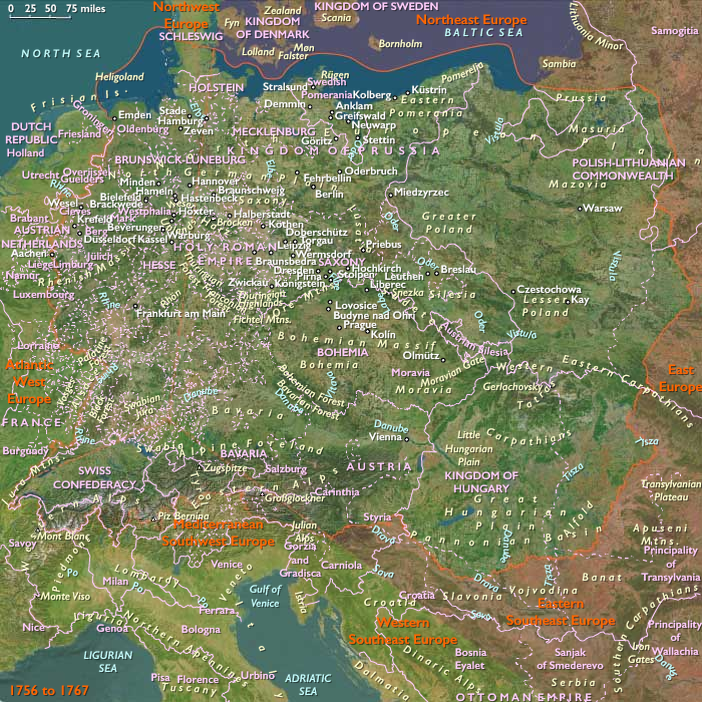
At this time Salzburg is the capital of an independent state within the Holy Roman Empire (the Prince-Archbishopric of Salzburg), now part of Austria.
Except for periods of travel, Leopold will spend the rest of his life here.
Leopold received the degree of Bachelor of Philosophy in 1738 but in September 1739 was expelled from the university for poor attendance.
In 1740, he began his career as a professional musician, becoming violinist and valet to one of the university's canons, Johann Baptist, Count of Thurn-Valsassina and Taxis.
This was also the year of his first musical publication, the six Trio Sonatas, Opus 1.
These were titled Sonate sei da chiesa e da camera; Leopold did the work of copper engraving himself.
He continued to compose, producing a series of German Passion cantatas.
In 1747 he married Anna Maria Pertl, who has borne him seven children, although only two of them will survive past infancy: Maria Anna Walburga Ignatia (called "Nannerl") and Wolfgang Amadeus Mozart.
In 1743 Leopold Mozart had been appointed to a position (fourth violinist) in the musical establishment of Count Leopold Anton von Firmian, the ruling Prince-Archbishop of Salzburg.
His duties included composition and the teaching of violin (later, piano) to the choirboys of the Salzburg cathedral.
In 1755, he wrote his Versuch einer gründlichen Violinschule, a comprehensive treatise on violin playing.
This work is published in 1756 (the year of Wolfgang's birth).
Today, the work is consulted by musicians interested in eighteenth century-performance practice.
This work will make a reputation in Europe for Leopold, and his name will begin to appear in music dictionaries and other works of musical pedagogy.
Leopold was born in Augsburg, son of Johann Georg Mozart (1679–1736), a bookbinder, and his second wife Anna Maria Sulzer (1696–1766).
From an early age he sang as a choirboy, and attended a local Jesuit school, the St. Salvator Gymnasium, where he studied logic, science, theology, graduating magna cum laude in 1735.
He then moved on to a more advanced school, the St. Salvator Lyceum.
While a student in Augsburg, he appeared in student theatrical productions as an actor and singer, and became a skilled violinist and organist.
He also developed an interest, which he has retained, in microscopes and telescopes.
Although his parents had planned a career for Leopold as a Catholic priest, this apparently was not Leopold's own wish.
He withdrew from the St. Salvator Lyceum after less than a year and, following a year's delay, moved to Salzburg to resume his education, enrolling in November 1737 at the Benedictine University (now University of Salzburg) to study philosophy and jurisprudence.
At this time Salzburg is the capital of an independent state within the Holy Roman Empire (the Prince-Archbishopric of Salzburg), now part of Austria.
Except for periods of travel, Leopold will spend the rest of his life here.
Leopold received the degree of Bachelor of Philosophy in 1738 but in September 1739 was expelled from the university for poor attendance.
In 1740, he began his career as a professional musician, becoming violinist and valet to one of the university's canons, Johann Baptist, Count of Thurn-Valsassina and Taxis.
This was also the year of his first musical publication, the six Trio Sonatas, Opus 1.
These were titled Sonate sei da chiesa e da camera; Leopold did the work of copper engraving himself.
He continued to compose, producing a series of German Passion cantatas.
In 1747 he married Anna Maria Pertl, who has borne him seven children, although only two of them will survive past infancy: Maria Anna Walburga Ignatia (called "Nannerl") and Wolfgang Amadeus Mozart.
In 1743 Leopold Mozart had been appointed to a position (fourth violinist) in the musical establishment of Count Leopold Anton von Firmian, the ruling Prince-Archbishop of Salzburg.
His duties included composition and the teaching of violin (later, piano) to the choirboys of the Salzburg cathedral.
Locations
People
Groups
Subjects
Regions
Subregions

Years: 1756 - 1756
December
Locations
People
Groups
Subjects
Regions
Subregions