Druidism apparently dies out around 500 in …
Years: 500 - 500
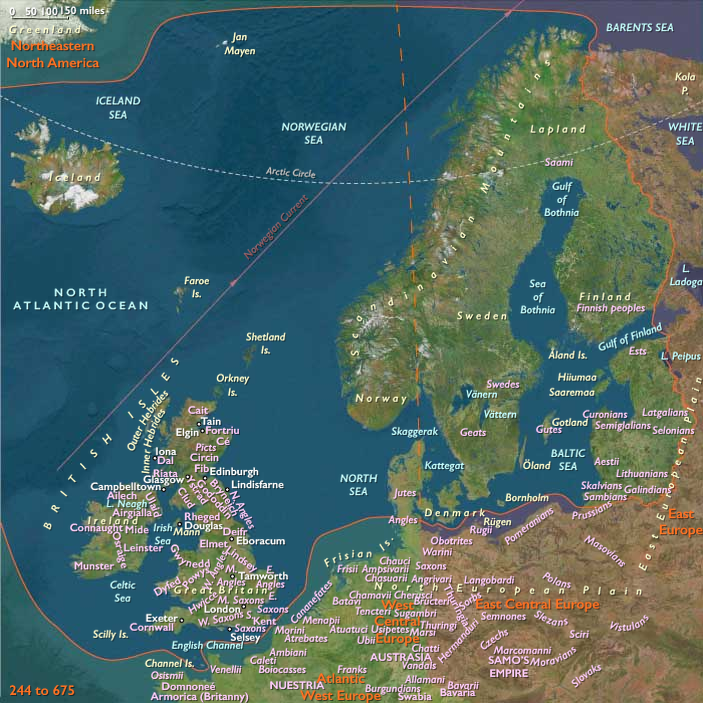
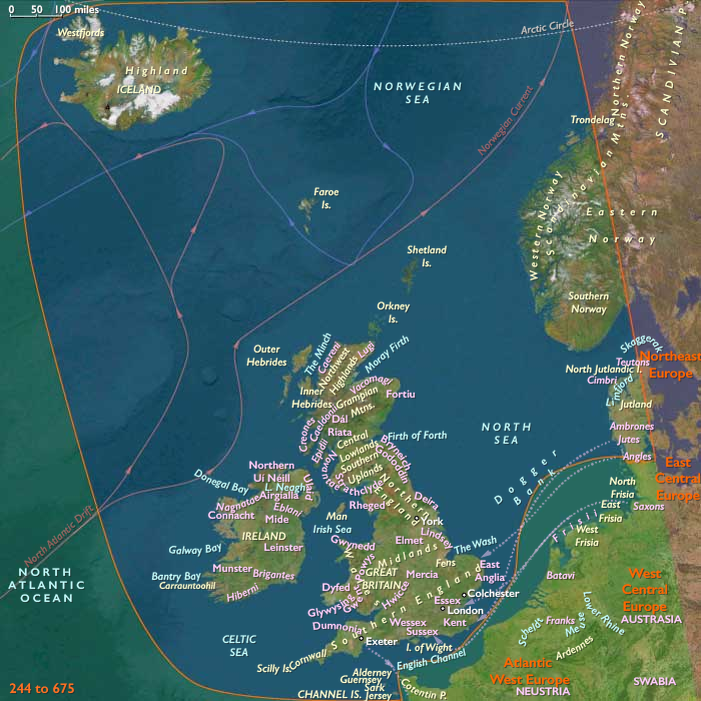
Druidism apparently dies out around 500 in Ireland, its last stronghold.
Groups
Topics
Subjects
Regions
Subregions
Related Events
Filter results
Showing 10 events out of 58338 total
Xuanwu recalls Yuan Xie by 500 to be prime minister.
With Southern Qi in disarray because of the tyrannical rule of its emperor Xiao Baojuan, Northern Wei annexes the important city of Shouyang (in modern Lu'an, Anhui) when the Southern Qi general Pei Shuye surrenders the city to Northern Wei in fear of adverse actions by Xiao Baojuan.
However, Northern Wei does not take further actions when Southern Qi is subsequently thrown into civil war during the rebellions of the generals Cui Huijing and Xiao Yan.
Xiao Baojuan is an arbitrary and violent ruler, and he often executes high level officials based on his perception of them as threats to his rule.
He executes his prime minister Xiao Yi in winter 500, and Xiao Yi's brother Xiao Yan, the governor of Yong Province (modern northwestern Hubei) declares a rebellion from the capital of Yong Province, Xiangyang (in modern Xiangfan, Hubei).
In response, Xiao Baojuan sends the general Liu Shanyang to Jing Province, ordering him to rendezvous with Xiao Yingzhou and then attack Xiangyang.
Xiao Yan, however, persuades Xiao Yingzhou that Liu's orders are to attack both Jing and Yong Provinces, and Xiao Yingzhou, after making Liu believe his good faith by executing Xiao Yan's messenger Wang Tianhu, surprises and kills Liu, seizing his forces.
He then openly declares rebellion and supports Xiao Baorong as nominal leader.
Xiao Yingzhou and Xiao Baorong remain at Jiangling (in modern Jingzhou, Hubei), the capital of Jing Province, which is then made into the provisional capital, while Xiao Yan advances east against Xiao Baojuan's forces.
Gundobad’s battle with his third brother, Godegisel, raged long according to Gregory of Tours.es
Unaware of the others actions, each call upon King Clovis trying to persuade him to join forces against the other.
Clovis sides with Godegisel, who had offered him his pleasure of tribute; Wood observes archly that Clovis' wife, Clotilde, whose father had been killed by Gundobad, "was not likely to encourage good relations between the Franks and the Burgundians."
Together they crush Gundobad's force.
Gundobad flees but Clovis pursues him to Avignon.
With Clovis's army at the gates, Gundobad fears the worst, but Aridius goes from Gundobad to Clovis and persuades him to spare Gundobad in return for a yearly tribute.
The chronicler Marius of Avenches dates this conflict to 500.
Thrasamund, king of the Vandals, marries Amalafrida, the widowed sister of Theodoric the Great.
She brings with her a very large dowry and an elite Gothic force of five thousand soldiers.
Irish king Fergus Mór mac Eirc, supposedly shipwrecked off the northeastern coast of Ireland, gives his name to a town on the north shore of Belfast Lough called Carrickfergus ("Rock of Fergus").
The historicity of Mór is doubtful.
Archaeological surveys show that Angles settled the lands north of the River Thames by the sixth century.
The name Mercia is Old English for "boundary folk", and the traditional interpretation is that the kingdom originated along the frontier between the native Welsh and the Anglo-Saxon invaders.
An alternative interpretation argued by P. Hunter Blair has them emerging along the frontier of Northumbria and the inhabitants of the Trent river valley.
The general Yu Lie and Yuan Xiang warn Xuanwu in 501 that Yuan Xi is growing corrupt and Yuan Xie is growing too popular, and suggests that they be relieved of their posts.
Xuanwu does so, and formally personally takes over governmental matters, but at his age, he cannot actually properly handle governmental affairs himself, so his trusted attendants and Gao Zhao begin to become more powerful and corrupt.
Traditional historians generally regard this as the starting point of Northern Wei's decline.
Late in 501, Yuan Xi, displeased that his power is being stripped and fearful that he will be killed, plots a rebellion to secede with the provinces south of the Yellow River.
His plot is discovered, however, and he is executed.
From this point on, Xuanwu grows increasingly suspicious of members of the imperial clan.
Later in 501, Xuanwu creates Yu Lie's niece, Consort Yu, empress.
Near the end of the year, with Xiao Yan's forces crushing Xiao Baojuan's, Xuanwu's general Yuan Ying suggests that a major attack be launched against Southern Qi to take advantage of Southern Qi's civil war.
However, Xuanwu only authorizes small scale attacks, which are generally fruitless.

Xiao Baorong is proclaimed emperor (as Emperor He) in spring 501 but actual powers are in Xiao Yingzhou's hands.
While Xiao Yan's campaign east initially stalemates at Yingcheng (in modern Wuhan, Hubei), by fall 501 he has captured Yingcheng and continues to advance east.
He quickly arrives at the capital Jiankang, putting it under siege.
(During the siege of Jiankang, Xiao Yingzhou, anxious over the facts that Xiao Baojuan's general Xiao Gui is approaching Jianling and that Xiao Yan is so easily able to reach Jiankang and gain popularly support, dieds; from that point on, Emperor He is controlled by Xiao Yingzhou's lieutenant Xiahou Xiang and Xiao Yan's brother Xiao Dan, both of whom support Xiao Yan.)
Muryeong becomes king of Baekje.
He is described as the second son of the twenty-fourth king, Dongseong, who became king when Dongseong was assassinated by the court official Baekga.
The following year, he crushed a planned rebellion by Baekga.
China's Liang shu gives his surname as Yeo and personal name as Yung, and states that he restored Baekje into a strong nation.
Japan's Nihonshoki gives his birth year as 461, and describes him as the son of Gonji, the younger brother of the twenty-first king, Gaero, making him the stepbrother of Dongseong.
It is said Gonji escaped the invading Goguryeo forces with King Muryeong's mother to Japan, and she went into labor as their ship was passing by a small Japanese island.
He was called Semakishi and King Shima in Japanese records because he was born in an island.
Some scholars claim Muryeong ruled the Yamato region under the name of King Bu before he moved to Baekje to be a king of kings.
He sends an army to attack Goguryeo's Sugok-seong in 501.
During his reign, the kingdom will remain allied with Silla and expand its relationships with China and Japan.