
Dom Pedro means to rule Brazil frugally …
Years: 1816 - 1827
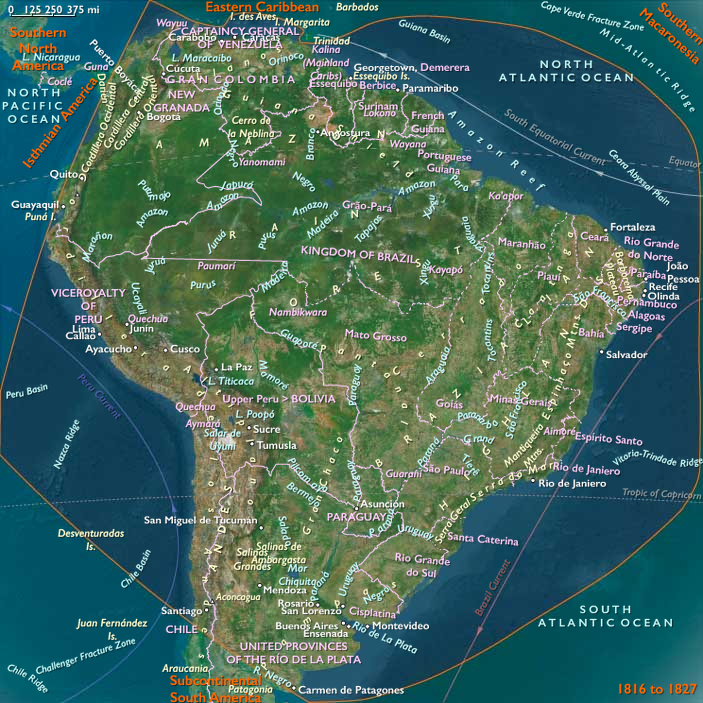
Dom Pedro means to rule Brazil frugally and starts by cutting his own salary, centralizing scattered government offices, and selling off most of the royal horses and mules.
He issues decrees that eliminate the royal salt tax to spur output of hides and dried beef, forbid arbitrary seizure of private property, require a judge's warrant for arrests of freemen, and bans secret trials, torture, and other indignities.
He also sends elected deputies to the Cortes in Portugal.
However, slaves continue to be bought and sold and disciplined with force, despite his assertion that their blood is the same color as his.
In September 1821, the Cortes, with only a portion of the Brazilian delegates present, vote to abolish the Kingdom of Brazil and the royal agencies in Rio de Janeiro and to make all the provinces subordinate directly to Lisbon.
Portugal sends troops to Brazil and placed all Brazilian units under Portuguese command.
In January 1822, tension between Portuguese troops and the Luso-Brazilians (Brazilians born in Portugal) turn violent when Pedro accept petitions from Brazilian towns begging him to refuse the Cortes's order to return to Lisbon.
Responding to their pressure and to the argument that his departure and the dismantling of the central government will trigger separatist movements, he vows to stay.
The Portuguese "lead feet," as the Brazilians call the troops, riot before concentrating their forces on Cerro Castello, which is soon surrounded by thousands of armed Brazilians.
Dom Pedro "dismisses" the Portuguese commanding general and orders him to remove his soldiers across the bay to Niteroi, where they await transport to Portugal.
Pedro forms a new government headed by José Bonifacio de Andrada e Silva of São Paulo.
This former royal official and professor of science at Coimbra is crucial to the subsequent direction of events and is regarded as one of the formative figures of Brazilian nationalism, indeed, as the patriarch of independence.
The atmosphere is so charged that Dom Pedro seeks assurances of asylum on a British ship in case he loses the looming confrontation; he also sends his family to safety out of the city.
In the following days, the Portuguese commander delays embarkation, hoping that expected reinforcements will arrive.
However, the reinforcements that arrive off Rio de Janeiro on March 5, 1822, are not allowed to land.
Instead, they are given supplies for the voyage back to Portugal.
This round has been won without bloodshed.
Blood had been shed in Recife in the Province of Pernambuco, when the Portuguese garrison there had been forced to depart in November 1821.
In mid-February 1822, Bahians revolt against the Portuguese forces there but are driven into the countryside, where they begin guerrilla operations, signaling that the struggle in the north will not be without loss of life and property.
To secure Minas Gerais and São Paulo, where there are no Portuguese troops but where there are doubts about independence, Dom Pedro engages in some royal populism.
Towns in Minas Gerais had expressed their loyalty at the time of Pedro's vow to remain, save for the junta in Ouro Preto, the provincial capital.
Pedro realizes that unless Minas Geraisis solidly with him, he will be unable to broaden his authority to other provinces.
With only a few companions and no ceremony or pomp, Pedro plunges into Minas Gerais on horseback in late March 1822, receiving enthusiastic welcomes and allegiances everywhere.
Back in Rio de Janeiro on May 13, he proclaims himself the "perpetual defender of Brazil" and shortly thereafter calls a Constituent Assembly (Assembleia Constituinte) for the next year.
To deepen his base of support, he joins the freemasons, who, led by Jose Bonifacio Andrada e Silva, are pressing for parliamentary government and independence.
More confident, in early August he calls on the Brazilian deputies in Lisbon to return, decrees that Portuguese forces in Brazil should be treated as enemies, and issues a manifesto to "friendly nations."
The manifesto reads like a declaration of independence.
Seeking to duplicate his triumph in Minas Gerais, Pedro rides to São Paulo in August to assure himself of support there and begins a disastrous affair with Domitila de Castro that will later weaken his government.
Returning from an excursion to Santos, Pedro receives messages from his wife and from Andrada e Silva that the Cortes consider his government traitorous and is dispatching more troops.
In a famous scene at Ipiranga on September 7, 1822, he has to choose between returning to Portugal in disgrace or opting for independence.
He tears the Portuguese blue and white insignia from his uniform, draws his sword, and swears: "By my blood, by my honor, and by God: I will make Brazil free."
Their motto, he said, will be "Independence or Death!"
Pedro's government employs Admiral Thomas Alexander Cochrane, one of Britain's most successful naval commanders in the Napoleonic Wars and recently commander of the Chilean naval forces against Spain.
Pedro's government also hires a number of Admiral Cochrane's officers and French General Pierre Labatut, who had fought in Colombia.
These men are to lead the fight to drive the Portuguese out of Bahia, Maranhao, and Para, and to force those areas to replace Lisbon's rule with that of Rio de Janeiro.
Money from customs at Rio de Janeiro's port and local donations outfits the army and the nine-vessel fleet.
The use of foreign mercenaries brings needed military skills.
The much-feared Cochrane secures Maranhao with a single warship, despite the Portuguese military's attempt to disrupt the economy and society with a scorched-earth campaign and with promises of freedom for the slaves.
By mid-1823 the contending forces number between ten thousand and twenty thousand Portuguese, some of whom are veterans of the Napoleonic Wars, versus twelve thousand to fourteen thousand Brazilians, mostly in militia units from the Northeast.
Some historians have erred in supporting historian Manuel de Oliveira Lima's contention that independence came without bloodshed.
In fact, although both sides avoid massive set battles, they do engage in guerrilla tactics, demonstrations, and countermoves.
There is little information on casualties, but the fighting provides a female martyr in Mother Joana Angelica, who is bayoneted to death by Portuguese troops invading her convent in Bahia; and an example of female grit in Maria Quiteria de Jesus, who, masquerading as a man, joins the imperial army and achieves distinction in several battles.
Britain and Portugal recognize Brazilian independence by signing a treaty on August 29, 1825.
Until no, the Brazilians had feared that Portugal would resume its attack.
Portuguese retribution, however, comes in a financial form.
Secret codicils of the treaty with Portugal require that Brazil assume payment of one million fp=our hundred thousand pounds sterling owed to Britain and indemnify Dom Joao VI and other Portuguese for losses totaling six hundred thousand pounds sterling.
Brazil also renounces future annexation of Portuguese African colonies, and in a side treaty with Britain promises to end the slave trade.
Neither of these measures please the slave-holding planters.
Organizing the new government quickly brings the differences between the emperor and his leading subjects to the fore.
In 1824 Pedro closes the Constituent Assembly that he had convened because he believes that body is endangering liberty.
As assembly members, his advisers, Jose Bonifacio de Andrada e Silva and Dom Pedro's brothers, have written a draft constitution that would limited the monarch by making him equal to the legislature and judiciary, similar to the president of the United States.
They want the emperor to push the draft through without discussion, which Pedro refuses to do.
Troops surround the assembly as he orders it dissolved.
He then produces a constitution modeled on that of Portugal (1822) and France (1814).
It specifies indirect elections and creates the usual three branches of government but also adds a fourth, the moderating power, to be held by the emperor.
The moderating power will give the emperor authority to name senators and judges and to break deadlocks by summoning and dismissing parliaments and cabinets.
He also has treaty-making and treaty-ratifying power.
Pedro's constitution is more liberal than the assembly's in its religious toleration and definition of individual and property rights, but less so in its concentration of power in the emperor.
The constitution is more acceptable in the flourishing, coffee-driven Southeastern provinces than in the Northeastern sugar and cotton areas, where low export prices and the high cost of imported slaves are blamed on the coffee-oriented government.
In mid-1824, with Pernambuco and Ceara leading, five Northeastern provinces declare independence as the Confederation of the Equator, but by year's end the short-lived separation is crushed by Admiral Cochrane.
With the Northeast pacified, violence now imperils the South.
In 1825 war flares again over the Cisplatine Province, this time with Buenos Aires determined to annex the East Bank.
The empire can little afford the troops, some of whom are recruited in Ireland and Germany, or the sixty warships needed to blockade the Rio de la Plata.
A loan from London bankers is expended by 1826, and Pedro has to call the General Assembly to finance the war.
The blockade raises objections from the United States and Britain, and reverses on land in 1827 make it necessary to negotiate an end to the thirty million US dollar Cisplatine War.
The war at least leaves Uruguay independent instead of an Argentine province.
Locations
People
- Domitila de Castro Canto e Mel, Marchioness of Santos
- Francis I, Holy Roman Emperor
- John VI of Portugal
- José Bonifácio de Andrada e Silva
- Pedro I of Brazil
- Thomas Cochrane, 10th Earl of Dundonald
Groups
- Brazil, Indigenous people in
- Irish people
- Germans
- Portuguese people
- Portuguese Empire
- Pernambuco, Captaincy of
- São Vicente, Captaincy General of
- Brazil, Colonial
- Portugal, Bragança Kingdom of
- Britain (United Kingdom of Great Britain and Ireland)
- France, (first) Empire of
- Spain, Bourbon Kingdom (first restoration) of
Topics
- Colonization of the Americas, Portuguese
- Brazilian Liberal Revolt
- Brazilian Declaration of Independence
- Cisplatine War
Commodoties
- Hides and feathers
- Domestic animals
- Textiles
- Fibers
- Strategic metals
- Sweeteners
- Beer, wine, and spirits
- Manufactured goods
- Money
- Stimulants
- Rubber
- Spices
Subjects
Regions
Subregions
Years: 1816 - 1827
Locations
People
- Domitila de Castro Canto e Mel, Marchioness of Santos
- Francis I, Holy Roman Emperor
- John VI of Portugal
- José Bonifácio de Andrada e Silva
- Pedro I of Brazil
- Thomas Cochrane, 10th Earl of Dundonald
Groups
- Brazil, Indigenous people in
- Irish people
- Germans
- Portuguese people
- Portuguese Empire
- Pernambuco, Captaincy of
- São Vicente, Captaincy General of
- Brazil, Colonial
- Portugal, Bragança Kingdom of
- Britain (United Kingdom of Great Britain and Ireland)
- France, (first) Empire of
- Spain, Bourbon Kingdom (first restoration) of
Topics
- Colonization of the Americas, Portuguese
- Brazilian Liberal Revolt
- Brazilian Declaration of Independence
- Cisplatine War
Commodoties
- Hides and feathers
- Domestic animals
- Textiles
- Fibers
- Strategic metals
- Sweeteners
- Beer, wine, and spirits
- Manufactured goods
- Money
- Stimulants
- Rubber
- Spices
Subjects
Regions
Subregions