
East Central Europe (736–747 CE): Saxon Dominance, …
Years: 736 - 747
East Central Europe (736–747 CE): Saxon Dominance, Bavarian Expansion, Slavic Consolidation, and Persistent Regional Stability
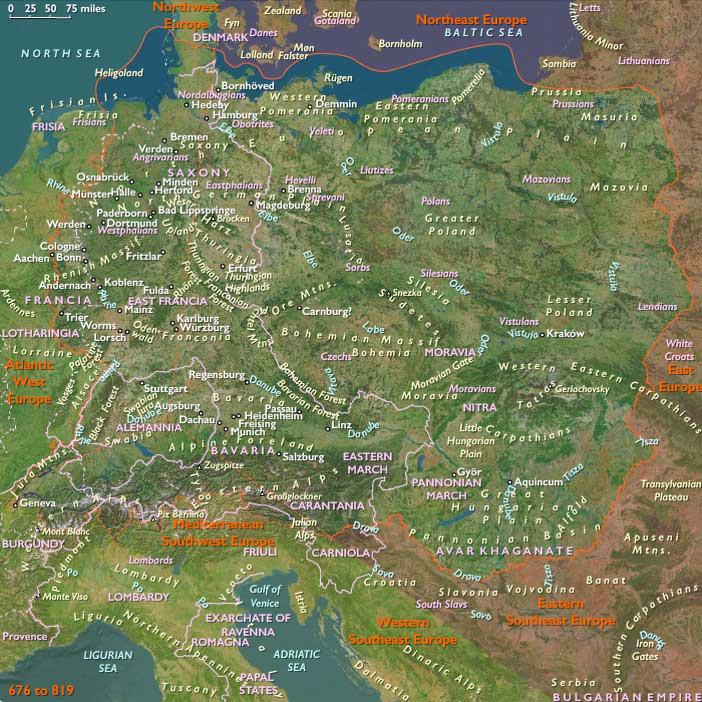
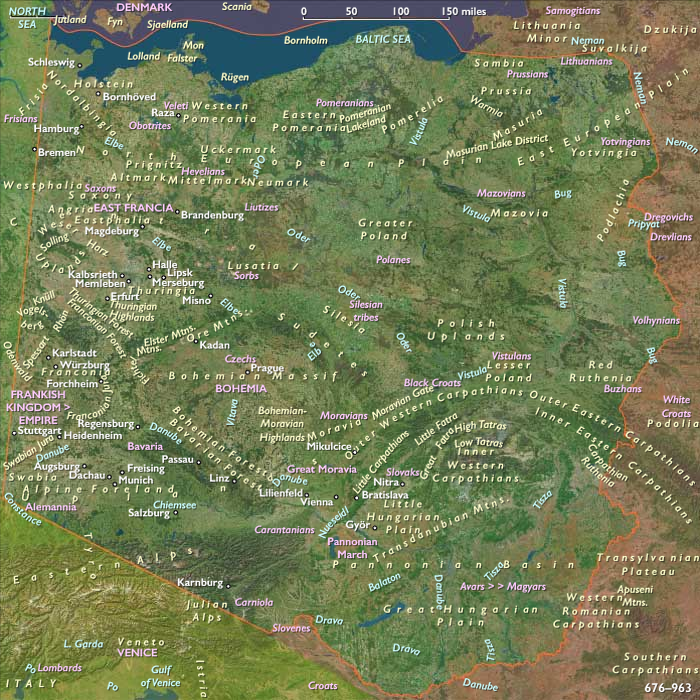
Between 736 and 747 CE, East Central Europe—encompassing Poland, Czechia, Slovakia, Hungary, and those portions of Germany and Austria lying east of 10°E and north of a line stretching from roughly 48.2°N at 10°E southeastward to the Austro-Slovenian border near 46.7°N, 15.4°E—underwent substantial political developments. Saxon tribes consolidated control east of the Elbe River, while emerging Slavic principalities in Bohemia and Moravia continued evolving toward stable state structures. Significantly, the Duchy of Bavaria, though nominally under Frankish influence, expanded its authority eastward by establishing a protectorate around 743 CE over the Slavic principality of Carantania (modern-day Carinthia and Slovenia). This Bavarian expansion created a strategic buffer, effectively separating the southern Slavs from their northern and eastern kin. Meanwhile, the Avar Khaganatemaintained internal stability, and Thuringia preserved its autonomy amid declining Merovingian power.
Political and Military Developments
Bavarian Protectorate over Carantania (743 CE)
-
Around 743 CE, responding to a request from Carantanian Prince Boruth for protection against Avar incursions, Duke Odilo of Bavaria established a protectorate over Carantania.
-
This political move extended Bavarian influence deeply into Slavic territories, strategically dividing the southern Slavic tribes from their relatives to the north and east, altering long-term regional geopolitical dynamics.
Saxon Eastward Consolidation
-
Saxon influence peaked east of the Elbe, consolidating their dominance across eastern Germany, western Poland, and northern Czechia, significantly shaping political, cultural, and economic relations throughout the region.
Continued Slavic Political Development
-
Principalities in Bohemia and Moravia further stabilized, moving toward more centralized governance and clearer territorial definition, laying the groundwork for medieval Slavic states.
Persistent Thuringian Autonomy
-
Thuringian dukes continued their effective independence from weakened Merovingian authority, highlighting Frankish decentralization and regional power dynamics.
Stability within the Avar Khaganate
-
The Avars retained diplomatic equilibrium and territorial stability within the Carpathian Basin, carefully managing relationships with Bavarians, Saxons, Slavs, and Franks.
Economic and Technological Developments
Regional Economic Networks
-
Trade networks flourished, facilitating prosperous exchanges of agricultural goods, metals, textiles, and luxury items among Saxon, Slavic, Bavarian, Thuringian, Avar, and Frankish territories.
Expansion of Fortifications
-
Defensive fortifications and settlements continued evolving, reflecting increased regional stability, technological sophistication, and demographic growth across Saxon, Slavic, Bavarian, and Avar communities.
Cultural and Artistic Developments
Saxon and Bavarian Cultural Influence
-
The expansion of Saxon and Bavarian influence introduced distinct Germanic cultural elements into Slavic territories, significantly shaping regional artistry, metalwork, jewelry, and burial customs.
Distinctive Slavic Identities
-
Slavic groups in Bohemia, Moravia, and now Carantania refined unique regional identities, evident in archaeological remains of ceramics, jewelry, settlements, and burial practices.
Continued Avar Cultural Traditions
-
Avar artistic and cultural traditions persisted strongly within the region, particularly evident in elaborate metalwork, decorative arts, and equestrian equipment.
Settlement and Urban Development
Saxon and Bavarian Territorial Growth
-
Saxon settlements developed into fortified, prosperous centers across eastern Germany, western Poland, and northern Czechia. Bavarian influence similarly fostered growth in Carantania, integrating these Slavic territories into wider regional economic and political networks.
Expansion of Slavic Political and Urban Centers
-
Bohemian, Moravian, and now Carantanian urban and administrative centers grew significantly, reflecting stable governance, increased population, and economic productivity.
Stability and Prosperity in Thuringia
-
Thuringian towns remained prosperous and stable, benefiting from peaceful trade networks and minimal external threats, maintaining regional significance and economic strength.
Social and Religious Developments
Bavarian and Saxon Hierarchies
-
Bavarian and Saxon societies reinforced their hierarchical structures under influential warrior aristocracies, consolidating political and military power within their expanded territories.
Slavic Centralization and Integration
-
Slavic political structures increasingly centralized leadership, integrating territories such as Carantania under Bavarian protection, and fostering more cohesive administrative and military capabilities.
Avar Sociopolitical Continuity
-
The Avars maintained cohesive societal hierarchies and effective governance structures, enabling continued internal stability and external diplomatic balance.
Long-Term Consequences and Historical Significance
The era 736–747 CE was pivotal in shaping East Central Europe's geopolitical landscape, notably marked by Bavaria’s establishment of a protectorate over Carantania, effectively redefining Slavic territorial alignments. Concurrent Saxon dominance, Slavic political consolidation, ongoing Thuringian independence, and sustained Avar stability collectively created foundational patterns influencing the medieval historical trajectory of the region.
Groups
- Polytheism (“paganism”)
- Franks
- Saxony, Old
- Germans
- Saxons
- Wends, or Sorbs (West Slavs)
- Christianity, Chalcedonian
- Avars, Eurasian
- Bavarians (West Germanic tribe)
- Bavaria, Agilolfing Duchy of
- Avar Khaganate (Eurasian Avars)
- Thuringia, Duchy of
- Thuringia, (Frankish) Duchy of
- Carantania
- Carantanians
- Roman Empire, Eastern: Isaurian dynasty
Topics
Commodoties
Subjects
Regions
Subregions
Years: 736 - 747
Groups
- Polytheism (“paganism”)
- Franks
- Saxony, Old
- Germans
- Saxons
- Wends, or Sorbs (West Slavs)
- Christianity, Chalcedonian
- Avars, Eurasian
- Bavarians (West Germanic tribe)
- Bavaria, Agilolfing Duchy of
- Avar Khaganate (Eurasian Avars)
- Thuringia, Duchy of
- Thuringia, (Frankish) Duchy of
- Carantania
- Carantanians
- Roman Empire, Eastern: Isaurian dynasty
Topics
Commodoties
Subjects
Regions
Subregions