
East Melanesia (7,821 – 6,094 BCE): Early …
Years: 7821BCE - 6094BCE
East Melanesia (7,821 – 6,094 BCE): Early Holocene — Semi-Sedentary Villages and Root Crop Precursors
Geographic & Environmental Context
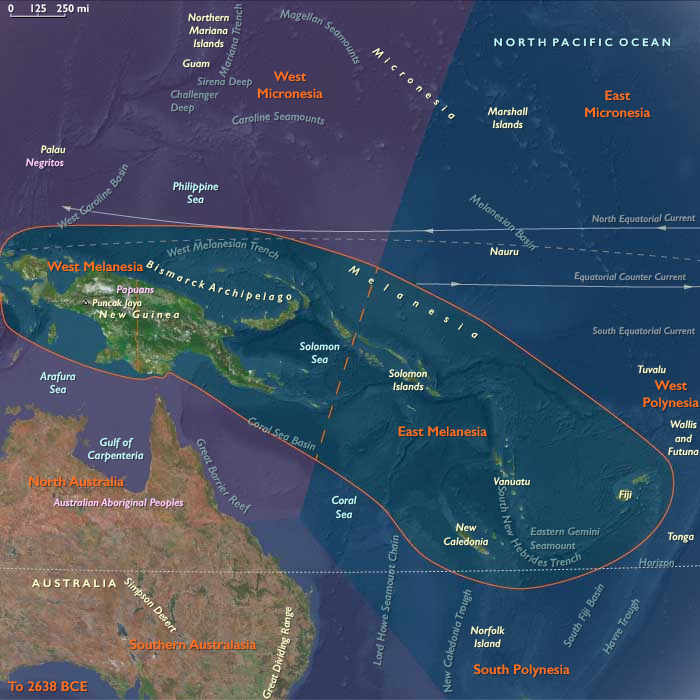
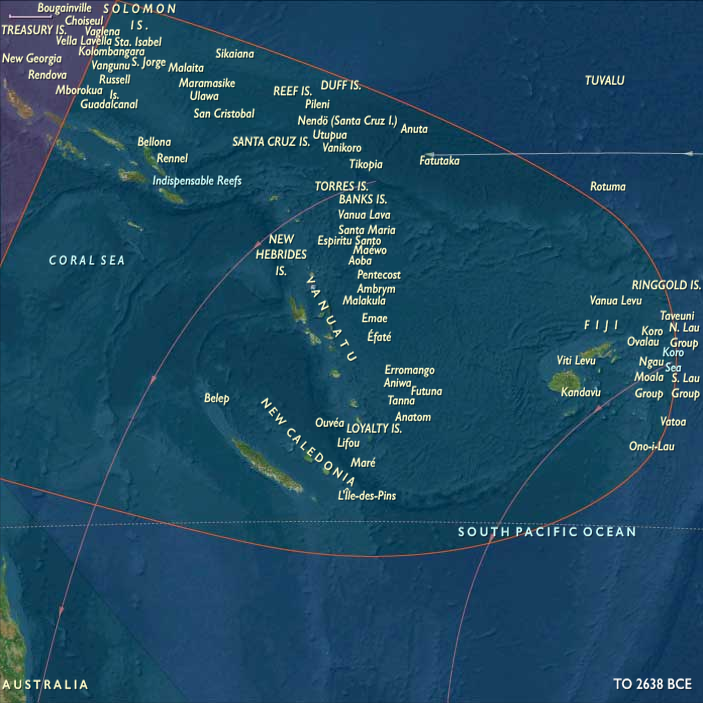
East Melanesia includes Vanuatu, Fiji, New Caledonia, and the Solomon Islands (excluding Bougainville, which belongs to West Melanesia)
-
Anchors: the Vanuatu chain (Efate, Espiritu Santo, Malekula, Tanna), the Fiji group (Viti Levu, Vanua Levu, Lau islands), New Caledonia (Grande Terre, Loyalty Islands), and the central/eastern Solomons (Guadalcanal, Malaita, Makira, Santa Cruz).
-
Islands now close to modern outlines; productive reefs and rich volcanic valleys.
Climate & Environmental Shifts
-
Early Holocene thermal optimum: wetter, warmer conditions favored dense forests.
-
Stable rainfall supported perennial streams and fertile alluvial fans.
Subsistence & Settlement
-
Foragers became more semi-sedentary, with recurring large sites near lagoons.
-
Early tending of yams, taro, bananas from wild stands; nut harvesting intensified (Canarium, Pandanus).
-
Shellfish middens expanded; inland foraging integrated with coast.
Technology & Material Culture
-
Pottery absent; ground stone and shell adzes common; net sinkers, fishhooks in bone/shell.
-
Early canoe innovation: dugouts with outrigger precursors.
Movement & Interaction Corridors
-
Regular inter-island voyaging evident between Vanuatu–Fiji–Solomons; obsidian moved from Banks Islands into wider networks.
Cultural & Symbolic Expressions
-
Burial sites with grave goods (shell beads, ornaments); persistent use of ochre.
-
Ritualized shellfish feasting inferred from midden contexts.
Environmental Adaptation & Resilience
-
Diversified reef–forest–river economies and proto-horticulture buffered resource shocks.
Transition
By 6,094 BCE, East Melanesia displayed a mixed economy and strong voyaging links—precursors of the later Lapita horizon.
Topics
Subjects
Regions
Subregions
Years: 7821BCE - 6094BCE
Topics
Subjects
Regions
Subregions